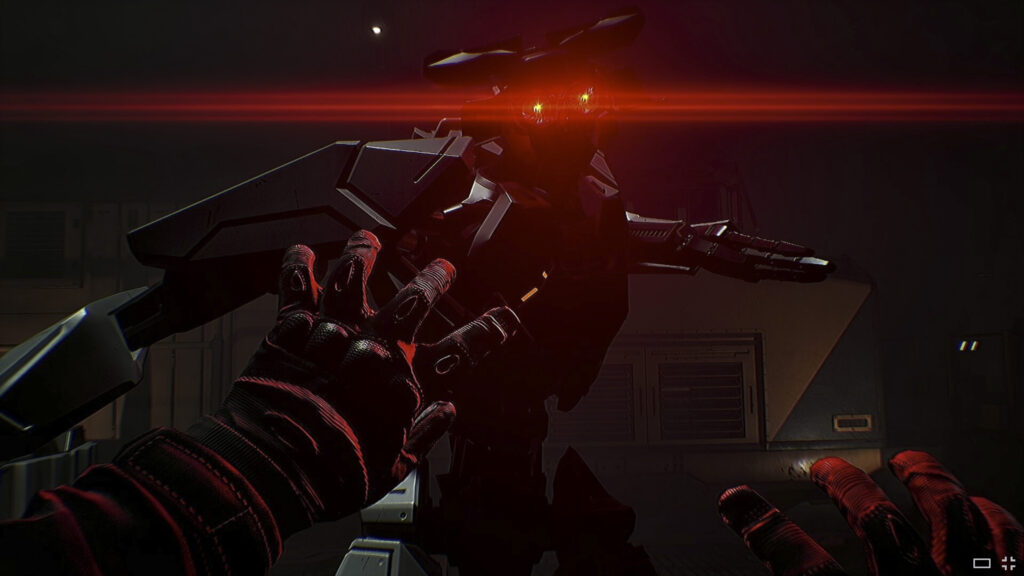

If you ever just knew that there was something creepy behind the smiles and sunshine and forced cheer of a show like BARNEY & FRIENDS, then BUDDY is the film for you. In fact, it’s for anyone who appreciates a horror film that turns apparent innocence on its head. RUE MORGUE spoke with Casper Kelly, who directed BUDDY and scripted it with Jamie King.
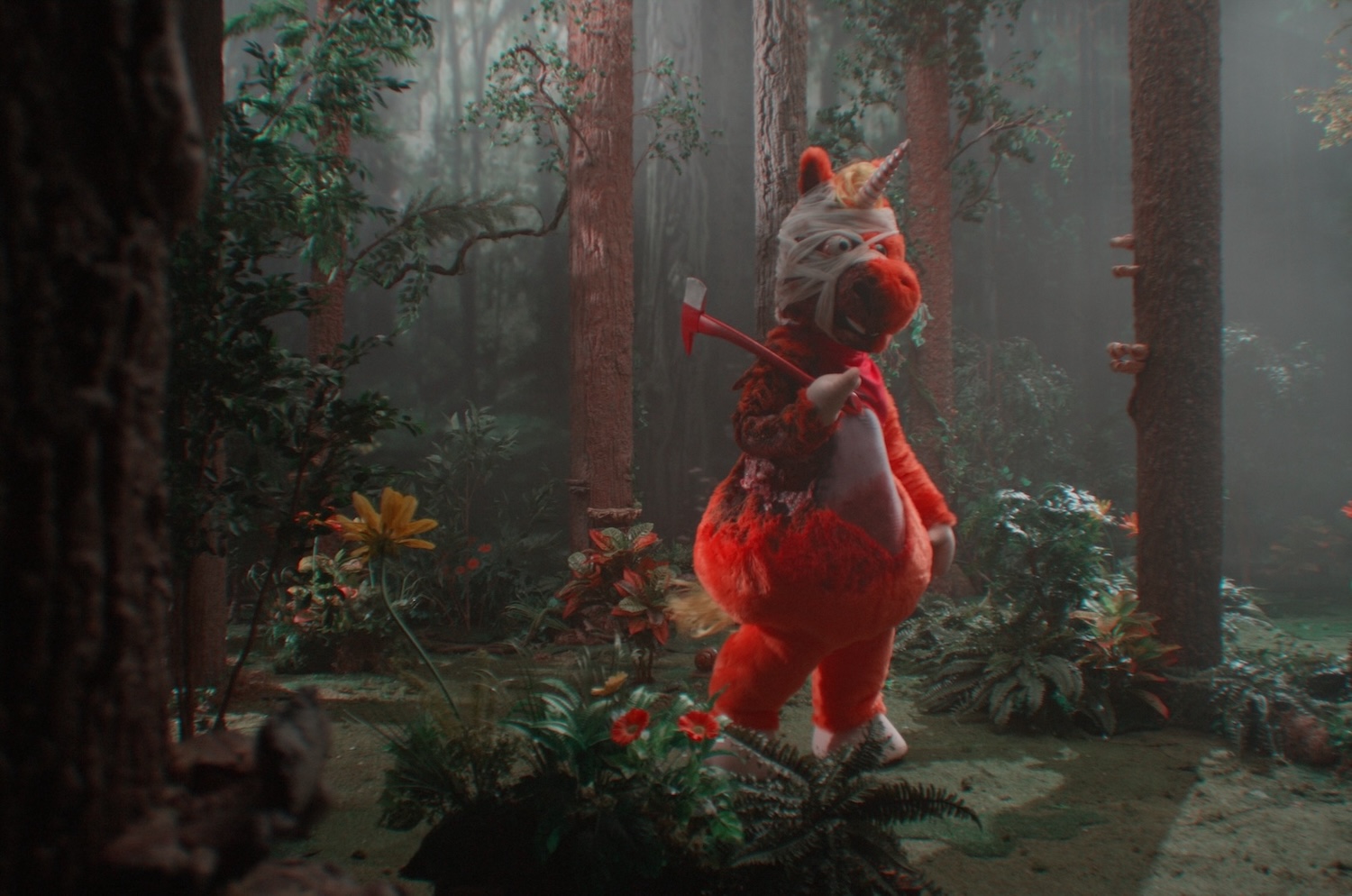
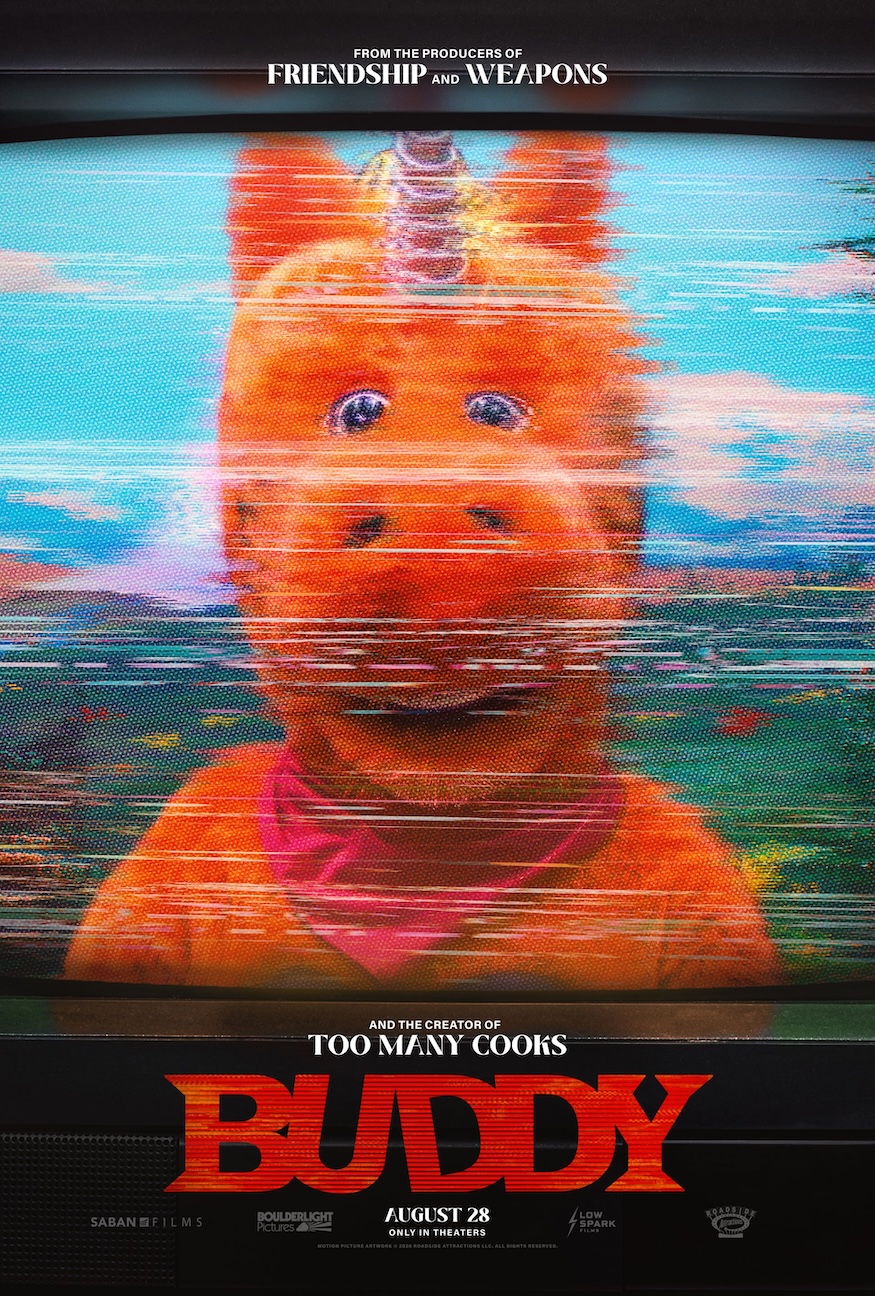
Opening this Friday, August 28 from Roadside Attractions and Saban Films, BUDDY begins in the televised world of its title character, an orange unicorn (voiced by Keegan-Michael Key) who seems devoted to friendship and helpful life lessons. Then one of the kids doesn’t cooperate with the rules of this happy world, and the scenario becomes sinister, unfolding in a series of twisted surprises. With credits ranging from the viral video TOO MANY COOKS and the “Cheddar Goblin” ad in MANDY to the ADULT SWIM YULE LOG TV movies, he’s clearly got a uniquely bizarre point of view, which finds full flower in BUDDY.
I guess the first question is, were there any kids’ shows that traumatized you as a child?
Yeah, though I’m a Gen X person, so the shows I’m referencing in BUDDY are more the ones my kids watched. For me, it would have been SCOOBY-DOO, and especially the Sid and Marty Krofft stuff, particularly the Sleestaks in LAND OF THE LOST. They were these weird lizard aliens that used these gems to travel through time and space. And they were sinister!
So what was the initial inspiration behind BUDDY?
It was thinking about children’s shows and how the kids are very well-behaved compared to how it is in real life, or even how it was in the 1970s’ BAD NEWS BEARS movies. I started thinking about, why are they so well-behaved? What would happen if they weren’t? And also, when they’re trying to present something so perfect, it often feels like there might be something wrong under the hood. I can’t help but be a little bit skeptical about things like, how many times has there been an apparently perfect celebrity-couple marriage, and then you find out there was all this awful stuff going on? Or a famous actor like Bill Cosby, for example, where there was this awful side to him. It was hard to believe, because he was such a lovable person.
How about Buddy himself? Barney the Dinosaur was clearly an influence…
Yes, he was. And then his creation was inspired by, if there was another show that came out while Barney was already out there, what kind of creature would he be? What color would he be? And what would his personality be like to differentiate him enough, but still feel like a companion—like Marvel and DC. A rival show that could be real.
How did this project get off the ground?
Luckily, J.D. Lifshitz at a company called Boulderlight, which did BARBARIAN and FRIENDSHIP and WEAPONS among many other movies, had seen TOO MANY COOKS and wanted to meet with me. We started talking, and then I wrote the script with Jamie King and they shopped it around. A lot of people were not into it, and then they finally showed it to another company called Low Spark Films that is very interested in weird movies; for example, they did TAKE SHELTER and COMPLIANCE, both of which I love. They were into it, and we were off to the races.
Lots of horrible things happen to kids and others in this movie, so what was the process of finding young actors who were right for the roles, and who could also handle being part of all this frightening stuff?
That’s a great question. And I was nervous about that. I expressly asked the casting agents to be very clear: This is a horror movie, and to let the parents know, who were considering whether their kids should audition or not, what they were in for. Luckily, all those people who would not have wanted to do it were filtered out. And of the ones who were left, these kids were very smart. A lot of them had seen horror movies and were fans of horror movies, and would ask very intelligent questions. For example, they would say, “In the parts in Buddy’s show, do you want me to play it sort of heightened like a kid on a Nickelodeon series? Or do you want me to play it more naturalistic?” You know, “What range do you want me to do there?” That really impressed me. These kids were professionals.
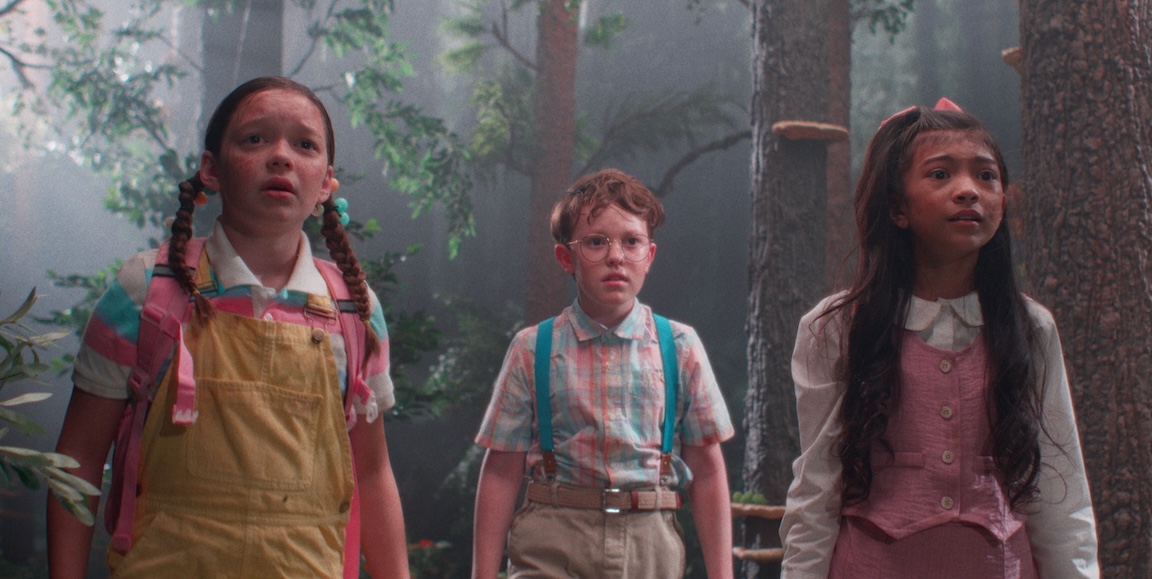
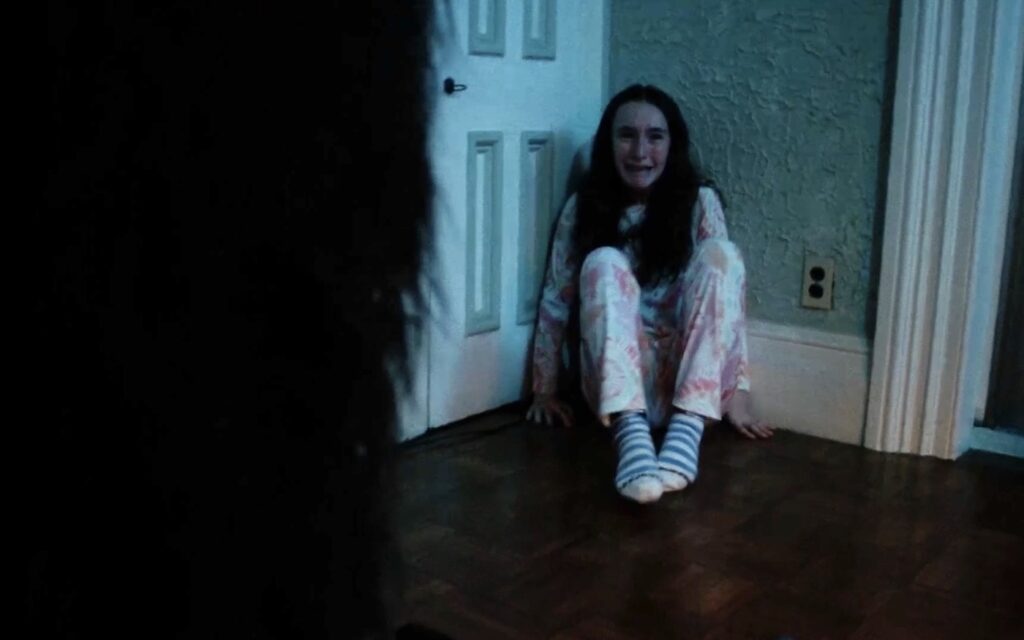
Delaney Quinn (pictured above left), who’s your final girl, for want of a better word, is especially impressive.
Oh, she’s great. And interestingly, she’d always wanted to be a final girl. She even knew that term and liked to pretend to be a final girl. That was one of the games she would play, where she would pretend a killer was chasing her, and she would hide and then kill the killer. So she loved it. When she auditioned, she told me that she wanted the part so badly; then some time passed, and she said to her mom, “I don’t think I got it, did I?” And then, of course, later she did get it and was very happy.
What made Keegan-Michael Key the right person to voice Buddy?
He just seemed like a natural right out of the gate. He’s so versatile, so talented, has such great range as an actor. And then he’s every bit as nice as you would guess. He was very thoughtful about developing the voice for Buddy and not making it a copy. Because this is not a copy of Barney. It’s influenced by Barney, but it had to feel like its own show that could have existed in the ’90s. He was a delight, and was willing to work hard to figure out the emotional beats of when we start to see the cracks appear.
The movie has terrific production design; you can also see a bit of PEE-WEE’S PLAYHOUSE in there. What went into bringing this world to life?
Absolutely; that’s a good catch. There is a lot of PEE-WEE’S PLAYHOUSE inspiration. I love PEE-WEE’S PLAYHOUSE, and I also love this documentary about [artist] Wayne White called BEAUTY IS EMBARRASSING. It’s really inspiring for any creative person, or person who wants to be creative; they should watch that. I worked very intensively with our production designer, Anna Kathleen, who really gave it her all, and Devon Hawkes Ludlow, the head puppet designer. It was fun, and stressful. You know, sometimes you can get stressed on something like what size and color the stones should be in the Worry Well, you know? But it was a great time.
What’s Ludlow’s background?
Devon Ludlow lives in New Mexico, and he’s a longtime puppeteer. He did puppets for these George R.R. Martin short films that have not come out yet, and also for [multimedia company] Meow Wolf. There were other puppeteers as well; I’m from Atlanta, and Chris Brown, Cedwan Hooks and Jimmica Collins are all from Atlanta, and they came up to play. We have this place called the Atlanta Center for Puppetry Arts, a wonderful facility that puts on original puppet shows, so we’re very lucky to have a great community there.
What were some of the particular challenges of the puppetry?
Well, this was the first time I had to use an intimacy coordinator, and it was interesting that it was between a suit actor and a regular actor. The scenes with Willie the marionette were difficult, because there isn’t a lot of control with the strings. And they were all kind of challenging because we just didn’t have enough time. We were always trying to figure out how to tell this story in the fewest amount of shots. But we did get a lot of shots in the end.
Speaking of Willie the marionette, how did you get Michael Shannon to voice that character?
Well, as I mentioned, Low Spark Films had also produced TAKE SHELTER, which was Michael’s breakout role. So I think they cashed in that favor; maybe they said, “You owe us!” No, I’m joking; I just think Michael is down to do interesting, weird stuff. I’m sure it’s tough because he’s such a great actor, and he’s got such an intensity, but he’s got a fun, playful side too.
You play around with aspect ratios a lot in BUDDY. Can you talk about that approach?
Yeah, I enjoy that, and I did it a little bit in ADULT SWIM YULE LOG 2: BRANCHING OUT. It just made sense for the movie to start out feeling like a ’90s show; it should be 4:3. And then it was fun, when we go to different worlds, to use different aspect ratios that evoke the appropriate look of that type of film. The color palettes were part of that too, as well as the sound design. Some of the movie is in stereo and some of it is in 5.1. It’s probably inspired by THE WIZARD OF OZ going from black and white to color, you know? It’s just fun to do those sorts of transformations.
Do you think there’s a message in BUDDY about how children’s shows try to manipulate kids’ behavior?
I think so, but when I’m writing, I try not to think too hard about theme. I try to do what feels true, and then usually a theme emerges. And I believe this story can apply to a lot of authority structures, be it a country or a family or a company. So I definitely think that’s part of it as well, what you mentioned.