
BY JOHN W. BOWEN
The Fantastic Pavilion — horror’s home at the Cannes Marché du Film — is heading into its fourth edition with its most ambitious slate of new programming yet. Founder Pablo Guisa Koestinger has unveiled the Fantastic Vertical Showcase, a world-first initiative bringing genre content to the vertical format, even as the Pavilion fields expansion invitations from the Toronto International Film Festival and the European Film Market.
“We’re receiving vertical pieces from all over the world, and we’re going to do a showcase to present in Cannes,” says Guisa Koestinger. “We believe the vertical format could be very interesting and fun to do with genre. For example, with found footage I think there are amazing things that can be done. I think one of the best friends of a good genre film is darkness. Sometimes you’re sitting in the cinema and even though it’s a huge screen, you are watching something in the darkness that’s happening in a very limited space. So, I think that vertical (formatting) would be very interesting. We’re walking a new path. This has never been done at Cannes or in the genre, so it’s a learning curve.”
Perhaps the most significant sign of the Pavilion’s continued growth is its expansion to having a physical presence rather than just an attending delegation at many of the other big international festivals — and this at the behest of the festivals themselves.
“We have had interest from the Toronto International Film Festival,” says Guisa Koestinger, “because they want to have Fantastic Pavilion activities at the new market this September. We had a meeting in Berlin this past February with a team from the European Film Market because they want to have Fantastic Pavilion activities at the European Film Market 2027.”
Ever mindful of the Fantastic Pavilion’s identity as an actual physical presence, Guisa Koestinger has no plans to trot out miniature portable versions of its Cannes “cathedral.” Instead, he wants to tailor the traveling versions to each festival’s vibe.
“It would be boring to say ‘Hey, I already have the style, let’s do the same style for Berlin or Toronto,’” he stresses. “Because Berlin is Berlin. It has a different vibe, a different style, different energy. In Berlin it’s actually winter. It’s raining, it’s snowing, it’s muddy. They’re Germans, they’re not French. They don’t have the (Mediterranean) coast.”
Hence, the Fantastic Pavilion’s original iteration will only happen in Cannes. Other places will find a different style, proper to the space. To wit, he reveals that in Berlin, he aims to have a horror castle powered by/produced by the Fantastic Pavilion. Big festivals in Korea, Colombia, and elsewhere have also responded enthusiastically to having a Fantastic Pavilion presence.
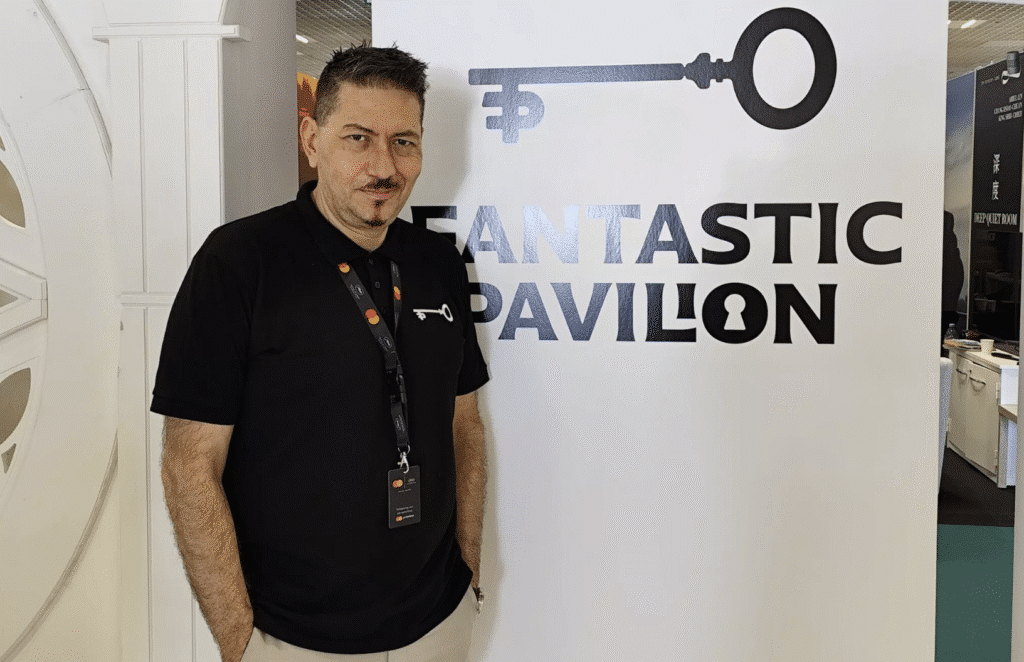
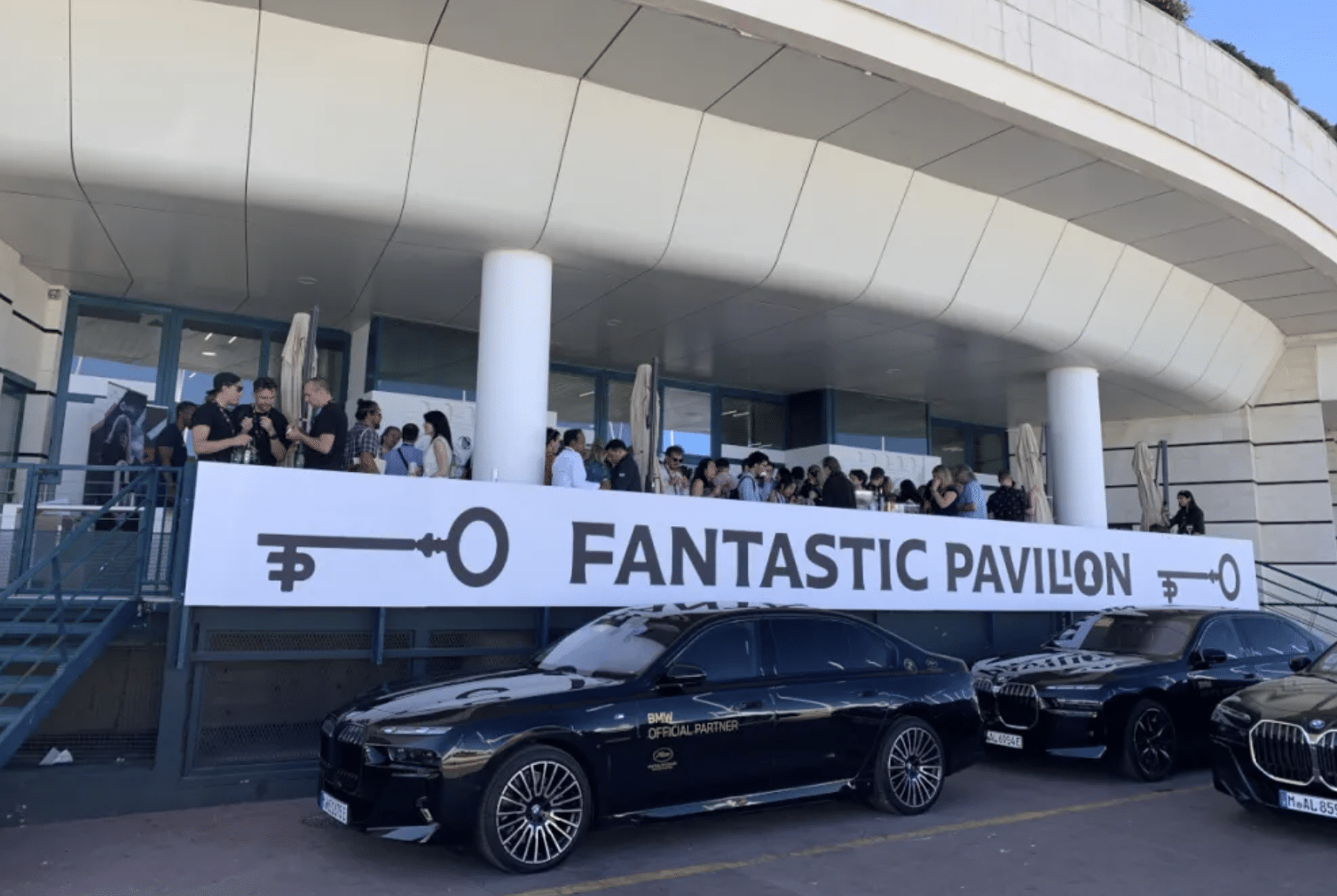
Three years ago, Mexican festival founder and director Pablo Guisa Koestinger and a group of like-minded genre film luminaries took matters into their cold, dead hands and established the first ever horror, sci-fi, and fantasy-specific pavilion at Cannes — the Fantastic Pavilion — in the heart of the Marché du Film. The strategy for selling the festival’s skeptical (and infamously conservative) brass on the idea was to literally treat genre film as a nation unto itself.
“When we asked Cannes about having our pavilion, the first thing they told us was that pavilions were reserved for countries,” recalls Guisa Koestinger. “So, my answer was, ‘Great! Because genre is a destination.’”
Hard work, innovation, and shrewd strategizing began paying dividends that first year, but Guisa Koestinger and friends were mindful to balance their excitement with an eye on the long game. “First year, there was a lot of energy, a lot of expectation and a lot of ignorance about what the pavilion would look like and who it would serve — more than just a gathering space for the community,” he says.
Not to sell said gathering space short, of course, since it provided a dedicated space for companies and networking, cocktail parties, and gala market screenings; a place where producers, festival programmers, distributors and sales agents specializing in the genre could congregate.
It is only natural that each year spawns new events at the Fantastic Pavilion that are added to the permanent annual roster. Guisa Koestinger cites one particularly important example: the Genre IP Remake Showcase, started in the second year.
“We gathered ten IPs from around the world that had certain success and presented them in the form of a cocktail [party] at the Pavilion to see what happens. (That year) one of the IPs we had was The Coffee Table, a Spanish film. And last year we presented at a gala The Turkish Coffee Table, which is the Turkish remake of that film — and that was born in the Fantastic Pavilion. In February 2026, it was released in Turkey. So now, after three of these shows, we can say that we’re helping movies being made.”
He also lauds the Fantastic Round Robin, an event introduced in 2025 that matches projects in their earliest stages with interested companies.
Not surprisingly, between the festivals and keeping tabs on projects that have taken off at Cannes in recent years, the Fantastic Pavilion is a year-round concern for Guisa Koestinger.
“Any project that comes to the Pavilion with the round robin, we follow them and check in with them,” he says. “‘Have you achieved the funding? Do you want to know about tax incentives, about co-production?’”
That level of ongoing engagement — part mentorship, part intelligence network, part co-production broker — speaks to how dramatically the Pavilion’s mandate has grown since that first nervous year on the Croisette. What started as a gathering space has become a year-round ecosystem, its reach now extending well beyond the Croisette.
“We’re starting to interconnect with markets in different parts of the world that we know are complementary with us, to bring to the Fantastic Pavilion in Cannes the results of year-round activities,” says Guisa Koestinger. “As Victor Frankenstein would say, ‘It’s alive! It’s alive!’ It’s kicking, it’s moving. It’s helping people to sell films, finance projects, sell IPs. We’re serving our purposes, and proof of it is that expansion. Activities in other markets are being asked from us. The Fantastic Pavilion today is an institution for genre. And like I have said since the beginning, this is a group effort. It’s the community feeding this thing.”
After all, horror is what Guisa Koestinger embraces not only as vocation but as identity.
“I have two nationalities: I am Mexican and horror,” he says. “Horror is my land, my space. And all genre fans, when we go to festivals, I am with my peers, my equals. We speak the same language. We speak genre. We speak horror.”