
By PAT KING
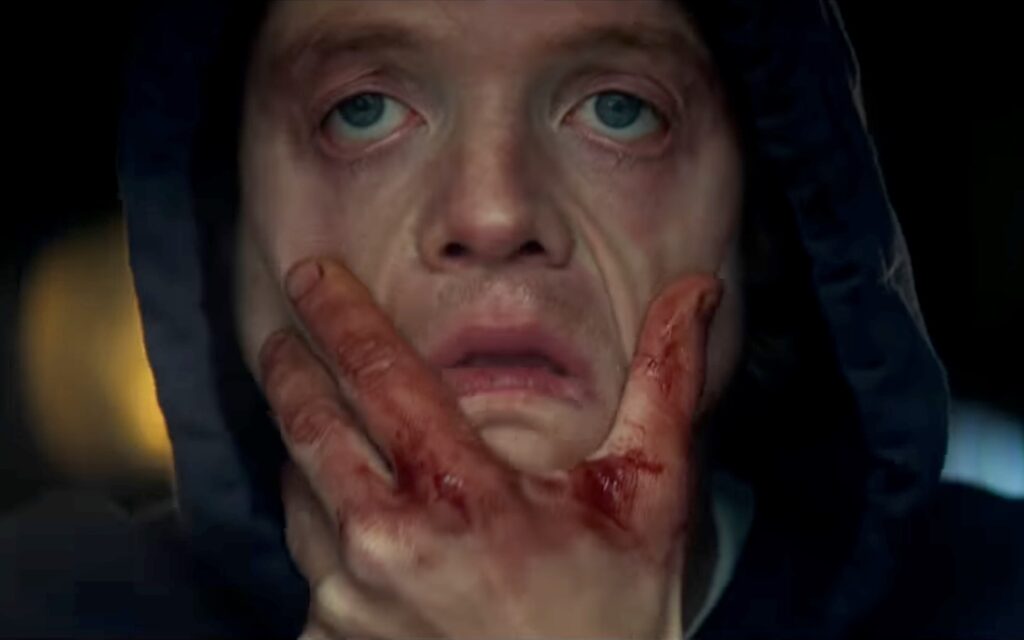
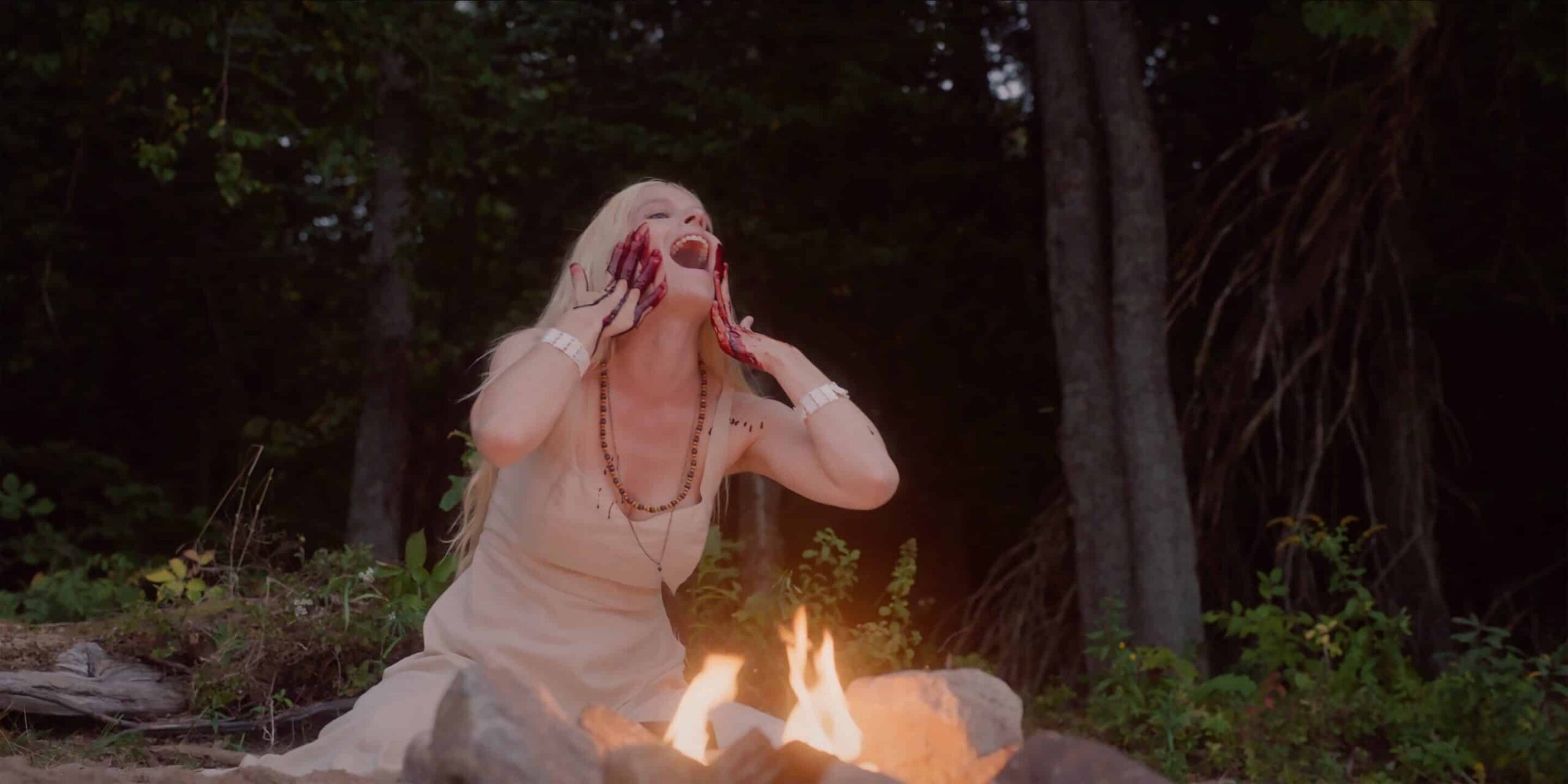
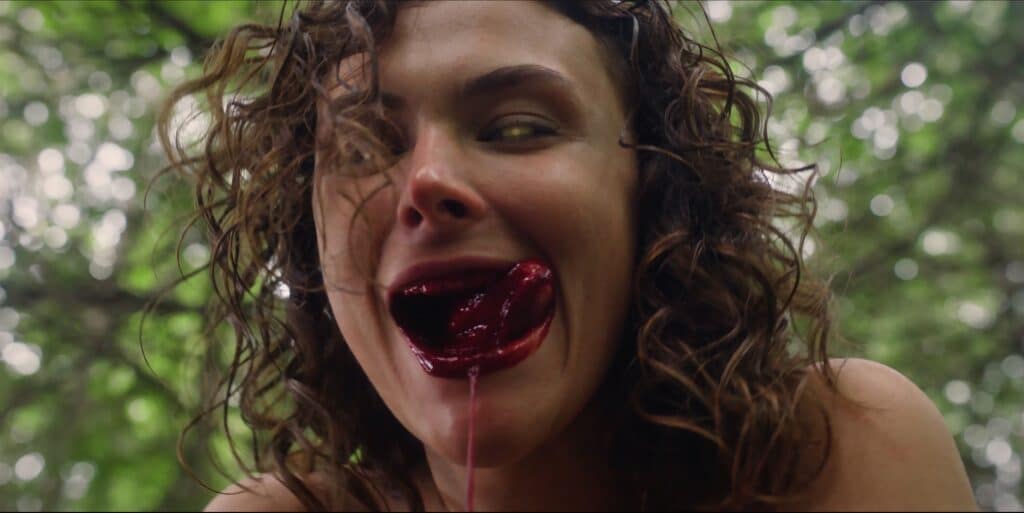
In Alex Noyer’s new movie, LOVE IS THE MONSTER, Ana (Madeline Zima) and Justin (Leonardo Nam) are a couple in crisis. Seeking to shore up their fragile relationship, they join a group of other troubled couples for a woodland retreat presided over by self-help guru Tiina (Milla Puolakanaho). Under her influence, they soon find themselves unwitting fodder for bizarre rituals involving the worship of Lempo, a Finnish goddess who embodies both the positive and negative aspects of love.
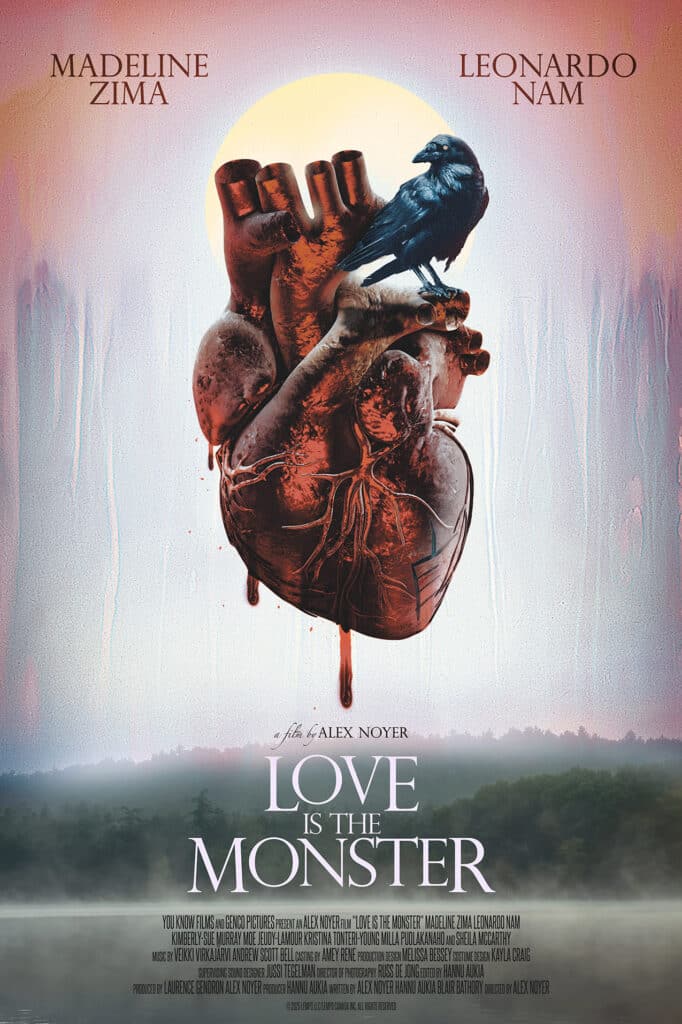
Murder, betrayal, jealousy and strange supernatural happenings abound as the group spirals into madness under the influence of the malevolent deity.
Recently, RUE MORGUE spoke with Noyer about the film and its unique take on folk horror.
You’ve said on social media that we may be in a new golden age of indie horror. Why do you think that is, and where does LOVE IS THE MONSTER fit in?
I posted that statement because horror has always sort of thrived when it’s under pressure. And right now we are in this phase where you have these big blockbusters coming out – big horror movies from studios coming out and seemingly dominating the narrative. It’s interesting to see how it galvanizes horror filmmakers. And we know that indie horror filmmakers especially are like mad scientists. They want to break something, to create something different. I feel that when the pressure mounts on the indie side of things, this is when great things come about. And the golden age for me is the moment when the audience wants to see something weird, or they don’t want something that is too safe. They want something. They’re bored with everything that is just tropey and stuff. The audience is demanding more, and the mad scientists are revving up their engines at the moment. I think that duality means that we are in or we’re about to enter a new golden age, because horror in general is always the innovative side of filmmaking. There’s something very specific about the horror genre that motivates innovation, breaking new ground and shocking quite a few people as well. So, I think it’s an exciting moment.
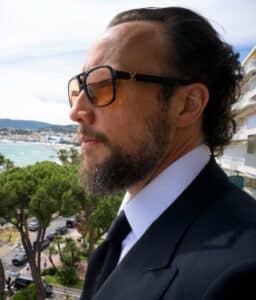
And as far as LOVE IS THE MONSTER, it was an interesting thing because we shot it three years ago, which is a testament to the way things are at the moment in the pipeline of horror. What was interesting was that we were still at the moment when there was a bit of a hybrid moment between drama and horror. We could do movies like this one or Sound of Violence, which allows us to bring horror into a different setting, whether it is drama or thrillers. The market right now is very much demanding horror that is pure horror and stands its ground as such.
I think because of its weird experimentation, it fits into that paradigm. But I also use it very much as an example of what happened over the last three years. So obviously, with my involvement in Fantastic Pavilion, I’m trying to stay very much abreast of everything that’s happening around horror and trying to champion it. It is fun to see the projects that are breaking through, the wonderful stories around Obsession or Backrooms or things like that. I just feel that horror filmmakers tend to be the most resilient because they’re never done with something they want to do. As long as they trust their vision and they’re used to doing it on a shrunk budget, what we get is always about stretching every dollar to the maximum.
That resilience and attitude are the reason why, in a moment of pressure, I do think we tend to enter a golden era.
What got you through the three years before it was distributed?
I say that resilience is necessary when I mentor young filmmakers. Whether they’re worried about not being ready or they’re worried about what’s going to happen if they do manage to get this or that off the ground or however long it’s going to take to get things out in the world, resilience is always going to be the test of character.
I did a documentary called 808, which, when we started shooting it, was in late 2011, and it had a premiere at South by Southwest in 2015. So that was already four years, but it didn’t come out until 2026 with Apple. So again, that project had very much tested my resilience and my stubbornness, and then, Sound of Violence came out during the pandemic. I had to face conditions that were very different from a typical release. So naturally, that means that resilience has to kick in. And here with LOVE IS THE MONSTER, first it took a long time to put it together. We had limited budgets. So we had things that we had to do. It took longer because when you don’t have the budget, you want it to be done well, it won’t be done quickly. We had to kind of let that project take its own course, and you forget about all of that as soon as it comes out. It’s a very satisfying moment.
When did you first hear about Lempo, and what made you want to center your movie on her? What would we call her? Is it even a “her”?
It’s a divinity of love. I’m Finnish, so obviously Finnish folklore is familiar to me. Finnish mythology is not something that is a very formally organized mythology, unlike Norse mythology or Greek mythology, which are much more familiar because it’s quite well documented and written. In Finnish mythology, there’s a book called the Kalevala, which is a book of poetry, and those poems are individual stories that are about human nature and our relationship with nature. The divinities are not gods in the sense of religion. They’re just beings that represent the forces that surround us, and they represent many things. For example, we have gods of harvest and thunder, and then we have things that are not so defined that they would have a lore. Or it’s more like they are part of folk stories that share a perspective in common. For example, love is an energy rather than a feeling, and then we start to define love. Lempo was a creature that I thought was very interesting because it kills the main hero of that poem.
It’s love as energy, and it’s a creature that is covered in feathers and beaks, and I was allowed to take enough liberty to actually shape it into something a bit more familiar: a goddess of love. Then accept the villain of the character in the midst of it. The energy of love that was either driving you to do good or terrible things. That ambivalence was very human. So what attracted me to this particular character in the Kalevala, and in Finnish mythology, was this very interesting idea that love is this energy that drives us to do great things or terrible things, and it felt a very sort of grounded way to explain why in any love story there could be terrible outcomes.
It’s both tapping into my Finnish roots, which I wanted to tap into for a while, and a very unknown mythology that even Finns don’t know. It is informal enough for me to take all the liberties I could. So I was creatively very stimulated about it, and that’s a great thing … As a Finn, I felt extra motivated to tap into that sort of heritage and bring it to the world.
You had two writing partners. What did they bring to the table as far as ideas?
I brought on Blair Bathory and Hannu [Aukia] because it occurred to me that love is such an international or universal topic that I wanted to have more points of view. Perhaps because I’ve been happily married for eighteen years with two kids and stuff, and perhaps I felt that my perspective on it all was very much limited, I felt that adding other perspectives to the process would allow us to create better couples to kind of evaluate people. One of the things that we wanted to do was to create a sort of familiarity with the characters. I first brought Blair on to bring her perspective, generationally, as well as because she’s American. I wanted to have her perspective on it all. And so it was also interesting to bring an international perspective. I’m French and Finnish. I was trying to combine my own journey, having lived in England, having lived in the U.S. for a very long time as well. But at the same time, I wanted to bring Blair, who brought a whole different perspective, and we had talked about collaborating for some time.
And then Hannu, who was my producing partner on Sound of Violence, his grasp of Finnish mythology and folklore was very helpful because I didn’t grow up in Finland, whereas he did. So there was, again, an enrichment there. I think the main idea was to make sure that we arrived with a multifaceted approach enriched by a different set of standards and experiences that we could just bring together. When I delivered the final draft, it really had benefited from that constant questioning and brainstorming, and Blair got very interested in the bird aspect of things. For example, Hannu had explained that the birds hold the souls of their children, and we broadened this to the souls of the victims of Lempo. And it was a very beneficial process to be able to bounce ideas on such a universal topic.
Madeline Zima and Leonardo Nam are excellent as the lead couple. How did you find two people who were so compatibly incompatible?
First of all, a big shout-out to my casting director, Amy Renee. She also worked with me on Sound of Violence, and she was the genius who had suggested Jasmin Savoy Brown for it. So obviously I went back to her for this movie, and we were looking, and we were thinking, and then we’d start to talk about Madeline. We sent her the script, and luckily for us, Madeline responded.
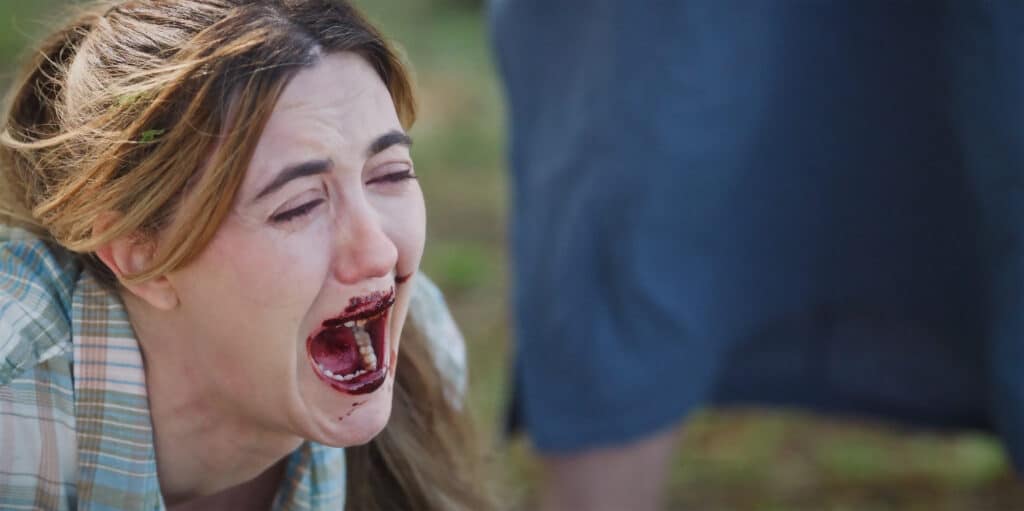
Madeline is very experienced. She’s been in the business since she was, I think, 4 years old. I think she was 4 or 5 when she did The Hand that Rocks the Cradle, and then, obviously, The Nanny and all that. She came with a set of questions and expectations that, from the first call, had set out the professional relationship. She saw the toxic relationships. She saw things that she felt were very relatable. So, we were thrilled to bring her on board, and then Amy suggested I speak to Leo, and we had a casual first call that lasted a while.
I think, funnily enough, it’s almost like my individual experience with both of them put me in a moment where I was like Okay, I know that I can work with both of them. That gave me a great perspective about how they could come together as a dysfunctional couple, especially one where he would be a complete narcissist, and she’s kind of attaching herself to the relationship while reeling from things from the past, and this disconnect was great. I had great confidence in them. They knew each other, and so when we had lunch, the three of us just evaluated the chemistry.
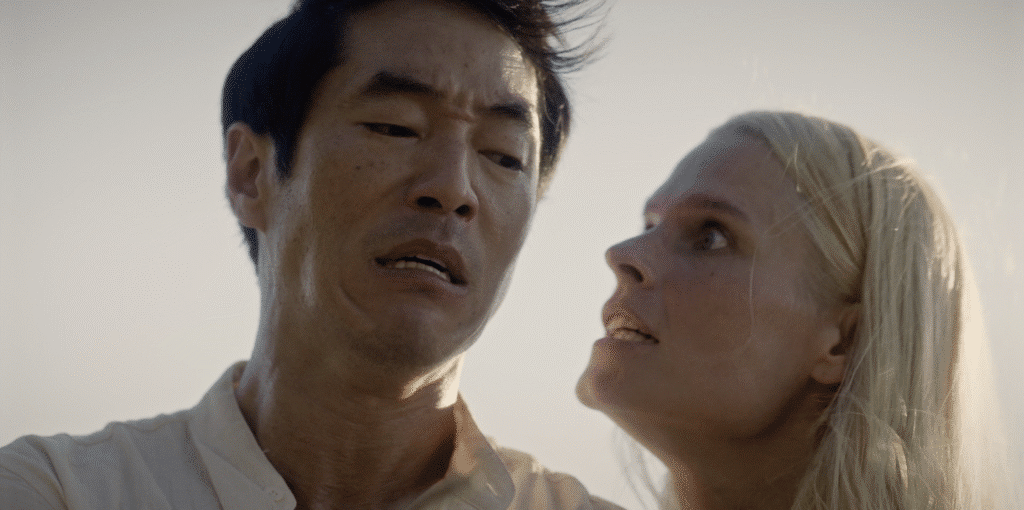
And they wanted to work together. That was obviously a great encouragement, and then I could see the antagonistic chemistry of what they, in their different personas, could bring as a dysfunctional couple. That gave me a lot of encouragement and definitely set the tone for the rest of the casting process. I could see the togetherness of all of them, so ultimately, hopefully, it shines on screen.
Milla Puolakanaho as Tiina brings just the right amount of crazy at the right times. That’s a tough thing to do. How long did it take to find her, and what was it like working with her?
I met Milla through Hannu. In 2022, we did a sort of proof-of-concept infomercial [for LOVE IS THE MONSTER], which you can now see at the beginning of the movie. Also, Milla had worked with Hannu on a film he directed called Someone Somewhere.
When we were putting the ensemble together, I obviously sent her the script, and I was like, “Okay, do you still feel like Tiina?” And she was very enthusiastic about it. She had a small baby, and she still came to Canada and shot and committed to the roller coaster role that it was. It very quickly felt after we shot the infomercial with her that she was Tiina.
She is also a Finnish person. So she brought all the authentic Finnish self of Tiina, but at the same time, she really had her own take on the commitment and the sometimes scary charisma of Tiina. So we were delighted to have her.
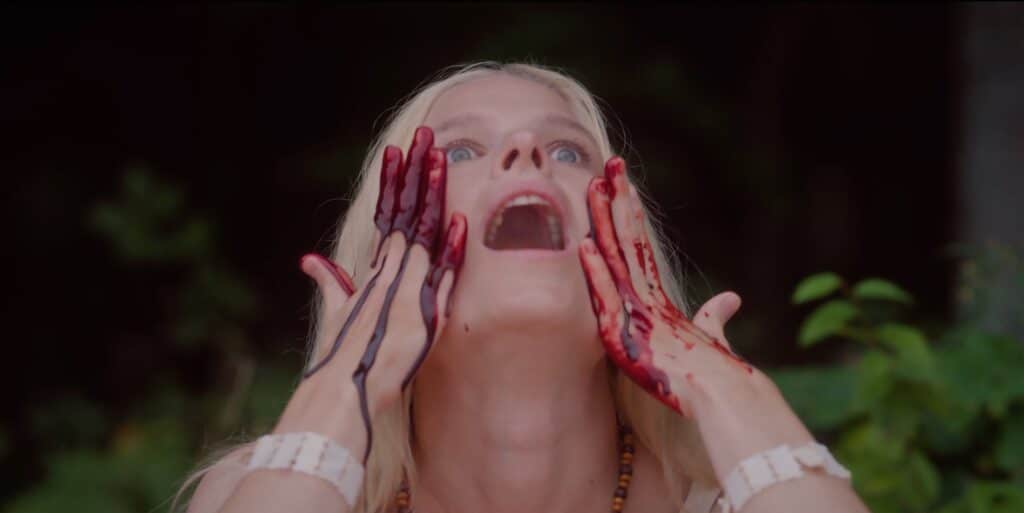
Ritual plays a big part in this film, obviously. Did you research any rituals, or was it all creative?
This is how I treat people when I invite them to Finland! No, the rituals were interesting, and again, this is where collaboration was key because there was a sense of trying to make things understandable but at the same time specific enough to where we were. And so there was a short list of things that we wanted to do – contemplation of certain rituals, certain things that would be just odd moments. And again, it was the idea of whether or not we wanted to make people deeply uncomfortable or just go along with the logic of the retreat, which is to get people to let it all go. And we have this great lake scene where Tiina explains to everybody to let it all go and to put yourself in the waters of Lempo. It sets a tone that anything can happen at this point for the rituals to take an extra edge.
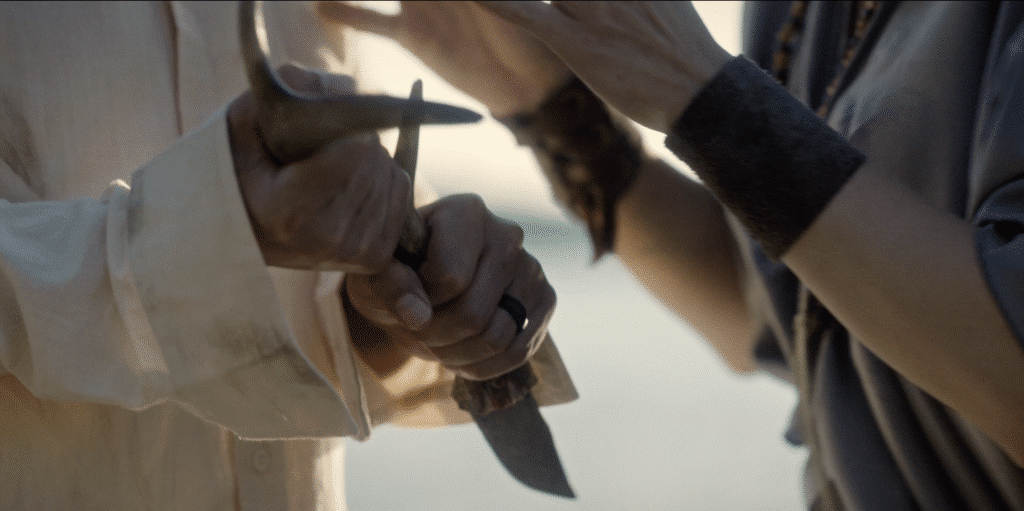
I live in Los Angeles, where a lot of people go to retreats. There’s almost a pride in finding the most obscure and weird set of treatments. I watched Goop Lab, the Gwyneth Paltrow show on Netflix. I watched a whole bunch of things. I really went deep into all sorts of rituals and stuff to find something that would attract all those people from abroad. I had to find moments that would fit the retreat and the vibe. And some elements were very Finnish. The sauna, I should say, is our greatest invention in Finland, so I had to integrate that. When you arrive in Finland, the first experience that a lot of international guests have is that they go to a sauna, and they walk in, and everybody’s naked and stuff. That’s discomfort that I can see. So I had to integrate that, obviously, into our ritualistic language. But apart from that, it really was a constant brainstorm to then narrow it down to those few rituals and just create something that would be both trippy and deeply uncomfortable.
LOVE IS THE MONSTER is now available to rent or buy on Prime Video.