
Just as he did 10 years ago with his breakout hit TRAIN TO BUSAN, Korean director Yeon Sang-ho demonstrates that there are still twists to be wrung from the zombie genre in his new movie COLONY. Yeon, who also directed the BUSAN sequel PENINSULA and scripted COLONY with Choi Gyu-seok, gave RUE MORGUE some insight into the creation of his new ghouls and their action.
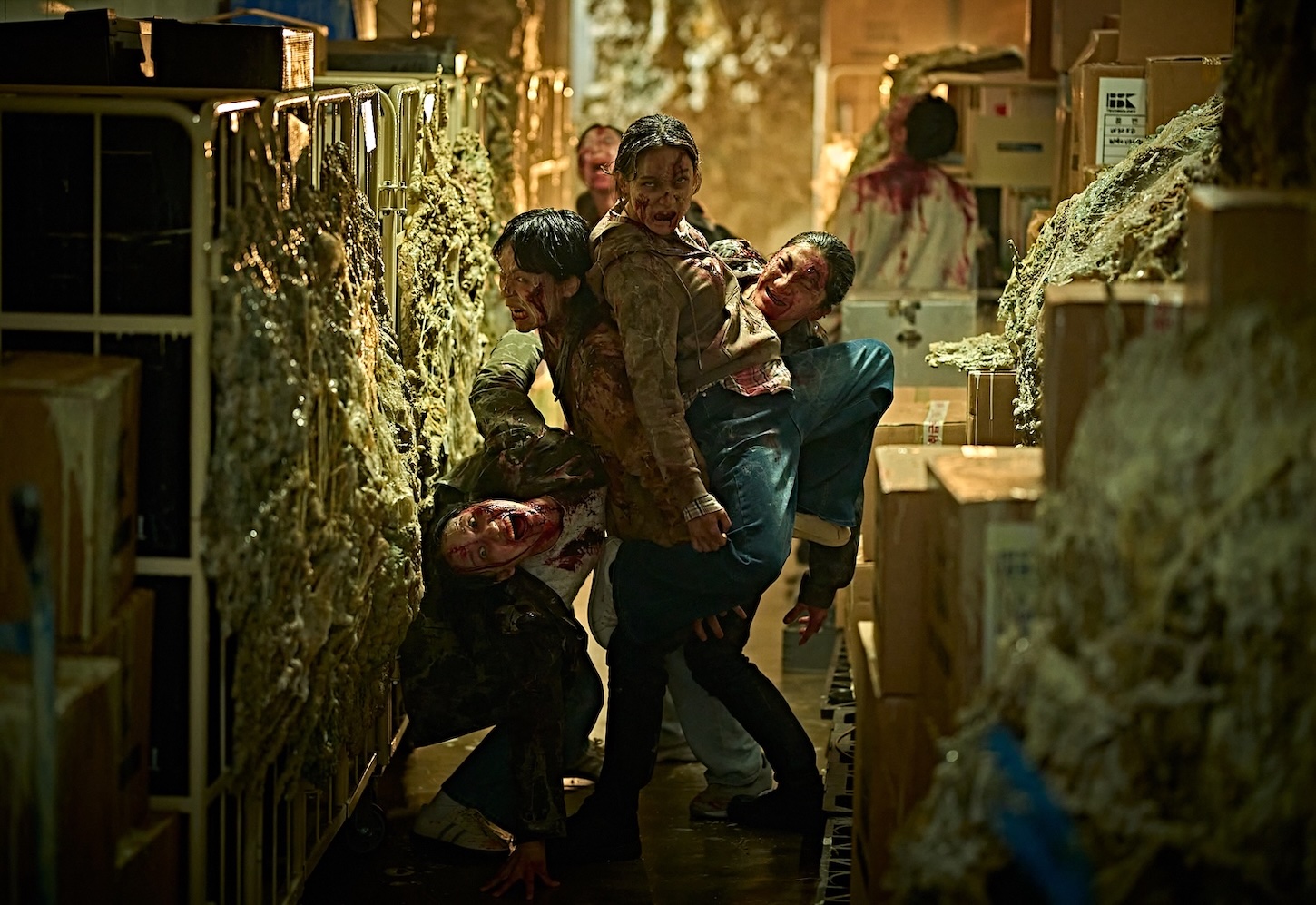
In COLONY, now in release from Well Go USA, Gianna Jun stars as a professor who goes to a high-rise building to attend a scientific conference. Her visit coincides with the unleashing of a new kind of zombie contagion, developed by a vengeful biologist (Koo Kyo-hwan). These infected, who first crawl and then run acrobatically after their prey, possess a hive mind that causes them to all stop in unison at various moments as they receive information. As a small group of survivors try to both outrun and outthink this threat, Yeon stages big-scale, bloody action inside and outside the building. (See our review of COLONY here.)
After the two TRAIN TO BUSAN films, what inspired you to take a different look at zombies?
I also worked on the HELLBOUND series [for Netflix], and my co-creator on that project was Choi Gyu-seok. After season two, we started talking about, “Well, I think there might be something more that we can talk about regarding our collective thinking, that tendency in society.” So we discussed that a lot, and especially how maybe our society is going more into that direction because of the social networks. Through those networks, a lot of information exchange is happening at breakneck speed, and also all these AI programs have been developed from that. And in the beginning, you know, AI seems to have developed into bizarre patterns because it mindlessly mimics what humans have done. So I figured out that we could discuss and show more about the peril of this collective thinking through these new ideas about zombies.
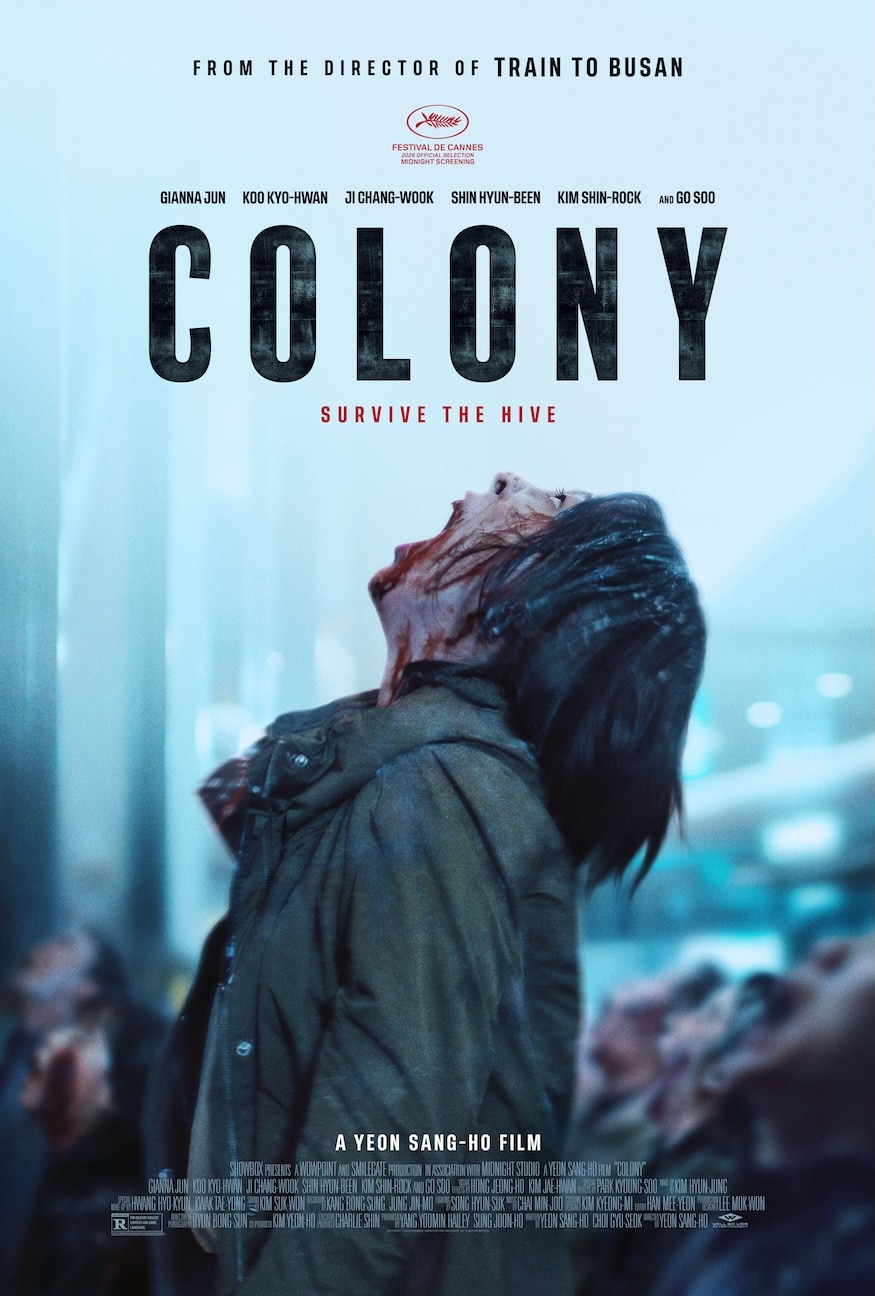
The zombie movements in the film are very striking. Can you talk about developing and choreographing those?
In making TRAIN TO BUSAN, we hired breakdancers and stuntmen to create the undead moves. But for COLONY, I really wanted to show how these zombies are behaving because they share this collective intelligence, and I needed choreography to express that. So I contacted three teams of contemporary dance companies, especially focusing on avant-garde style. We started talking, and what I emphasized during our discussions was that yes, they are moving as one, but that doesn’t mean that they move in the same direction, doing the same thing. Like, imagine when you play a piano; each of your 10 fingers is doing its own thing, but you are creating this one beautiful piece of music. So that was the idea I gave my team.
How did you find all of the zombie actors—people who could do the movements and also handle all the makeup?
When I was making TRAIN TO BUSAN, there were not too many actors or people in general who can handle zombie performance. However, that was 10 years ago, and after that, it kind of created a boom for the zombie genre in Korea, and that also nurtured a lot of actors who could specialize in this kind of role. So you can say that the Korean film industry has plenty of people who can play these characters now. So I had no problem finding performers to play the zombies in COLONY. And through their networks, I was able to find dancers and a stunt team and conduct auditions.
Did you find an actual shopping center and offices that allowed you to trash them, or was a lot of the movie shot on sets?
Well, most of the scenes were shot on a set that was created as a shopping mall, though of course I went to actual buildings for certain inserts. But the thing is, we didn’t really have a lot of money. Our budget wasn’t too high. At first, I envisioned a huge shopping mall set, and then during the filming process, we kept changing the sets here and there to tweak them and create more details.
I’m surprised to hear you say COLONY had a limited budget; the movie has a very expansive look to it.
Well, you remember the climactic scene where the zombies disperse onto this large area of the street? That was actually a set, and the road and ground you see is the only physical thing there. It was an open set, and all the buildings surrounding the area were created through CGI. And also, all the car stunts where Gianna Jun’s character was driving, and other people, it was not hard driving. We actually put two steering wheels in the cars, so the actor was on the left side, but on the right side, there was actually a stunt driver maneuvering the car. Those were pretty risky scenes, and I had to really pay attention to what we were doing, but these actors and drivers were all consummate professionals. Thankfully and luckily, they didn’t get injured, but it was quite thrilling and nerve-wracking.