By MICHAEL GINGOLD
Starring Egor Venned, Pilou Asbæk and Sofía Nolsøe
Directed by Kasper Kalle
Written by Rasmus Birch
SF Studios
Describing NO REST FOR THE WICKED as a combination of queer romance and vampire horror may be accurate, but it does the film a disservice. That logline would likely create basic expectations that the movie completely eschews in favor of something fully imaginative, completely captivating and sometimes deeply frightening. It’s a true original, and a major highlight of the current international genre scene.
A world premiere at this month’s Fantasia International Film Festival (where it has its second screening this Saturday, July 25), NO REST FOR THE WICKED is also the first genre effort by the clearly gifted Danish director Kasper Kalle. He immerses us immediately in the eerily beautiful atmosphere of the Faroe Islands in the North Atlantic Ocean/Norwegian Sea, specifically a small village on the forbidding coastline. The year is 1862, and Baldur Joensen (Egor Venned) is a young fisherman taking care of himself and his widowed mother Ásla (Sofía Nolsøe).
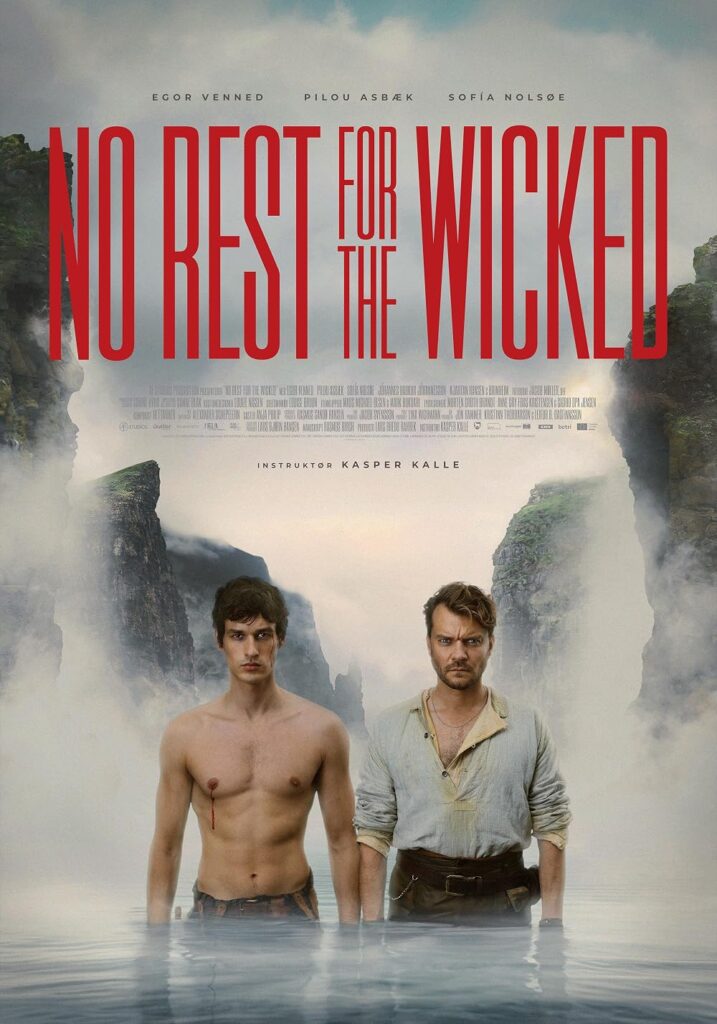
The routine of his life is upended when he attempts to rescue Danish whaler Helge (Pilou Asbæk) from the rocky waters, and Helge winds up saving him. Slightly older and handsome, Helge represents the outside world that Baldur longs to experience and explore, and when Helge takes up residence in Baldur’s house while awaiting the next ship, an attraction begins to develop. Awkward moments at the dinner table and knowing glances exchanged in church give way to a full-blown relationship that is perfectly played by Venned and Asbæk.
The casting seems especially appropriate: Venned, a former model, had never acted before this film, while Asbæk sports international credits including OVERLORD, AQUAMAN AND THE LOST KINGDOM and playing Straker in the recent SALEM’S LOT. The romance that develops between them feels real, as does the tension of engaging in it amidst a devoutly Christian community. The possibility of escape arrives when a whaling vessel docks at the island, and Baldur signs on to join Helge in setting sail—to his mother’s great consternation. And then…
Well, it wouldn’t be fair to detail the circumstances under which the heartfelt drama gradually and inexorably transitions into a supernatural horror scenario. That’s in part because Kalle and scriptwriter Rasmus Birch take their time in getting to the scary stuff, allowing us to become fully involved with the central couple and their circumstances before things get scary. It’s also because NO REST FOR THE WICKED, while technically a vampire story, finds fresh ways to approach the mythology and iconography; it’s that rare film that shows you variations on a classic genre you’ve never seen before. Suffice it to say that it begins with one character praying to God for the resurrection of a loved one while dripping their own blood into the ocean, and proceeds into all manner of chilling ramifications.
Drawing inspiration from an 1884 short story by Karl Heinrich Ulrichs that’s one of the earliest examples of gay fiction, Kalle and Birch have here struck just the right balance between the personal and the uncanny. In their perfectly evoked 19th-century setting, they tap into timeless emotions while complementing them with intriguing new wrinkles on classic genre tropes. The timeless dramatization of occult otherness reflecting gender deviance gets a full-blooded exploration here, though the metaphors are as unforced as the fully convincing period detail. Beyond the terrific work by the cast, NO REST FOR THE WICKED showcases superb craft contributions, from Jacob Møller’s cinematography and Sabine Hviid’s production design to the entrancing score by Hettarher (a.k.a. Torleik Mortensen and Andreas Tyekjær Restorff). Among many other things, the film features some of the best cinematic fog since John Carpenter traveled to Antonio Bay, suffusing scenes in mist so thick that at one point, people caution each other against moving lest they fall off a cliff in the gloom.
Amidst all this palpable, tactile mood, there are moments of visceral horror incorporating strong and startling makeup effects by THE UGLY STEPSISTER Oscar nominee Thomas Foldberg. These provide graphic punctuation within an otherwise lower-key yet fully involving experience, one that will hopefully win international attention, find an appreciative distributor that can bring it to a wide North American audience and create more opportunities for its talented creators.