
By LINDY RYAN
When Maggie Wise’s son sets out to carry his estranged mother’s body to its final resting place, he soon discovers that death is only the beginning. In CARRY ME TO MY GRAVE, Christopher Golden transforms a cross-country funeral procession across 1950s America into a haunting odyssey of ancient monsters, family secrets, and supernatural reckoning – one that proves some legacies are far more dangerous than death itself.
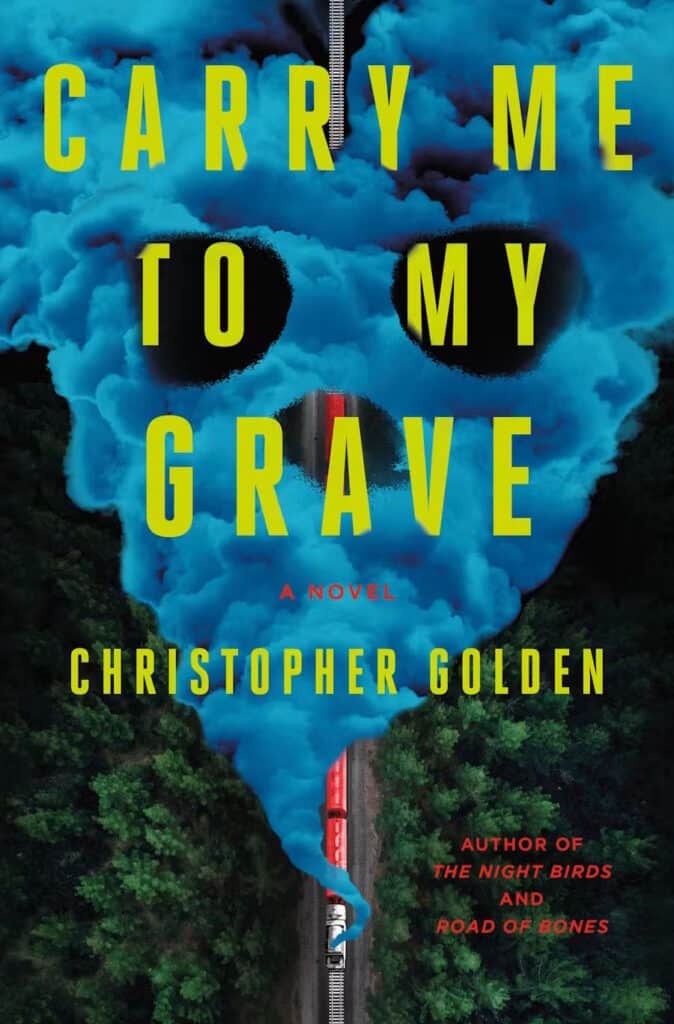
RUE MORGUE recently had the opportunity to sit down with Christopher Golden to chat about CARRY ME TO MY GRAVE, coming July 2026 from St. Martin’s Press.
CARRY ME TO MY GRAVE has an incredible hook: a son transporting his estranged dead mother’s body across the country while ancient evil closes in. What first sparked the premise for this story – the family drama, the road-horror structure or maybe the monsters themselves?
Oddly, the monsters were the last thing to click into place for me. I don’t remember the exact moment, but the story is partially inspired by the complicated emotions surrounding the death of my own mother in 2021. I loved her, but she was deeply complicated, and it was sometimes difficult to deal with the weight of her expectations. I was out for a walk with my wife, and I just had this spark of an idea – a son trying to bring his mother’s body to its final resting place, and something is trying to prevent that from happening. That was all I had, at first. It’s always a process of discovery for me, as elements come together. Setting it in 1956 and making so much of the first half about the train were just instincts, but I think they were good ones. The novels I end up happiest with are filled with the results of a hundred little epiphanies, probably none more so than CARRY ME TO MY GRAVE.
There’s something deeply American about horror built around travel – empty roads, dying towns, strange people watching from unknown corners, even train travel. This novel turns a sort of funeral procession into a full-on nightmare odyssey. What makes the “journey horror” structure so effective for you as a storyteller?

Author Christopher Golden
There are so many great things about a journey story, starting with its essential metaphor. You’re literally traveling, on a journey, but each of the characters is also on a personal journey. In a more practical sense, this novel combines the journey with a ticking clock. You must reach your destination by a certain time, which adds to the sense of desperation. Travel nearly always means characters are in unfamiliar environments, which makes them more vulnerable. But for me, the best part of a journey-horror story is that it allows the perfect combination of the momentum that goes with fleeing in terror, and the intense downtime of traveling in any conveyance, which puts the characters in small, intimate spaces where you can really focus on those interactions.
Maggie Wise is iconic from the book’s synopsis alone (“Maggie Wise will take your eyes”), feared as a witch, mourned as a mother and dangerous enough that things long-buried begin waking up when she dies. Were you consciously playing with “witch mother” archetypes while writing her, or did she evolve into something stranger along the way?
I was very much focused on the family dynamic, the single mother and her adult children, and what she meant to each of them, and how each of them turned out differently because of their individual relationships to her. It’s also intentionally about the idea that parents are not necessarily who their children see. Or, at least, children only see certain facets of their parents, who had lives and experiences before they became parents, many of which they don’t share with their children. Yes, it’s a relentless horror story and all about the momentum of the story, but it’s also about these other things that are layered beneath the horror. No spoilers, but there are elements of who Maggie turns out to be that were not part of the original idea and grew organically in the storytelling.
A lot of your work balances relentless action with emotional grief and damaged family dynamics. CARRY ME TO MY GRAVE reads almost like a collision between a horror-thriller and a Gothic family tragedy. How do you maintain that momentum without losing the emotional weight underneath the monsters and violence?
If you look around any gathering, you’re seeing a group of people who all have their own story. Most of us have something – or many somethings – that we’re managing, or that is simmering in our lives and could boil over at any moment. I just try to always keep in mind that these are people, that everyone’s a little bit broken. That’s what makes them interesting and what drives their reactions to whatever situation you might put them in. It’s one thing to come up with a cool story concept or a plot with a natural momentum, to write horrible things happening to people or terrifying folk tales come to life, but without people you can care about, it falls flat. As for maintaining the momentum, that comes from honing and revising and moving scenes around. It’s a delicate balance. You’re never going to please everyone. Some readers want the story to move faster, some slower. Some want more character exploration, some less. I find the balance that feels right to me.
Early readers, myself included, have identified CARRY ME TO MY GRAVE as not only one of your best works, but have also compared the novel to everything from Clive Barker to Indiana Jones-style adventure horror. The book blends old-school monster terror with pulp momentum in an incredibly satisfying way. Were there particular horror novels, films or creature features that influenced the tone?
First, thank you so much. I’m happier with this book than anything else I’ve written, so that means a lot. I’m sure there are dozens of books, movies and comics that are in the stew of my imagination that contributed, but it’s hard to isolate any of those ingredients. One thing is for sure: it includes the influence of every story I’ve ever enjoyed that has a significant train journey, including everything from Strangers on a Train and The Lady Vanishes to White Christmas and From Russia with Love.
Horror so often tells us the dead don’t stay buried, but CARRY ME TO MY GRAVE makes that idea literal in such a visceral way. At its core, what do you think this novel is really afraid of: death itself, family legacy, inherited guilt or the impossibility of escaping the past?
That’s a great question. I prefer to think of it less as being afraid of anything and more about hope. The hope that you can fulfill your obligations, live up to your own expectations of yourself and that escaping the past is possible… as long as you can avoid being eaten by something ancient and merciless.