By ROB FREESE
What sets Nick Cato’s new book, Dark Dreams: An Obsessive Look at Romano Scavolini’s NIGHTMARE (Headpress Cult Film Series), apart from others of its ilk is that it is a fan’s deep dive. Not just the typical behind-the-scenes/making-of account of a film’s production, Cato’s book documents his personal history – and obsession – with the 1981 cult classic.
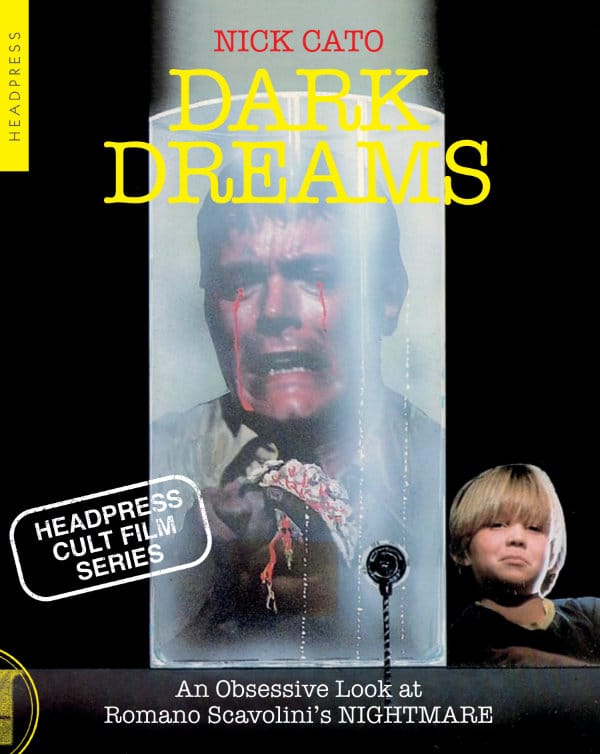
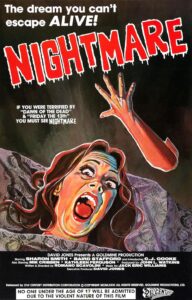
For the uninitiated, Nightmare is a Golden Era slasher that broke away from the tropes established by Friday the 13th, combining the thrills of Halloween with the gore of Dawn of the Dead. It became infamous for being one of the 72 successfully prosecuted films during the U.K.’s initial Video Nasties hysteria. Nightmare is a grim movie. It is not what most fans consider a “fun” slasher or a “popcorn” slasher. It is more like Bill Lustig’s Maniac than Paul Lynch’s Prom Night.
 Before I can really get into what this book is, it’s important to establish what it is not. It doesn’t offer a production schedule, a list of locations or a production diary. It’s not a collection of interviews, although it contains some essential ones. It is not a book that looks into the film’s conception or Scavolini’s inspiration. The controversy surrounding Tom Savini’s involvement is not a concern. As Cato states plainly in his introduction, “There is a wealth of information about this slight scandal (if you will) online. I’m not dealing with it here because this book is mainly aimed at those who love the film.”
Consequently, Dark Dreams is more satisfying than a typical behind-the-scenes/making-of tome. If the traditional behind-the-scenes film book suffers from an imbalance of production stories and too many distracting “fanboy” diversions, this exploration solely from Cato’s point of view establishes a fan-centric vibe early on, making the book more accessible and, by extension, enjoyable to fans.
Nick Cato was kind enough to answer a couple of questions about his book and the movie that has haunted him for more than 40 years.
I really enjoyed the concept of the book being from your perspective as an “obsessed” fan. How long did it take you to figure out its overall structure?
Not too long, especially since the main section is my commentary on the whole film. Within four to five months, I had the basic shell set.
Aside from Kathleen Ferguson, who played Barbara, and producer Bill Milling, did you attempt to interview anyone else from the film?
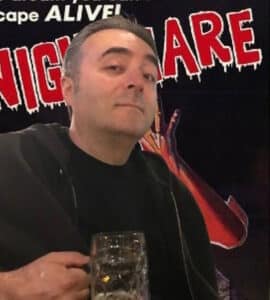
Author Nick Cato
I attempted to contact Scavolini, but he never responded to a few emails. I also managed to locate a guy in Florida who claimed to be Scott Praetorious, the young actor who played the young version of killer George Tatum. He agreed to do an interview via email, but never returned my questions, nor did he respond to further emails. Judging by the picture I found before contacting him, it surely looked like Scott, so I was either ghosted by the real person or had spoken to someone who was playing me. Attempts to contact Sharon Smith, Mik Cribben and CJ Cooke were unfortunately fruitless.
Do you think Romano Scavolini approached the film as a straight slasher, or was he maybe trying to tell a different story, and the producers played up the story’s slasher aspects?
According to interviews with him, Scavolini claims he wasn’t aware of the term “slasher.” I find that hard to believe, but he has said it many times. He claims a story he read about an experimental drug to cure schizophrenia inspired him, yet it’s barely mentioned in the film and not explored. The people who advertised the film on its infamous poster surely tried to sell it as a slasher by comparing it to Friday the 13th and Dawn of the Dead, which, as you know, is not a slasher, yet was incredibly gory for its time.
You’ve probably seen this movie more than anyone I know. Do you see George Tatum as the villain of the film or another victim?
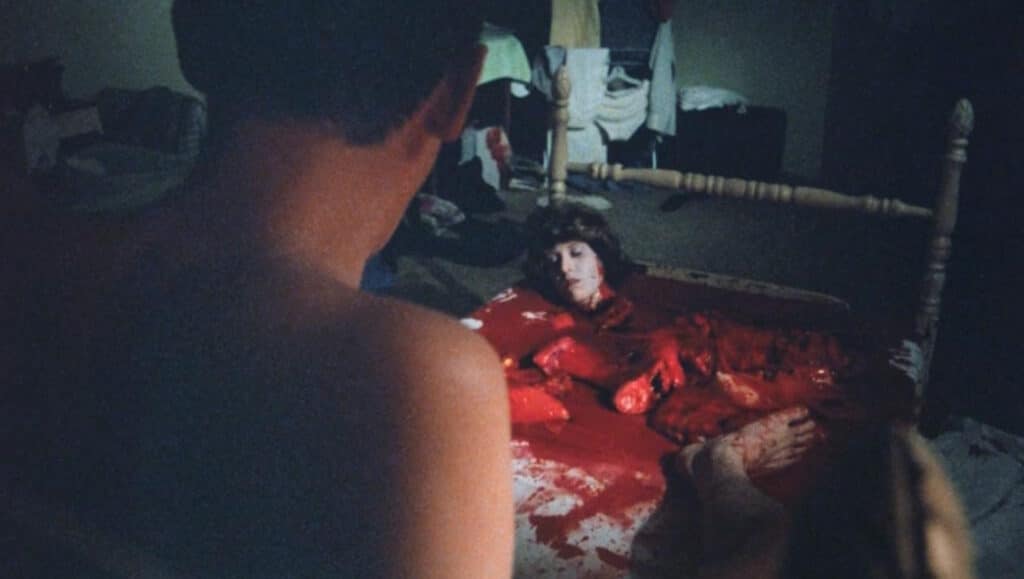
Definitely both, but more the victim. I mean, his violent rage was triggered at an early age, so chances are he may never have lost his shit had he not stumbled upon his dad involved in that freaky sex situation.
What is it about Nightmare that sets it apart from the other slashers of the era?
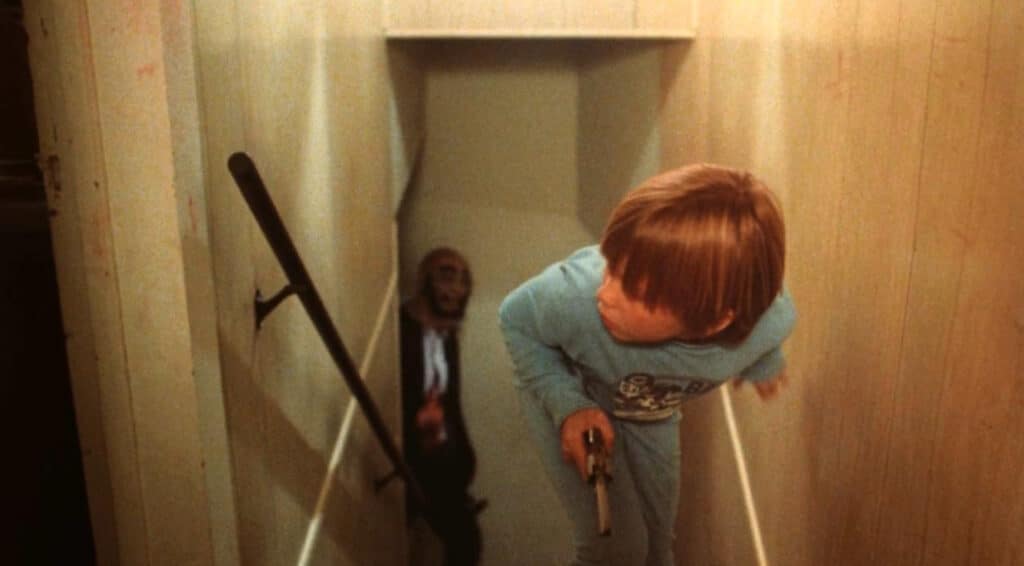
Mainly its use of children in violent situations. You have that incredibly gory finale, where the young George murders two people, one being his father, with an axe, and years later, you have George’s son, CJ, defending his sisters with a handgun and a rifle, going so far as to blow holes in his dad’s chest. There was just something, back then, about seeing kids in this scenario. There had been kids in plenty of horror films before Nightmare, but this was next-level craziness.
If someone is starting to get into slasher movies, and they’re interested in the films from the Golden Era (1978-1984), when do you think they should give Nightmare a watch?
I’d say watch the classics first, then if you get a taste for the subgenre, give Nightmare a chance. I am under no illusion that technically, it’s not one of the better slasher films, but it works for me on a personal level. If viewers can appreciate a film for its concept and not just its overall quality, they may enjoy it.
Total fanboy question: If you were given the job of writing a sequel, either in novel form or screenplay, where would you take the story?
I’d take a look at George’s son, CJ, but instead of having him grown up as another killer, I’d have him discover his father somehow wasn’t killed at the end of Nightmare, and he finds out that he not only survived but managed to get out of prison on an insanity deal or something to that extent. CJ would then spend much of the film trying to find where his dad is now living, so he can finally put him to rest.
If you would like to pick up a book, meet Nick Cato and actress Kathleen Ferguson at Forbidden Planet in NYC on March 28 from 5:00 p.m. to 7:00 p.m.