By MICHAEL GINGOLD
Starring Virginia Gardner, Melanie Jarnson and Mitchell Hope
Directed by Jo-Anne Brechin
Written by Katharine E. McPhee and Jo-Anne Brechin
Lionsgate/Grindstone
Scientific reports tell us that killer whales, which are generally thought of as cold-water creatures, regularly migrate to tropical waters for purposes of skin regeneration. The orca in KILLER WHALE, however, is situated in the Thailand area because of the machinations of callous humans. And yet the film can’t decide throughout its running time whether its central predator is supposed to be seen as a figure of sympathy or fear.
Thus the young woman who cares most about Ceto the captive killer whale, and even has a chance to express that concern to her, becomes the central target of her wrath. This is Maddie (HALLOWEEN 2018’s Virginia Gardner), who has the obligatory Tragic Past. In a prologue, she’s visited one night at the diner where she works by her boyfriend Chad (Isaac Crawley), who, typical of the movie’s on-the-nose approach, is wearing a mortarboard cap to let us know he’s been at a graduation party earlier in the day. Then an attempted robbery goes fatally awry, ending in a way that was evidently supposed to subvert expectations but ends up inadvertently comical.
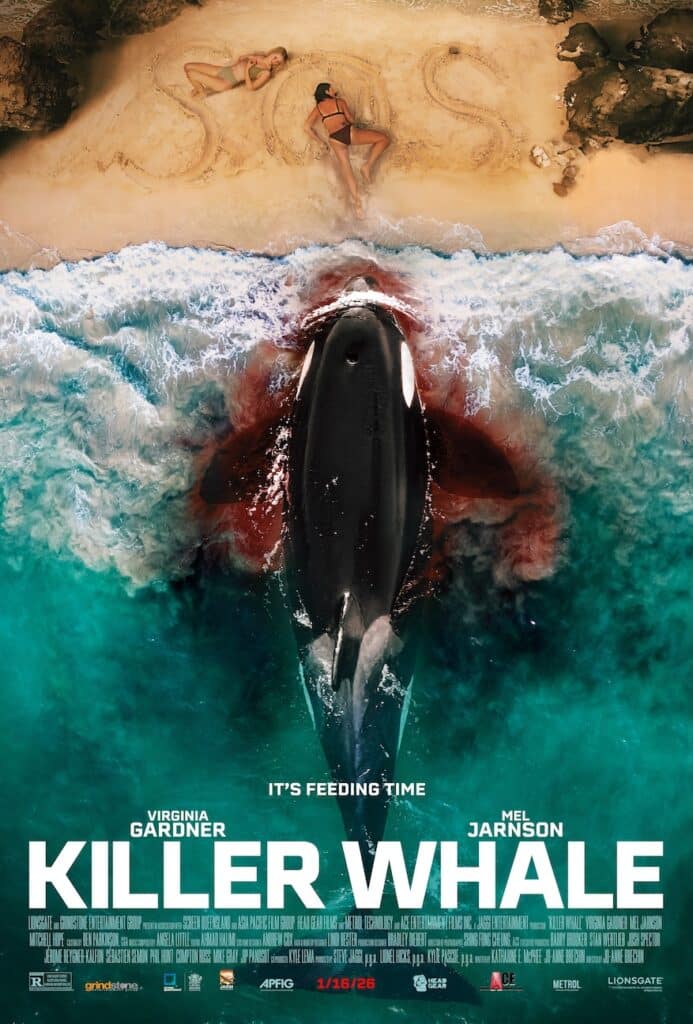
A year later, Maddie is still grieving, and approached by old friend Trish (WITCHBOARD 2025’s Melanie Jarnson) to go on a long-planned vacation to help cheer her up. The destination: Thailand’s Andaman Sea Islands, where Ceto has been the star of a tacky SeaWorld-esque attraction. Maddie has been obsessed with Ceto and her mistreatment for some time, particularly since the orca’s baby allegedly died but might actually have been stolen away to another park. Ceto has clearly had it in for humans ever since, having already killed a trainer, and during a late-night break-in to Ceto’s home to “have a moment” with her, Maddie witnesses another of her victims.
This death results in a mysterious voice on a walkie-talkie telling a security guard to “Get rid of that damn fish”; next thing you know, a jet-ski joyride by Maddie, Trish and local guy Josh (Mitchell Hope) takes them out to sea and into a perfectly circular atoll where Ceto has somehow now been stranded. The purpose and process of this is never explained, but is necessary plotwise to keep Ceto feeling trapped and antagonistic toward people, since in reality, no one has ever been killed by an orca in the wild. So Josh soon gets munched, leaving Maddie and Trish perched on a tiny rock outcropping as Ceto circles menacingly around them.
What we have here, in other words, is a combination of THE SHALLOWS and FALL, the latter of which also starred Gardner (and whose upcoming sequel is also set in Thailand). Yet unlike the former, KILLER WHALE doesn’t come up with enough inventive developments once the situation is established, and unlike the latter, the CGI used to create the environment isn’t quite convincing, which is a distraction throughout. Despite an “orca manufacture” credit for veteran Aussie effects creator Steve Boyle (BEAST OF WAR), Ceto is largely, and clearly, a digital creation as well. Fans of aquatic-animal-amok fare will also be disappointed that the script by Katharine E. McPhee (no relation to actress/singer Katharine McPhee of SHARK NIGHT 3D) and director Jo-Anne Brechin doesn’t give Ceto much to do for a good portion of the movie.
Instead, the filmmakers attempt to mine drama from the relationship between the two heroines under pressure, and although Gardner and Jarnson deliver sincere performances, they’re let down by the material. There are too many lines like “There’s no else that I’d rather be stuck on this shitty, shitty rock with,” and toward the end, there’s a wildly implausible revelation in the service of contriving friction between the two of them. In the process, the more potentially interesting tension of Maddie facing death at the jaws of an animal with whom she’d previously empathized never has a chance to be properly explored. Nearly 50 years after its release, and its own shortcomings notwithstanding, ORCA retains its status as the Cadillac of the sub-subgenre dealing with this particular species.