


By ROBERT DANVERS
Starring Caleb Landry Jones, Christoph Waltz and Zoë Bleu
Written and directed by Luc Besson
Vertical
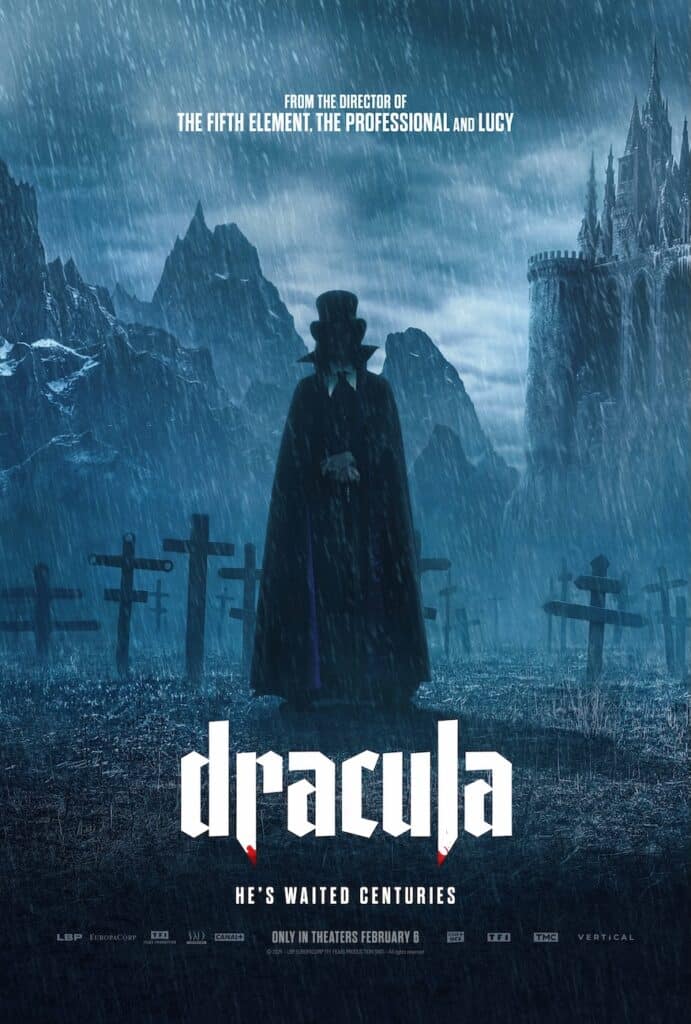
In recent years, there have been more Dracula reimaginings than one can…er, count, but the central fantastical horror yarn retains its transgressive allure. As does the work required to flesh out the courtly-but-deadly Count himself, for both actor and filmmaker. Director Luc Besson’s work with actor Caleb Landry Jones on 2023’s DOGMAN proved a surprisingly felicitous matchup, so their quick reteaming gives DRACULA: A LOVE TALE an immediate leg up. The establishing sequences in the late 15th century presenting Dracula as a skilled combatant fighting a Holy War; an anguished witness to the tragic death of his true love Elisabeta (Zoë Bleu, daughter of Rosanna Arquette); and a violent renouncer of God plunged into cursed immortality and bloodlust, all prime the pump well enough.
Besson’s screenplay title card specifically cites Bram Stoker’s novel—which, of course, got its own full-credit shout-out in Francis Ford Coppola’s BRAM STOKER’S DRACULA—and as such, this new iteration (being marketed without the A LOVE TALE subtitle) can’t help but echo that take. Even casual moviegoers will be put in mind of the 1992 film when Landry Jones materializes “400 years later” as an aged Dracula under a precariously towering ’do and mummified skin broken up by wet-whistle lips. Other moments unavoidably give off a sense of déjà vu from additional works; when captive Jonathan Harker (Ewens Abid) plays for time by exhorting his hungry host to recount his activities from the last few centuries, he’s brokering an interview with…oh, you know.
The latter cues some of the new movie’s best flourishes by Besson and most effective scenes for Landry Jones. This Dracula gets a glass-half-empty inversion, engendering empathy as he undergoes trial-and-error for years in attempting to channel his energies. Landry Jones deftly portrays the younger, passionate prince as well as the drolly seen-it-all (very) senior. These ruminations on longevity and purpose, in fact, prove far more interesting than the horror throughline. The intrigue with Harker et al. comes across as too prosaic; when the latter arrives at Castle Drac, the Count is quickly, matter-of-factly at his side in “Hey, wassup” mode. Recent works such as THE LAST VOYAGE OF THE DEMETER and NOSFERATU benefitted from dramatizing the humans’ desperate attempts to get over or around the supernatural doings; DRACULA: A LOVE TALE often feels as if the players in the story are overly cognizant of the game they’ve been dropped into.
Nowhere is this more apparent than with the character of the vampire-hunting priest—who is never addressed by any given name, let alone one with the initials V and H—played by Christoph Waltz. The actor is always a welcome presence, but seeing and hearing him here, with his puckish line readings and raised-eyebrow reactions, makes one long for a campier or more over-the-top approach. To that end, Matilda De Angelis compensates somewhat by enacting the transformed Maria as a manic celebutante, but she’s hardly a driving force in the narrative.
As the story progresses, one also comes to wish for more verve beyond the surface-choreographed mayhem and period pomp in Besson’s staging. A decked-out side trip to a carnival sideshow seems to have been imported whole from a Tim Burton movie, and adds naught. Some of the motifs and elements that fans look forward to in a Dracula flick are elided or omitted; the bite-downs are done traditionally with shot/reverse shots incorporating arched-back agony and then ecstasy, and there’s less gore—and certainly less spurting—than expected. The exception is an amusing but predictable decapitation scene that runs into overtime. The film itself runs over two hours; it never bores, yet the closer it gets to its resolution as the hunted-down Dracula strives mightily for eternal communion with Elisabeta’s reincarnation Mina (also played by Bleu), the more anticlimactic it becomes.
DRACULA: A LOVE TALE can’t be called a missed opportunity, but as its full title indicates, all concerned seem more enamored of the kiss-kiss than the bite-bite.




Where can I watch this movie
Luc Besson’s DRACULA opens in theaters in Canada and the U.S. on Friday, February 6, 2026.