
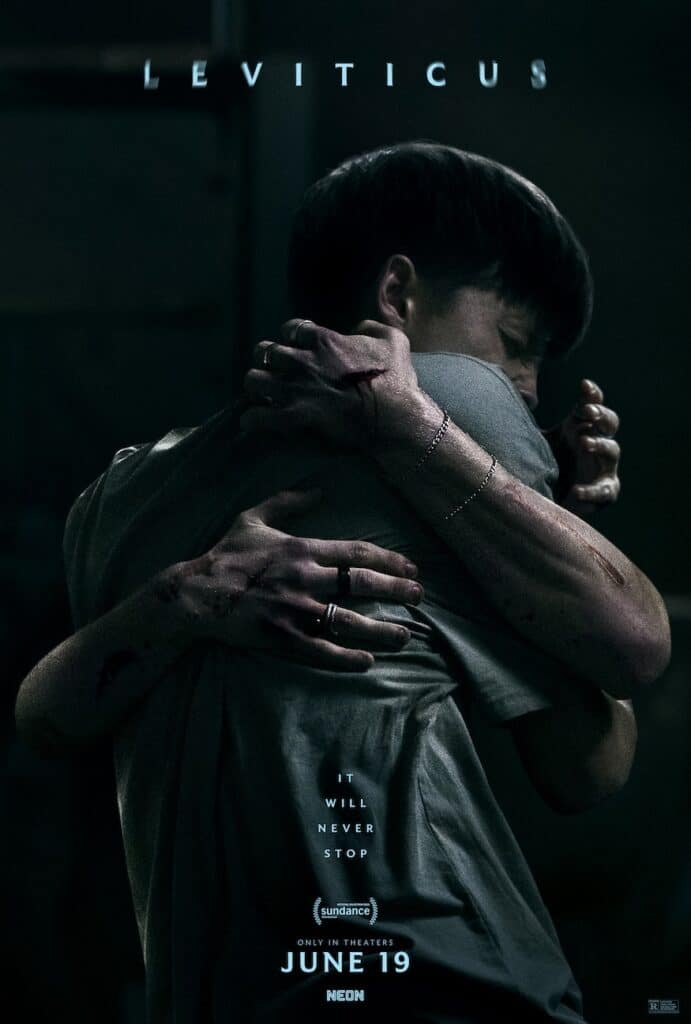
Australian filmmaker Adrian Chiarella has already gotten a lot of people talking about his feature debut, LEVITICUS, which hits theaters tomorrow from Neon. The movie explores provocative themes while delivering serious chills, and Chiarella discusses them below.
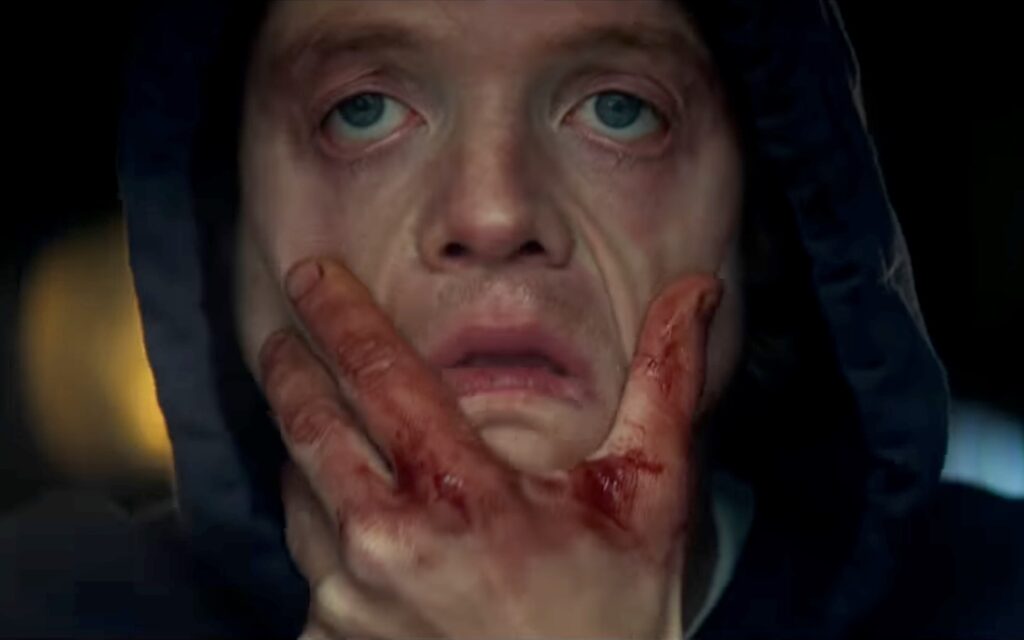
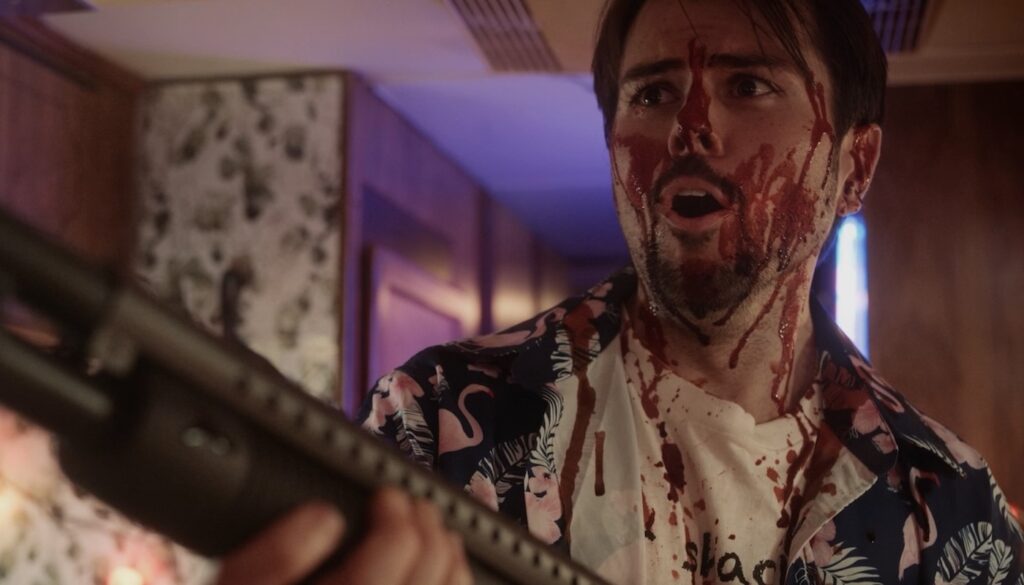
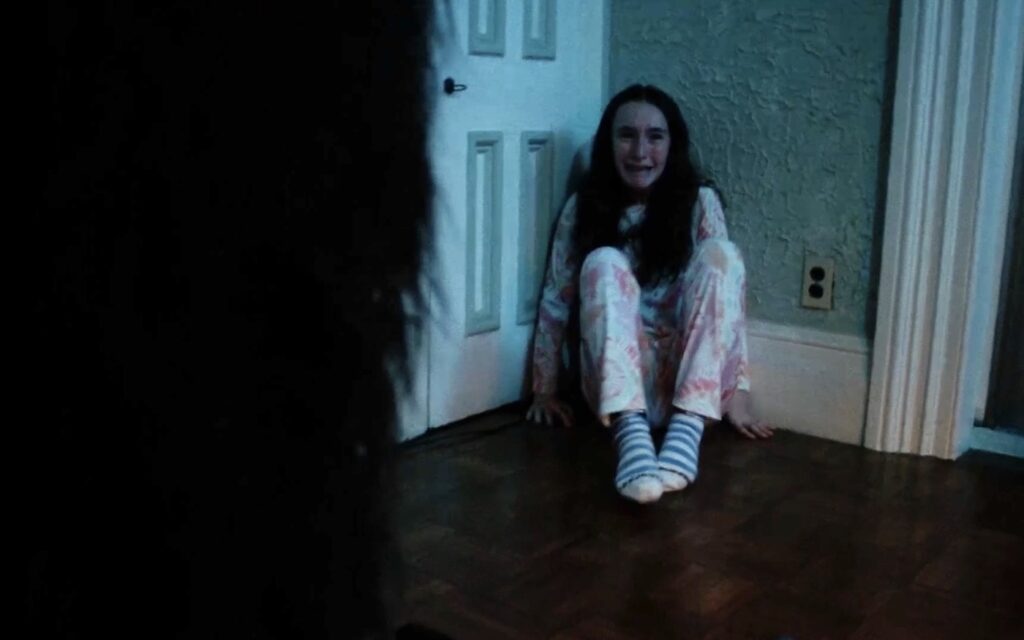
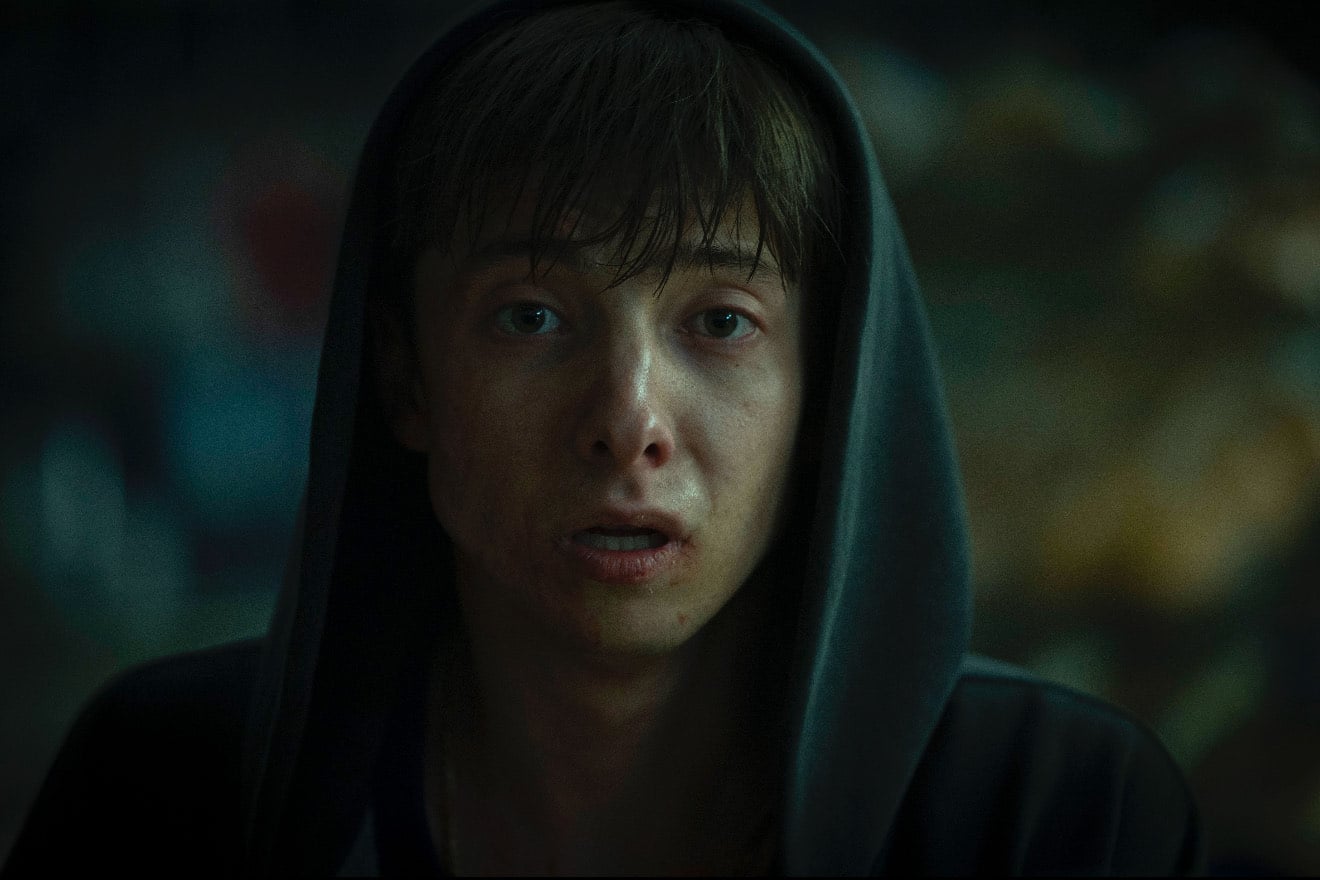
Joe Bird (TALK TO ME) stars as Naim, a teenager in a rural Australian town whose friendship with classmate Ryan (Stacy Clausen) has grown to be something more. That puts them at odds with the conservative and devoutly religious adults around them, and soon they face an even greater threat: a demon that takes the form of the person you desire most. How do you confront an evil that looks just like a person you love and trust, and violently attacks you? In posing and answering that question, LEVITICUS (also starring CRIMSON PEAK and ONLY LOVERS LEFT ALIVE’s Mia Wasikowska) becomes an affecting and deeply unnerving combination of the horror and coming-of-age genres.
LEVITICUS plays almost like a queer drama first and a horror movie second. Can you talk about combining those two genres?
Yeah, that was very much something I intended to do from the start. I wanted to make a movie where we explored homophobia, and homophobia is a type of fear, and horror is the genre of fear. That’s what it always does; it doesn’t matter if it’s a supernatural film or a slasher movie or some sort of psychological study. It’s about digging into the deep fears of the characters and expressing them in this genre that is a little larger than life. That is something I had always wanted to do with this story: put it in the genre that I loved when I was a kid growing up.
And it’s interesting: I learned as I got older, and began to understand more about movies, that I was not alone as a queer teenager with this love of horror. I think it’s something we all shared. There’s something in this genre about the exploration of otherness and of feeling a little destabilized when you’re on that journey of self-discovery.
Back in the 1980s, there was a lot of discussion about horror films having a subtext of teenagers being punished for their sexuality. And now, with movies like IT FOLLOWS and yours, the subtext is becoming text.
Yeah, exactly. Something you definitely notice when you grow up watching horror movies is that they are this genre where something bad happens because you’ve committed a transgression. You know, don’t feed this thing after midnight or don’t walk through this place at a certain time. And particularly in the ’80s, you’re right, often the transgression had to do with sex and sexuality. And then that started to lend itself well to a story like mine and other recent horror movies we’ve seen.
There’s also a great history that goes way back before the ’80s. A lot of our great horror masters were queer people themselves, like F.W. Murnau and James Whale, and they lived in a time when they couldn’t really talk about their experience in their work. So they took the metaphors and the story models of the horror genre and used them to express something that they felt very deeply. It’s always wonderful to go back and look at their work.
Were there any true cases involving conversion therapy that inspired the LEVITICUS script?
I had read a lot about exorcisms performed not just in Christian cultures, but all around the world—exorcisms performed on queer teenagers. Early in this process, I thought, “Well, maybe I’ll just do something like THE EXORCIST, but put this queer spin on it.” That seemed cool, but you need an idea that isn’t just cool; you need an idea that actually has some depth to it. And when I thought about a queer version of THE EXORCIST, it just felt like that would only perpetuate the myth that people were putting out there, that there was this gay demon inside of people.
So I thought, “Well, what’s the opposite of that? What’s the other thing that’s part of this?” And I came up with this notion of planting a seed of fear within these people, within these young teenagers. And the seed of fear was making them scared of their own desires. And that’s when the idea of a horror-movie monster that takes the form of the person you’re most attracted to emerged.
You could also say it derives from the fear of the adult characters regarding their children’s sexuality as well.
It’s very much about that, yes. And the fear that their kids might be somehow endangering themselves. LEVITICUS is very much a kind of cautionary tale toward adults, yeah.
I love the setting you found for it. How did you discover that bleak little town where all the action takes place?
Well, that town does not exist. It’s an amalgam of a whole bunch of locations we found. And that’s mainly because myself and our production designer, Bethany Ryan, and our DP, Tyson Perkins, had such a specific vision for what we wanted. We knew we were after a sense of a town trapped in amber, partly because we wanted an effect that we sort of spoke to a little earlier, of those vintage horror movies. We wanted any audience who was watching the film, no matter how old they were, to feel like they were getting a sense of nostalgia for their own childhoods. But also, from a narrative point of view, I wanted the town to feel like the kind of place that maybe boomed once. Maybe there were a lot of people in industry there at some point, but now, with all these faded industrial buildings, perhaps those people have moved away, but a lot of the ideas they brought to that land have stayed behind.
It’s interesting you brought that up, because when I was watching the film, I almost got a sense it was taking place in a past time. There are only a few scenes involving smartphones and such that place it in the present day.
That’s right. And our production designer and I, we didn’t want to date-stamp anything with too much technology. We were very sparing about the use of that for that exact reason.
Can you talk about the casting, specifically Joe Bird? Had you seen him in TALK TO ME, and did that inspire his casting here?
You know, I saw TALK TO ME back when it came out three years ago, and I was writing LEVITICUS at the time. And I remember when I was working on that script, I thought, “This is really exciting, but where on Earth am I going to find a teenager to play this role?” Because the more I worked on it, the more ambitious the part became, and the more demanding, just emotionally. And I went to see TALK TO ME and thought, “Wow, that kid’s incredible. What a scene-stealer.” But back then he was so young; he was only about 14 or 15 when he made that movie. And I left the theater thinking, “Anyway, back to my script. I’ll just go work on the next draft.” It didn’t at all connect for me.
But as soon as Joe sent his self-tape in for LEVITICUS, it was immediately apparent. He had this rawness and a very natural vibe that you don’t often see in actors of his age. Sometimes they are too undertrained or too overtrained; they just don’t quite feel like natural teenagers who still have the skill to carry a movie. So it was a very, very special and very meaningful find when we got him in to do his auditions.
What was the process of then finding the right actor for Ryan, where his and Bird’s chemistry was just as important as their individual performances?
You know, when I do callbacks for my auditions, I don’t just get actors to come in and do a scene for a couple of takes and then shuffle them out of the room. I like to get them in a group and spend a few hours with them, and do scenes that are in the film or maybe some that I cut out of the script and never made it into the final draft. Or maybe even do some improvisations, just to really explore the story with these actors and see what ideas they bring to the table. Stacy brought so much to the idea of playing Ryan, both in terms of the real Ryan and the dual-role element; he had to play the entity as well at times. And as soon as I gave him scenes to do with Joe, the connection between the two of them was so organic, so natural. It was just there. We didn’t have to do any work; we saw that spark straight away. Not only myself, but my producers, all of us, were very excited as soon as they were on screen together.
It was great seeing Mia Wasikowska in there too, and this is the first time I’ve seen her playing a mom. How did she come to the film?
I mean, I’d never even seen her carry a baby on screen before. So I was kind of like, “Is this going to work?” I saw her recent stuff, though, like BERGMAN ISLAND and CLUB ZERO and those independent films she’d done recently, and I felt like she was at a point in her life now where she could do this kind of role. I didn’t want a mother who was too old, because I wanted a sense that perhaps she’d had this kid before she’d really figured everything out in her life, and she was more susceptible to being pulled toward this kind of life.
She’s also an incredible actor with a wonderful, quiet intensity in everything she does, whether that’s movies like THE KIDS ARE ALL RIGHT or things that skew a little more toward horror like STOKER. She has always had that remarkable presence. I knew that this film was going to be very much focused on the kids, and the adults in this particular story weren’t going to get their own subplots or their own little scenes where we cut away to them. So I knew that Mia could bring the weight of this character and her history to the role with very little screen time.