By BILL REICK
You may not immediately recognize Joel Harlow’s name, but you are likely very familiar with his work. Harlow is responsible for the innovative makeup effects in some of the biggest, most successful movies in Hollywood history. His résumé includes credits on movies such as Pirates of the Caribbean, How the Grinch Stole Christmas, Star Trek (2009), Black Panther, and Godzilla: King of the Monsters. It’s clear, though, from just a glance, that Harlow is frequently brought back to work with the same people over and over again. His portfolio highlights a trust he’s earned over decades in the industry.
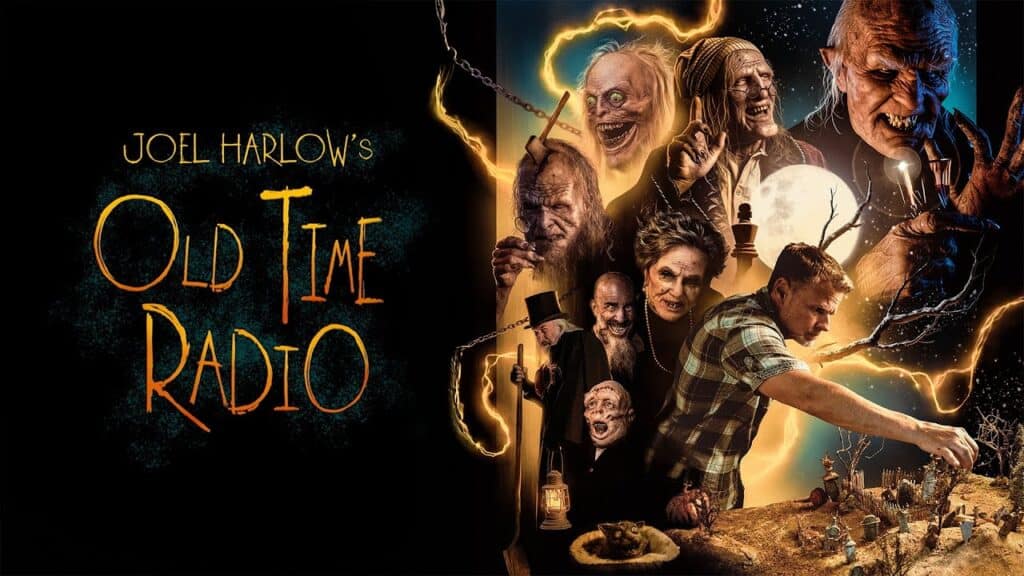
Now, Harlow takes the helm of his passion project, a series of new shorts titled OLD TIME RADIO (now streaming on Screambox), a throwback to the imaginative genre programs he tuned into as a kid. Recently, he shared with RUE MORGUE the inspiration, relationships and characteristics that sculpted his career.
Your work has long captured our imaginations, so it’s really a treat to learn a little bit about what goes on in your world. First, I’d like to go back to when you were a kid. I read that King Kong got you, but what are some of your other influences?
I was just one of those kids who appreciated art of a slightly darker cast, I guess. You know, fantasy art, specifically horror art, like comic books – Tales from the Crypt, House of Mystery, Tales of the Unexpected, Weird War Tales. I guess they all have to have “tales” in the title. All the artwork from those just sucked me in, and I knew very early on that [was the path for me], whether it was as a makeup artist or a makeup designer or a sculptor or an illustrator or painter, something like that. I knew I wanted to be involved in creating work like that, a darker but still fun kind of work, like “Haunted Mansion” kind of fun.
Disney Imagineers Mark Davis and Rolly Crump did a really great job of walking that line between dark and kind of “tongue firmly planted in cheek.” A lot of great gags.
Yeah. Mark Davis was a huge inspiration. Yeah, I like that expression. “Tongue firmly planted in cheek.” I’m gonna steal that!
Where did you grow up?
Grand Forks, North Dakota. The frozen North. And yeah, like you referenced King Kong. That’s where I first saw King Kong. Every Thanksgiving, they would play the original, so I’d eat, and I’d go downstairs and turn it on. And that’s back when you had to look in the newspaper to find out what time something was playing and on what channel. And it was always a treat like that. The excitement of Halloween had passed. So, the next exciting holiday coming up was Thanksgiving because of the yearly showing of King Kong.
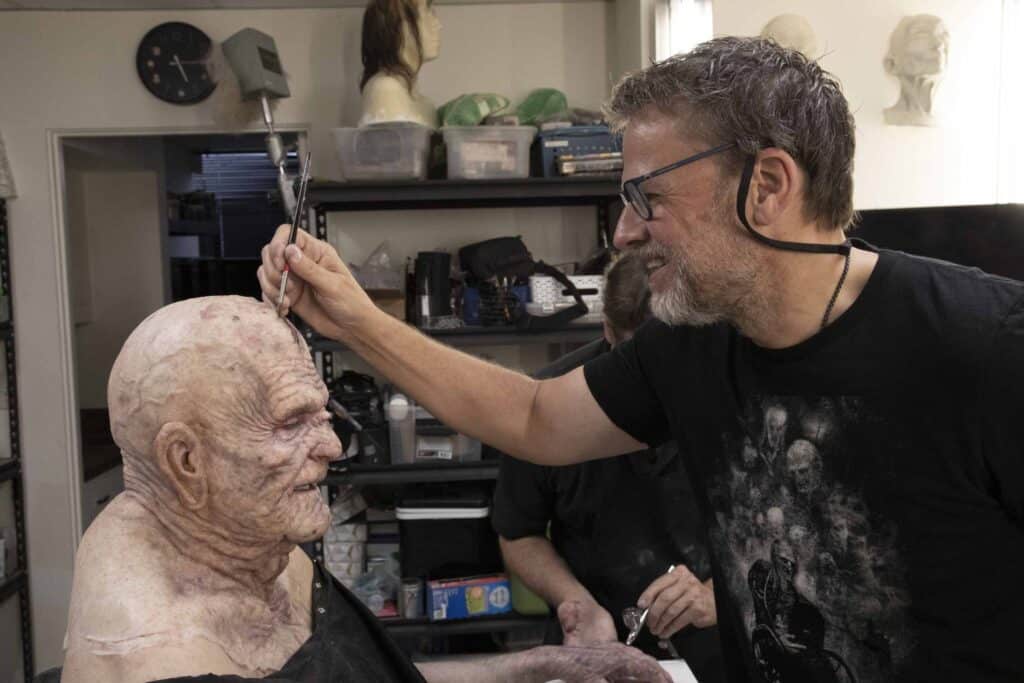
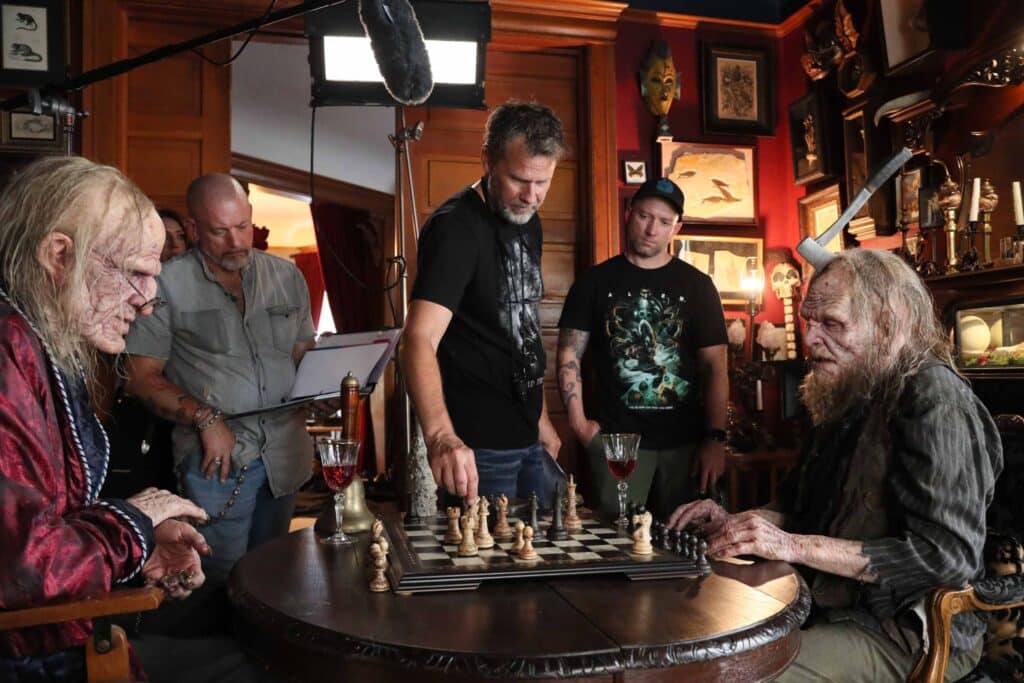
filmmaker and FX master Joel Harlow plies his ghastly trade on the set of “OLD TIME RADIO”
Was Halloween an early opportunity to implement some of your future craft?
Oh, yeah. Absolutely. I would do rudimentary makeups on myself and my friends, and if I wasn’t doing that, it was just sort of a magical atmosphere, you know, especially being in kind of a small town. You’d go to the five-and-dime, and they’d have all their Halloween stuff out and some bad masks, and the blow-mold ghost figures and jack-o-lantern figures. It was cool just to see some of that.
At the time, I thought it would be around forever, but now, it’s all on eBay and incredibly expensive. At that time, just living in that sort of environment, it felt really magical. Then, of course, growing up in Grand Forks, you’ve got a change of seasons. I’m out in California now, and now and then you’ll get a cold day when the leaves fall. But in Grand Forks, every autumn, leaves are falling, blowing across the road. Halloween, you run out there with your friends, and you hit all the good houses, and the leaves are blowing across the street. The smell and the feel of that time are still very much part of my DNA.
When you were a kid, did you have any early co-conspirators, or was makeup kind of a solo thing?
The makeup aspect of it was solo. But my parents had a Super-8t camera, so I’d pull friends into shooting little movies and stuff. And then later on, our high school got a video camera, so we’d shoot stuff with the video camera. But yeah, it was definitely me spearheading it, which is pretty similar to doing these short films. It all sort of stemmed from an idea, and then I pulled people into it.
I’m lucky enough that I get to interview a lot of different artists in the horror space, and they were usually the ones in their crowd who were pulling and dragging folks along.
How did you go from there to the film industry?
I moved from Grand Forks to New York because I was like, “I’m going to join the School of Visual Arts for animation.” Because at the time, makeup was out there, but I didn’t think of that as a possible career path for some reason. So, I thought, “Okay. King Kong… I like stop-motion. It’s probably the easiest way for me to create characters.”
And, really, that was the base of everything I did back then to get me going forward, to get me to this point, and still the base of everything I do now. It’s not about the makeup. It’s not about the techniques or the art form. It’s about making characters.
While I was there, a buddy of mine was down in Florida. I had gone to high school with him in North Dakota. He’d moved to Florida. He met a filmmaker named Tim Ritter down there and brought me down to do the effects.
So, I think there were seven or eight characters in this movie that were killed and brought back to life as zombies. Not very good, but fun and sort of experimental insofar as what we were doing. I went back to New York, got offered the opportunity to work on Toxic Avenger 2 and 3. So, I dropped out, did that, and that’s when I left school.
What were some early lessons that you learned about executing a prominent part of a larger vision in a feature film?
At the time, obviously, you don’t realize you’re learning lessons, but because you’re doing something low-budget, it’s really just about getting whatever the piece is – whatever the makeup is, a character – to film that day. The end of your race is the end of that day, and then you start a whole new race the next day. I think that linking those days together is a big lesson, setting yourself up to succeed, and learning from, ”Okay, this doesn’t work here, tomorrow I’m gonna do this, tomorrow I’m going to do that.”
Back when I was starting, I would use anything to get an effect. I did this movie in Florida called Woodshop for a friend of mine. And we had gloves that went up to mid-forearm. I’m thinking the guy’s going to be in a jacket. He shows up, he’s in a tank top, and these are bubbly molten arms, kind of Toxic Avenger-ish, and then it comes up to here [mid-forearm], and then it’s perfectly fine skin all the way up to where the tank top starts. So, I went to the craft service table, got that peanut butter and jelly combo mix, and just put that on there because the paint job was fairly similar. And it worked.
So, I think that was a good lesson. Just pull from whatever you can to get the shot. And that’s true now. When I’m sitting in the director’s chair, it doesn’t matter if this thing is going to last all day. It just needs to last for the shot. Same mentality, as it doesn’t matter if this thing is going to last a whole shoot. It just needs to last a day, and then I can address the problems and get it ready for the next day.
What do you value most in a collaborator? Is it having a specific vision, or is the ability to articulate more valuable?
I come with a pretty strong vision. I think if your collaborators can’t work with you, then they’re not really collaborators. But I do appreciate, in talking about these films specifically, people bringing ideas to me. I’ve got a buddy named Rod Maxwell, whom I bounce ideas off all the time. We’ve got a very similar sensibility when it comes to these films – this sort of light-hearted horror touch. He leans more towards the softer things, happier, not as horrific works. But when it comes to this stuff, he has a good sense of comic timing. That kind of back-and-forth collaboration is very important because you can come up with an idea and write yourself a treatment solo, but unless you start getting feedback from people, it kind of stagnates. So, I think collaboration is probably paramount.
My favorite part of the A Chronicle of Craetivity, the documentary about the making of OLD TIME RADIO, was how familial everybody felt. You can tell that there was a real love, not just for what was going on, but also for the people. It seemed like you’ve really earned the trust of a lot of people over the years who were willing to put time into your project now. That was really beautiful to see without anybody having to come out and declare it.
I do consider them family. Nobody is an island. I couldn’t do any of these without the support of a lot of really talented people giving their time and skills to help me bring these wacky ideas to life. It’s very humbling, and I don’t take any of it for granted. I owe these guys, because if nothing ever comes from these, I still have them as a personal high point in my creative life. I’ve still done it, and I’m happy with it. And the people who help, that means a lot to me, and by extension, they are dear to my heart.
In addition to your years of experience, what has changed that you now put yourself behind the wheel, directing these shorts?
I think I’d always wanted to. It’s all about character. Back when I was designing characters in my room in Grand Forks, sculpting a character on somebody, seeing it come to life. That was, through most of my career, the height of the Frankenstein complex: seeing your monster live. And with OLD TIME RADIO, I not only get to do that, but I also get to take that character, add it to a mix of other characters and let them play off each other – put them in an environment, give them a story, give them an objective. It’s just a more complete version of creating characters, I think. Actually, that’s the first time I’ve really put it into those words, talking to you right now.
I think it is the culmination of creating a character, not just building it and seeing it move, but also giving it motivation, direction and personality with the help of the performers, and then tying it into a 10-15 minute film where there’s a bit of an arc.
That must be different from a lot of other projects in that the character design shapes the story.
Yeah. There have been times, certainly on the bigger prosthetic makeup stuff, when it’s like, ”Okay, this character lends itself to this, or it has to have these traits.”
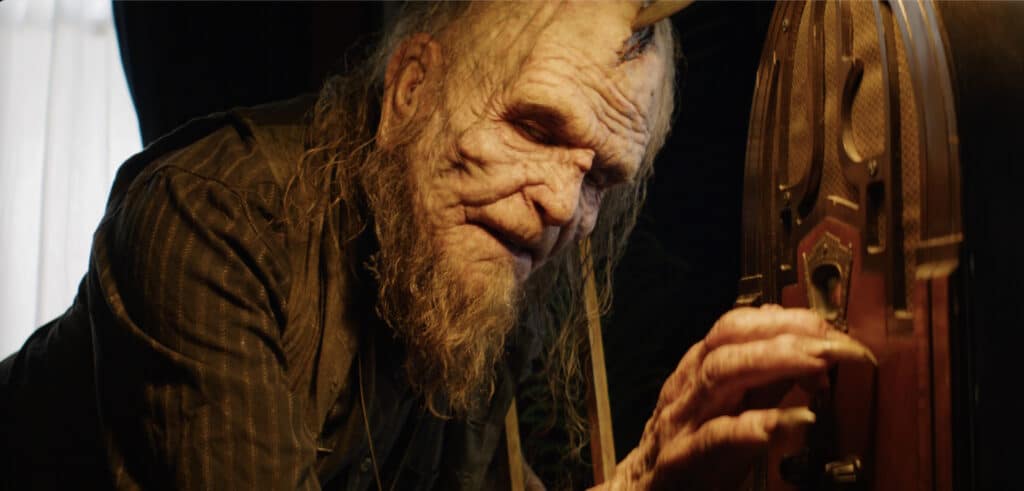
But in OLD TIME RADIO, since I’m steering the ship, it all develops at the same time. The character anatomy, the aesthetic of the characters and the motivations of the characters all develop simultaneously and in unison.
In my day job, I design a character with a lot of input from a lot of people, and that character then leaves the nest and goes and does its thing on set, where I can make suggestions, but I’m not in control. It’s not that I’m a control freak; it’s just that my contribution ends after the character leaves the makeup chair.
This must have been very refreshing to not have your contribution end after the application.
Yeah, it is. Absolutely. Plus, I think it’s made me better as a makeup designer because doing these films and designing these makeups and characters for what I know they’re going to do, there are things necessary to build into a character and things unnecessary that you’re never going to see. Rather than overbuilding and letting the budget spiral out of control, now, I’m more attuned to, “Okay, this character is going to do this, this is the environment, this is what we’re building towards.” We’re not building towards, like, “Let’s take this guy in full makeup to Denny’s and let people study him up close,” because that’s never going to happen, and it saves production time and money. That’s a lesson.
I also heard you say a takeaway from these projects is that you learned to let go a little bit. Would you elaborate on that?
I’ve done five of these now. One is in post because it’s got over a hundred visual effect shots, and it’s the Halloween one. But there are four that are done. The first one, I shot myself down in the basement. The second one, I shot at the house, and I brought in the Edward character and got a proper crew. I was pretty rigid in that, “I need this reaction shot, I need this reaction shot,” because it’s a silent movie, basically, and all about the reactions. I think the performances suffered because of that. I had to really cut it when I was editing, to find little beats that fit in, building a character that I had in my head that I never got on set.
The third one, which I think is the funniest, “Dance With Me,” I let go of that a lot more …. Letting [the actors] riff off each other, I found a lot more of those moments that build their performances.
It all informs itself, doesn’t it?
It does. Absolutely. You can’t let it go completely, obviously. It’ll spiral out of control. It’s like fishing. You let the line go, and maybe that’s a horrible analogy, but you let it go a little bit, but still hold on to it. Maybe that’s it.
You gotta allow the bigger fish some slack.
And ultimately, you’ve got to reel it in, which is the completion of the project. But there’s some beautiful stuff that happens as it’s swimming around out there. At the end of the day, you’re reeling it in, but for most of the day, it’s doing cool stuff, and the closer you keep it to the ground, the less cool stuff the wind’s going to let it do.
OLD TIME RADIO… All radio is old-time now. Talk to me about the Lights Out radio program.
Lights Out was awesome. In Grand Forks, my dad and I would walk to the public library, and they’d have cassettes of old radio shows, and that’s when I discovered Lights Out. “The Chicken Heart” was crazy, and that one always stuck with me. Because I like that weird horror element so far out in left field that if you were pitching it, people would be like, “What are you talking about? It’s like a chicken heart?!”
My dad, in the documentary, was like, “It’s like The Blob.” I’m like, “Yeah, it is like The Blob, that makes sense.” Lights Out, Suspense, I’ve always been a Lovecraft fan, and Suspense did a version of the Dunwich Horror that was fantastic. Ronald Coleman narrating from the base of Sentinel Hill as Wilbur Waitley’s twin, being sort of rebuked by Armitage and the gang. Even with the sound effects and all, that just lets your mind run wild. I go for walks listening to soundtrack music, coming up with a bunch of ideas, stories, whatever. I come back home and write them down. It’s letting your mind sort of fill in the blanks. Radio is beautiful because it guides you, but doesn’t put it in a box.
That paints a beautiful picture of a kid listening to these things and growing up and showing the world that imagination. That’s really neat. You mentioned going on walks and listening to soundtracks. Any particular composers that really strike your fancy and inspire you?
Yeah. actually a composer that I listen to a lot is not specifically a soundtrack composer, although he’s been on soundtracks, is Lustmord. And if your readers don’t know who Lustmord is, I highly recommend listening to any of his albums. It’s very cool. After this, pop on “Heresy” or one of his albums and give it a listen, and you’ll know what I’m talking about. I think they use some of his work in The Empty Man, like at the beginning in the Tibet sequence, where they’re up there in the snow. There’s some of his music in that.
So, that’s in the conception process. When you are in the process of building out a vision, is there a type of music that you prefer?
It all depends on what the story is. Granted, everything I’ve done has been lighthearted, but I have stories that are very dark. If the story requires something playful and happy and still darkly fun, then it’ll be a different composer. Usually, it’s soundtracks. Certainly, I could say John Williams, and there are multitudes of people who would agree with me, and I love John Williams, but there are also more obscure composers who, depending on what I’m trying to think of, will get me going in that direction. Sometimes I’ll just put on John Williams and come up with stuff. But John Williams’ problem with coming up with ideas from his scores is that his soundtracks are so iconic that they don’t allow me to venture outside of that. If I hear Raiders, I’m not thinking of a couple of guys driving to the grocery store. It’s like I’m thinking of Indiana Jones. He’s the voice of the soundtrack of a lot of people’s childhoods, including mine. That’s so ingrained that it doesn’t allow me to venture outside. But it is great if you can’t watch the movie, you just listen to it, and it all comes back. It’s like radio in that sense.
Absolutely. But too evocative for creating. Next thing you know, you’re molding a fedora by accident. I think a lot of people who read these kinds of things are looking for those little tidbits… “Maybe I’ll go ahead and listen to that.”
What do you think is the most valuable thing that you are able to impart at this juncture in your career?
 I would say, if you have an idea that you want to do, do it. Don’t wait to perfect it. Just do it. I wish I had started making films much earlier, because I had ideas for them going way back. I just wish I had done it because I think I would be farther along, not in the sense of a career, but in the sense that I could have created more stuff by now. That’s really why I’m doing it: to create things. I’m doing it because I love it, not because I want to get something from it.
If you have an idea, even if you don’t feel like you’re ready, pick a day. That’s what I always do. “This is when I’m going to shoot this,” and everything starts funneling into that day because you have no choice. The second you start booking people, you’re going, regardless of whether you’re 100% or not. And you’ll never be 100%. Get ready, also, to problem-solve because when you’re not 100%, you’re going to have to spin on a dime. “Okay, we need this, we need this.” The last one I did, I had Scott Ian of Anthrax for two parts in the interior of the house, one part at the door, and then one part at a set further in. I was shooting from the first set and building out. It was taking a while. It always takes longer than you think. He wasn’t going to be able to be around because of prior commitments for the exterior stuff. So, I had to pivot and alter what I was going to do with him in the first scene to make everything else work. It actually works better now than it would have worked if I got both those pieces. It would have felt too much.
Just be prepared for that. Put your problem-solving cap on because that’s all this is, just solving problems. You’re going to be presented with a lot of problems. You’re going to have to be able to solve them and get people going in the right direction. People are going to head off in the wrong direction. You have to pull them back and make sure you have a good team around you because they’re the ones that will make your vision come to life. There are so many lessons: Be collaborative. Don’t be too rigid. I learned that one firsthand.
Sounds like a lot of that TROMA rulebook still rings true for you, even all these years and projects later.
Yeah, that was very collaborative, the TROMA films. Definitely a lot of problem-solving too. You’re not waiting around.
It’s like, okay, you’re going. That extends to just getting through the day. Your goal is to get through the day. That’s your finish line. The next day, another finish line. You can run that race tomorrow.
How do you move a mountain? This is a good metaphor. You don’t move the mountain all at the same time. You move it one stone at a time.
How do you stay in control without being overbearing in a situation like that?
Personality is a lot of it, and temperament is a lot of it, and appreciation is a lot of it. It is a lot of pressure, a lot of stress. But just remember, everybody’s there to help you. If you can’t hold all those strings, share that weight with somebody you trust, and they can help … It all comes down to that one point, which is the day you shoot. Once you get through that day, you can let it all go. It’s about getting through that day.
Are you conscious of or do you do anything to honor that little kid in North Dakota going to the five-and-dime? Do you think there’s any sort of connection to that childlike wonder that helps drive a project?
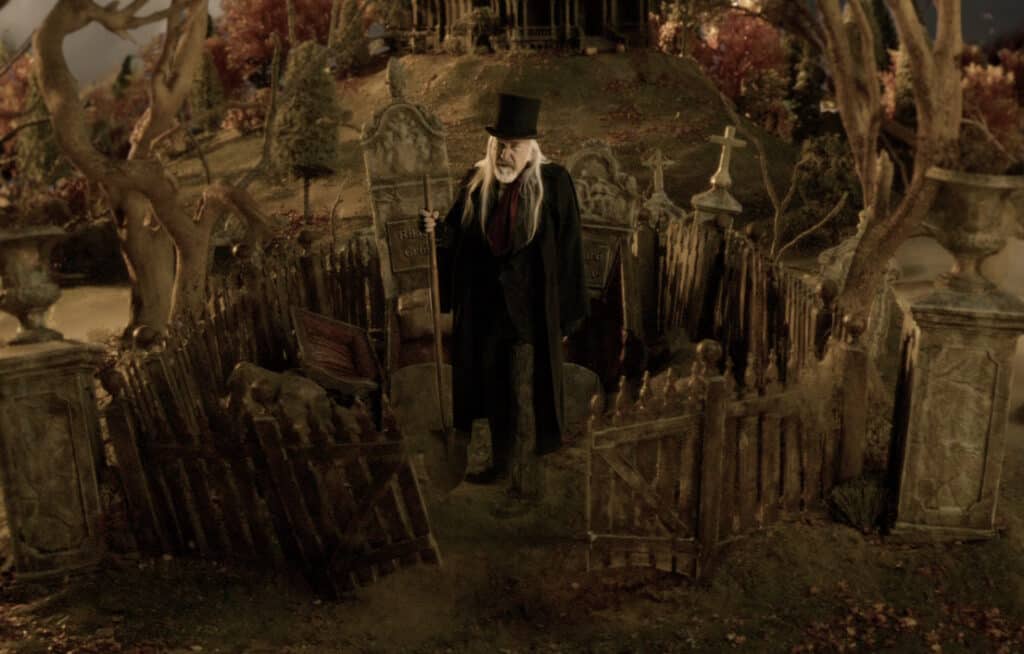
All of these films are created by that kid. This is that kid’s childhood. I don’t know if that’s one of the reasons I use those old songs, but it is an attempt to take all the things I loved as a child, miniatures, puppets, makeups, EC horror, creepy environment, Tales from the Crypt, and put them into my love letter to my childhood passions – Bernie Wrightson, Richard Corben. Every frame is an homage to that kid. The whole thing is honoring him. Trusting that the adult version will take care of the insurance and all that. I see stuff on set as it’s coming together, and it’s like, oh, this is cool. If it wasn’t exciting, I wouldn’t do it. I could make a living as a makeup artist creating characters, and I love that. But these films are my reward to myself, and I share them with people, hoping they like them. Still, I’m making them because I want to see them. It’s my sensibility. It’s more for that childhood version of myself. They aren’t overly violent, overly aggressive. They’re very family-horror. Cool, fun characters, lots to look at. It doesn’t get bloody. It keeps on the family side of that line.
We were talking about how, on a lot of projects, your role ends at the makeup chair. What’s the most surprised you’ve been to see a performance enhance the work that you’ve done?
Baba Yaga in Hellboy, the David Harbour version of Hellboy that I did. Troy James, you know, goes on Instagram as Twisty Troy. Contortionist. He has all of those skills, right? Being able to move his body in weird ways and creep you out and everything. And I saw him, I was like, “Oh, I want that guy to be Baba Yaga.” I presented it to production. They were like, “Yeah, all right, cool. Bring him in.” His part got much bigger. It was just supposed to be a couple of beats of him being a monster. There was actually some acting that needed to happen because of the script once we got there, and we’d gotten everything made, and he hadn’t really done acting, at least not that I was aware of. But when I saw him actually giving the performance on set, I was like, “Wow, that’s great.” You don’t even need the twisting contortion gimmick because his performance is so good as it is. That gimmick is almost, I thought, kind of taking away from what he was delivering just as the character, without throwing his arm behind his head and all that business, walking crablike on his back.
With a project like that, or any of the more IP-based projects you’ve been involved in, is there still a kick that you get out of nailing a design that’s been a longstanding thing, or do you much prefer going from scratch?
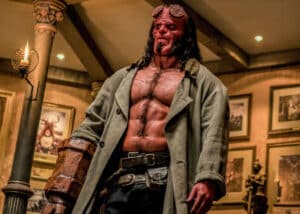 It’s both. I do want to be able to bring my twists to something. Maybe it’s going from scratch in that sense. In my version of Hellboy, I changed a few things. I gave him hair on his chest and arms, and the Hand of Doom was more hexagonal in shape as opposed to round. But yeah, it’s cool to be able to nail something that resonates with the fans. I do like creating my own characters. Like Evil, the TV show I did – monster of the week, demon of the week. I would pitch things. Let’s do a version of Dick Smith’s goat with the multiple eyes from Altered States. And I did that as one of these other characters with the five eyes and a goat-kind of head. Doing that stuff was tremendously satisfying.
In addition to learning to let go, how do you feel that your continued work on OLD TIME RADIO will inform the rest of your work? Do you feel that having this outlet opens your eyes to anything new in the other work that you’re doing?
Absolutely. Doing these and knowing what it takes to get something to a screen is tremendously challenging, and it’s given me a whole new appreciation for all the other departments I have to work with on these bigger productions. The lesson is that no matter what you’re doing in the shop, what you’re building, what kind of character you’re creating, it’s just part of the character-creation process. It’s going to go to props, wardrobe, hair, environment, whatever it is. Building, not overbuilding, and making it more collaborative is important. Building something in the shop does get very solitary; you’re there by yourself, or you could be there with your crew, feeding off each other. That thing has to leave the shop and go on to do what it was designed for. It’s better to bring in the rest of the people who are going to help it do that at the beginning than waiting until you’re done … That’s a lesson I probably should have learned a long time ago, but it’s reinforced by doing these films because if something isn’t going right, as the guy dictating what the characters, ultimately, are going to do on set, I can say “Okay, well, I wish I had done this, I wish I had done that.” I don’t want to put any other director in that position. Collaborating sooner than later is probably the biggest lesson.
Folks (myself included) who enjoy these OLD TIME RADIO shorts on Screambox right now, might they be seeing some more of them soon?
Yeah. I just finished the fifth one, which is a Halloween episode. Exciting. If that’s the last one I do, the problem is that the industry sucks right now, where we are in California, and even in the other states. I don’t have back-to-back projects or multiple projects at the same time like I used to, which would sort of feed the “Jet Ski Fund.” And the “Jet Ski Fund” is this pot of money that I pull from to make these films. Now, that goes to mortgage, car payment, all that stuff. If this is the last one I do, I really want to make it sing and make it really stand out. So far, it is. It’s fun. It’s a good one. And it’s Halloween, which is that environment I love. We’re shooting in Los Angeles, but I got fake leaves from Etsy and put them on the porch. Anything to make it feel like childhood memories of mine of Halloween in North Dakota.
In your work, primarily, is there anything that you haven’t done that if you don’t get to, you’ll regret?
Yeah, there are so many things. A lot more ideas, a lot more stories. In the OLD TIME RADIO world, I wanted to do a Lovecraftian piece next. If I get to do another one, it’ll be specifically Lovecraft-based with the same character. I’m thinking of bringing Lovecraft himself into the mix, which might be kind of fun.
Even though I made OLD TIME RADIO for myself to scratch an itch, I don’t want to keep them for myself. I want to share them. I know people have appreciated them, and I hope readers will find them. Give them a watch! They’re not that long. If you enjoy them, watch the next one. Hopefully, it turns into a way for me to keep making them.
Joel, before I let you go, do you believe in ghosts?
I do.
Do you have a story you could share?
After my first semester of college, I went back to Grand Forks. The house we lived in had a basement with storm windows at the top. In winter, they’re completely covered by snow, so no light comes through. My buddy and I had gone to see Pee-wee’s Big Adventure. Came back, turned on the TV, and we were sleeping on the couch. My friend fell asleep at the far end, and I was at the other end. Lights out. I woke up, looked down the couch and saw a figure standing. It was a white luminescent figure, made up of geometric shapes floating in front of each other, in the shape of a person. I looked around for light, but there was none. I could see the red light from the smoke alarm. I got up a little bit. I was on the floor next to the TV. I looked at it and went, “What?” It started moving. I got up, turned on the TV to fill the room with light. By the time the TV came to life, it had passed into another room, and that was it. I went upstairs. It was the middle of the night, no light coming in. That was it. It didn’t do anything. It was like, “Sure,” but still a lot. We had smoked a little pot before…
You’ve got to open the story with that.
I don’t think that’s what it was. If anything, it put you in touch with the veil.
Joel, may your days continue to be mellow.
Joel Harlow’s OLD TIME RADIO and OLD TIME RADIO: A CHRONICLE OF CREATIVITY are now streaming on Screambox.