
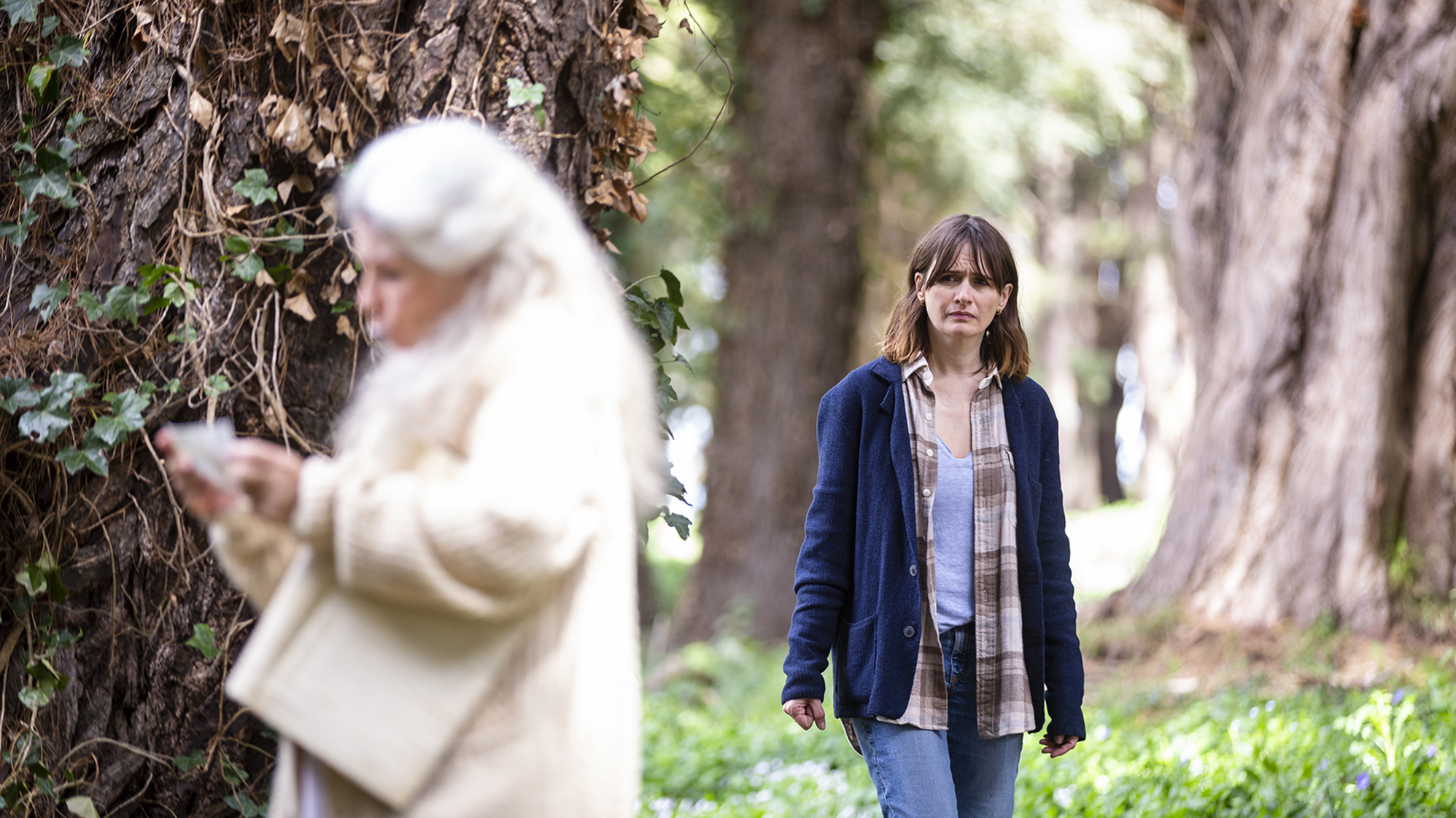
Much like the most recent heavy-hitters in the horror world, RELIC deals with heavy emotions, family dynamics, and pulls no punches when it comes to exposing primal fears. Director and co-writer Natalie Erika James discussed with us the personal experiences that lead to the creation of the film, and how she built a film that will make you both scream and cry.
How did the idea of RELIC come to you?
It was born of experiences I had with my grandmother. Those moments of uncanniness or fear that you feel when having a loved one decline. Obviously the events in the film are heightened. Luckily she wasn’t aggressive at all, but she did sometimes talk to people who weren’t there. That was always really unsettling. It made me think that the horror genre was the best way to tell the story. It was specifically this trip I took to visit her in Japan. It was the first time she couldn’t remember who I was. I was living in Australia at the time, so I had a lot of feelings of guilt for not having seen her more regularly. She lived in this quite scary, traditional Japanese house, that I had always been terrified of as a kid. It was the combination of that setting and those feelings that was the genesis of the idea of RELIC.
Were you frightened of your grandmother on that trip?
No, it was definitely more sadness. I also had this sense about the town itself. It is a small, rural town in Japan, and it felt like there were other things in town that were on the decline. Like shops that I went to as a kid were in stasis. Most people had moved to the bigger cities. I was taken by the atmosphere and the sense of loss in the town as well as in the dealings with my grandmother. It wasn’t fear of her, but a fear of what was to come and the transformation.
Did making RELIC then feel cathartic for you?
I think it helps with how you process emotions. Writing in general can do that for you. Certainly process the grief, but also the shifting dynamics in family members too. In writing this, I certainly had moments where I was moved to tears. When it affects you that way, hopefully you are hitting on something truthful, or emotionally truthful. I think it can help guide you, as well. There are certainly a lot of elements vying for your attention, but there were scenes with Edna (Robyn Nevin) where I would be crying behind the monitor. So you are not immune to it, even when you are trying to intellectualize it.
Going through this process helps, but it doesn’t make it so that your problems are solved.
Particularly because my grandmother only passed away in November of last year. It was just after we found out we would be screening at Sundance. My parents came to the premiere, so it was all very wrapped up.
For as much as RELIC is a haunted house movie, Edna is essentially a haunted person too. The parallel between her and the house is fascinating. Did these elements come through development together, or were they paired later?
It was there from the beginning, in terms of the house deteriorating. As far as her being haunted, I think that is apt. When you have Alzheimer’s you are almost existing in other timelines, which is what ghosts are. People from the past coming to the present. In some ways, Edna exists in the past and the present simultaneously. That has an unsettling, uncanny ghost-like quality to it. There was some consideration about which came first. Did it grow from Edna into the house? But, in the end, by creating this mythology of the great grandmother in the cabin, we reversed it. The mold from the relic invades the home first. That infused the house, and then contaminated Edna. It’s funny to talk about mythology, because when you get to the nitty gritty it can quickly fall apart. Supernatural mold? What the fuck is that about? [Laughs] It’s more of a visual motif that is mirrored in Edna as well.
“It wasn’t fear of her, but a fear of what was to come…”
How was the casting of the film? How much rehearsal did you get with them?
There were offers and we had them in mind from the get go; there was no audition process. I was able to meet with them all individually in the states and chat through the script, but also share life experiences. Develop a language together of experiences and emotions, so that when you get on set you have had that dialogue already. That was most of the process prior to the film. Emily’s (Mortimer) flight was delayed, so I think she only had two days with us before we started in earnest. I don’t do a lot of rehearsal. There were bits and pieces that we rehearsed, but I think it is more about the actors working together. Most of the work happens on set. I will say though, that Robyn went to go see an Alzheimer’s ward. This was research, but I don’t think she found it very helpful. It was more about taking it moment-by-moment than trying to emulate a performance.
With the times we live in, very few people will get to see RELIC in a theater, with an audience. Seeing haunted house films in your own home are extra creepy, but cinema is also a social exercise. How do you feel about us consuming this in a different way than you thought we would be?
There is something really nice about taking in a horror film in the darkness of a cinema. The darkness just plays with your primal fight or flight response. Maybe the fact that there is no escape or no distraction. And experiencing it with people is really nice too. But you can recreate the experience at home, and we are playing at drive-in theaters as well. I’m really curious to see how people will consume the film, and what will make it more effective and scary.
I personally won’t be watching it because I cannot handle watching my work. It is a personal quirk. I watched the Sundance premiere, squeezing my partner’s hand the whole time.
Are you a horror fan?
I’m a massive horror fan. I’m interested in doing other things as well, but everything I’m writing is in a subgenre of horror. One is a folk horror, one is a demon horror, one is a body horror. I think that is just how my brain processes things. I’m interested in the tropes of horror subgenres and using them, or embracing them, or subverting them. I watch a lot of horror.
Were there any films you had in mind as a reference when making RELIC?
I think the closest would be THE ORPHANAGE. They are very different films, but the emotional impact of the end really hits you. It has its freaky moments as well. I was always a massive Cronenberg fan, so some of the practical effects were probably influenced by him.
What are you afraid of?
The non-serious answer is magpies. They swoop at you, and they’ve got big beaks. I used to have a lot of fears as a kid, and a lot of nightmares growing up. Mostly to do with the supernatural and ghosts. Everything I’m writing has something to with what I’m afraid of. That’s why horror is such a great vehicle to explore those stories. In RELIC, it is the fear of your parents’ mortality. In what I’m currently writing, the folk horror, it is the fear of motherhood. That’s the more serious answer.