
For Richard Kelly, the easy way has never held much appeal.
Picture this: It’s the late nineties, eve of a new millennium. Our aspiring writer/director is twenty-three-years old, fresh out of University of Southern California film school, living on Hermosa Beach, and working as a client assistant at the boutique visual effects studio 525 Post Production, in close proximity to glamour but hardly glamourous. Kelly, for example, once made Madonna a cappuccino and cheese and cracker plate during the composting work on the classic “Ray of Light” music video.
He’s feeling intense pressure to make good on the promise of his degree from a prestigious institution with towering marquee-dominating alumni such as George Lucas, John Carpenter, Robert Zemeckis, Ron Howard; to gain entrée into the showbusiness he sees just tantalizingly beyond cheese and cracker plates.
A more cautious artist in similar circumstances would likely hedge their bets, dream a bit smaller, pursue perhaps a second-tier franchise sequel or a highly contained narrative with a micro-cast set in one location, maybe two, tops.
Instead, Kelly sat down and wrote a bold, sprawling, epic screenplay tossing his lot in with a Twilight Zone-esque conceit of a jet engine falling out of sky and crashing into a suburban bedroom; with parallel realities and tangent, alternate universes; with a boy struggling to navigate teenage life and late 1980s American society even as he discovers he is the one entity standing between life as we know it and a catastrophic, existential black hole destroying everything we’ve ever known and loved.
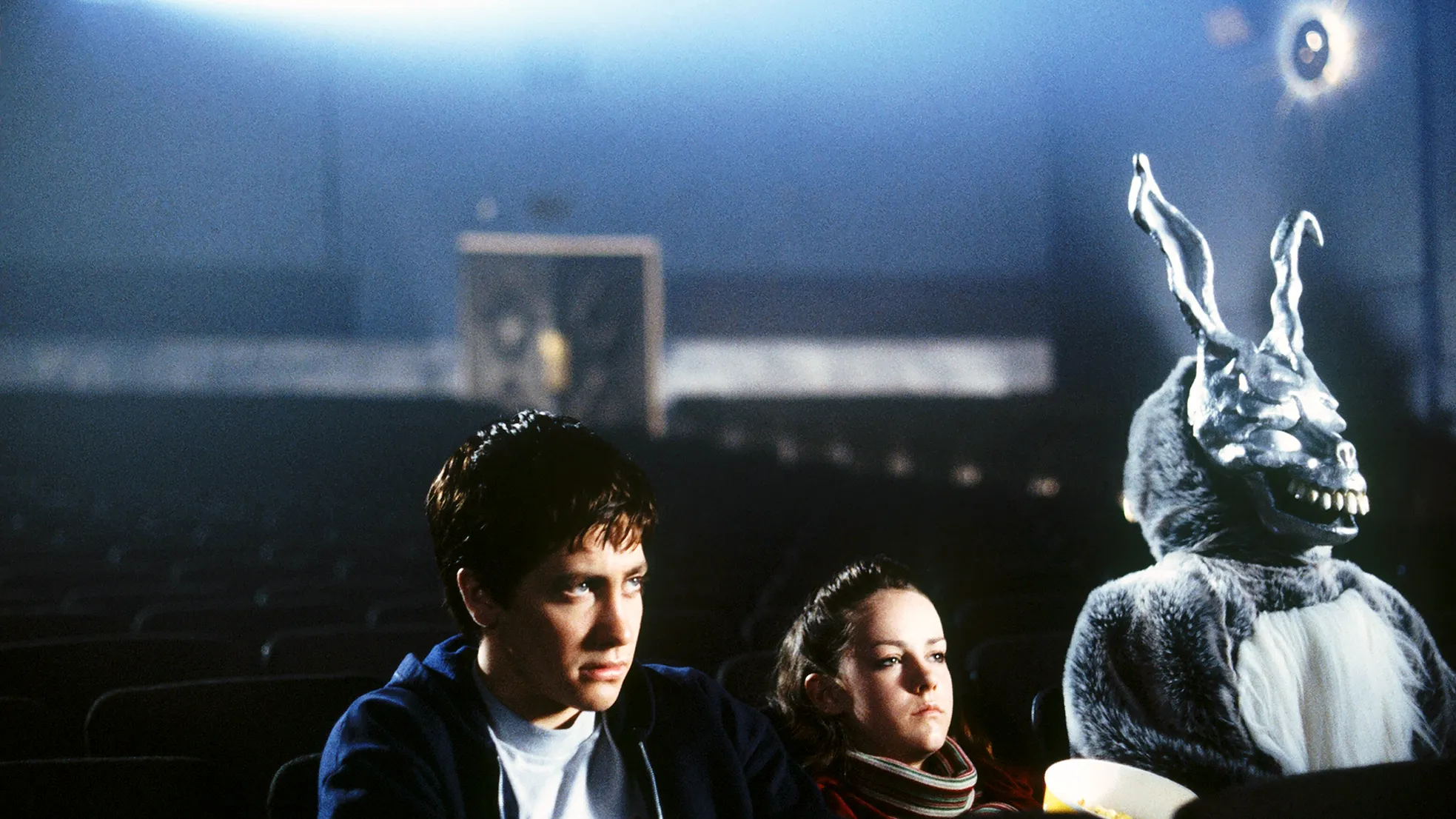
The result was the 2001 cult classic DONNIE DARKO, an intellectually provocative, reality-refracting, timeless and utterly unique mélange of sci-fi, coming of age drama, and deep, fourth dimension-skating philosophical thought experiments.
Now, as the film returns to theaters this weekend (October 2-4) for 25th anniversary screenings, the auteur is himself jumping between timelines.
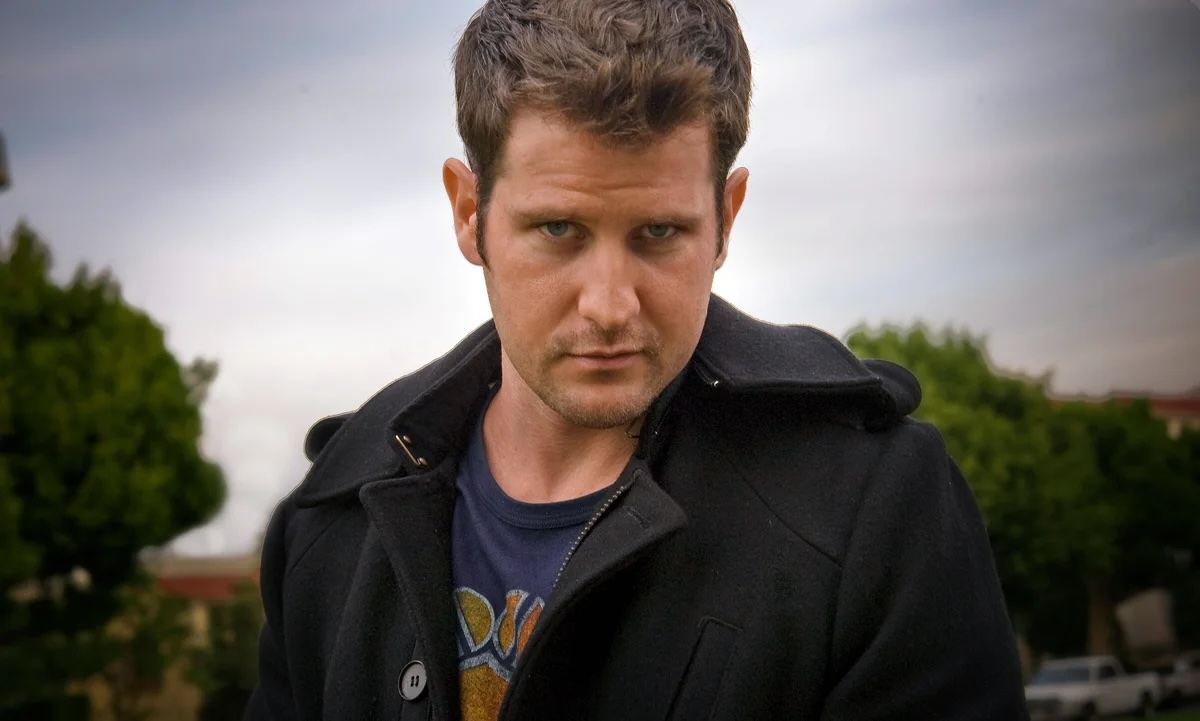
“DONNIE DARKO continues to speak to me, you know?” Kelly tells Rue Morgue from a hotel room in Santa Monica. “This story is still very much alive in my mind — probably more alivethan it’s ever been in many ways. It doesn’t feel like this thing that is decayed or stuffed with mothballs.”
It’s true: A quarter century on, DONNIE DARKO remains the quintessential never-step-in-the-same-river-twice film. Each viewing unlocks new epiphanies and conundrums as well as different frequencies of resonance to our own lives, hopes, fears, and quests for meaning — and Kelly is, somewhat paradoxically, both author of and participant in this dialectic.
“Those days I was on set with the actors and crew shooting are cauterized into my memory in such a significant way because we were united making this really intense piece of art,” Kelly says. “So, in one sense, the movie as a project is tied to a very specific moment in my life and also — as a movie set in 1988, shot in 2000, and released in 2001 just after 9/11 — to very specific moments in history. A time capsule. In another sense, the story itself is a separate narrative that I’m still wrestling with and reevaluating 25 years later — almost as if the movie is evidence left behind by my younger self for present day me to discover, if we want to make a time travel metaphor out of it. Which I guess is appropriate… I feel like I’m still finding like Easter eggs that I subconsciously hid for myself all those years ago.”
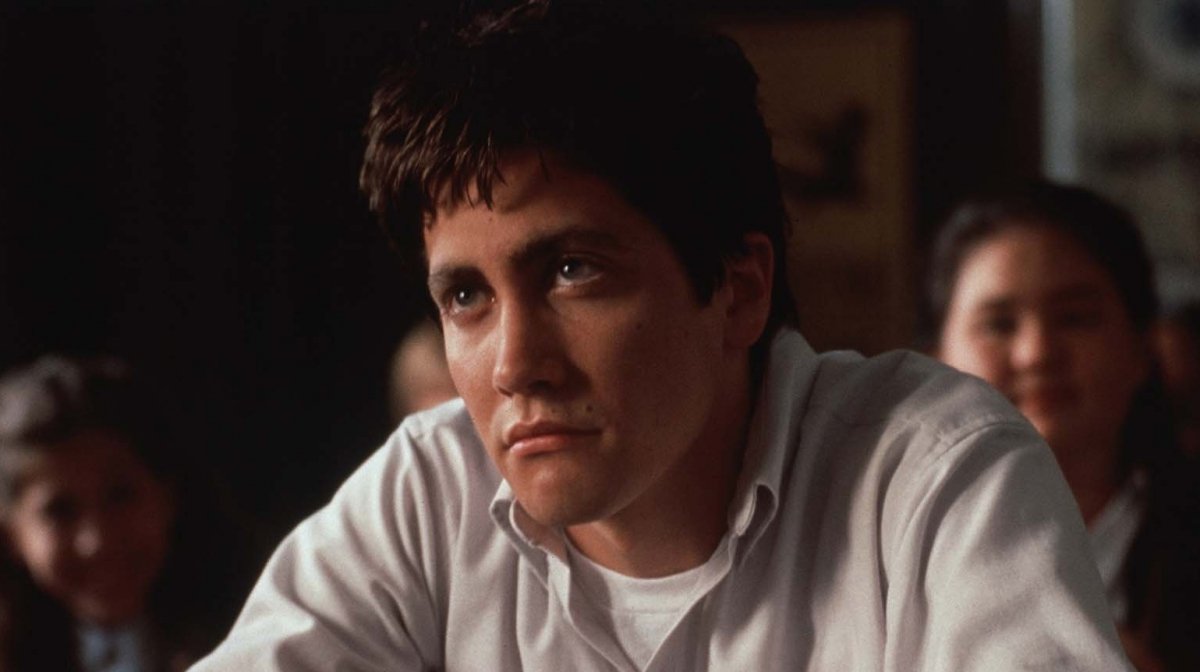
And much like DONNIE DARKO’s own strange and haunting heroism, the film’s actualization and — eventual — success was hardly preordained. Even the exhausting process of writing a stellar, talk-of-the-town script and convincing agents and producers that he, a 25-year-old neophyte director, was the right guy to helm it proved to be not the beginning of the end but merely the end of the beginning.
“The shoot, especially the first week, was terrifying,” Kelly recalls. “We had the most insane, ambitious schedule — and not enough time or money.” The crew, for example, had to knock out all of Drew Barrymore’s scenes in a week to accommodate the shooting schedule of her starring role in Penny Marshall’s RIDING IN CARS WITH BOYS. And then there was the small matter of this epic story resting in those aforementioned untested hands. “There was an enormous amount of skepticism about me,” Kelly confirms. “You know, ‘Can Richard handle this? Will he be able to maintain control over this set?’ Luckily, by that first Friday I had proven myself and everyone rallied around me and the project. Yes, we all knew this would be tough, but we also all believed we would make it to the end of this crazy schedule and create something special.”
In many ways, DONNIE DARKO is a deeply autobiographical film that draws heavily from Kelly’s imagination, as well as his youth growing up in Midlothian, Virginia. The fear/love lifeline Donnie challenges in the film and the self-help curriculum for which Patrick Swayze’s Jim Cunningham is an evangelist, for example, are drawn from ideas Kelly encountered at Midlothian High School. Drew Barrymore’s bohemian teacher Karen Pomeroy was a composite of a few actual middle and high school English teachers Kelly had including the eighth grade teacher who assigned him Watership Down, which Donnie and Pomeroy debate in a scene from the extended director’s cut, as well as the junior year teacher who assigned Kelly Graham Greene’s short story “The Destructors,” which Pomeroy teaches at her own risk and whose plot mirrors Darko’s own surrealist rampage. His sophomore year English teacher told him the anecdote from the film about the famous linguist who said “cellar door” was the most beautiful combination of words in history.
“I feel like maybe I should have given Mrs. Carillo a special thanks in the end credits, but I guess I’m thanking her now?” Kelly says with a soft, affectionate chuckle. “I was definitely drawing on experiences from my childhood all throughout the movie as part of its blueprints, its architecture. It was very organic and took on a life of its own, like laying a foundation — the jet engine, the lunar month, my experiences, Halloween as a destination for the climax of the movie, exploring the beginnings of ’80s nostalgia and the seismic cultural shift between the movie’s setting of 1988 and 1998 when I started writing the film — and then watching a time-lapse video of a house build itself in my mind.”
Of course, for a project in which there the audience is asked to suspend disbelief to the degree necessary to buy into a dream-like parallel universe populated by nuanced, sometimes slightly askew characters, casting is a make-or-break proposition. They have to believe the aforementioned house is actually a house, in other words. And DONNIE DARKO with its incredible ensemble, several of whom were either known quantities playing against type or then-unknown future superstars, is firmly in the “make” category.
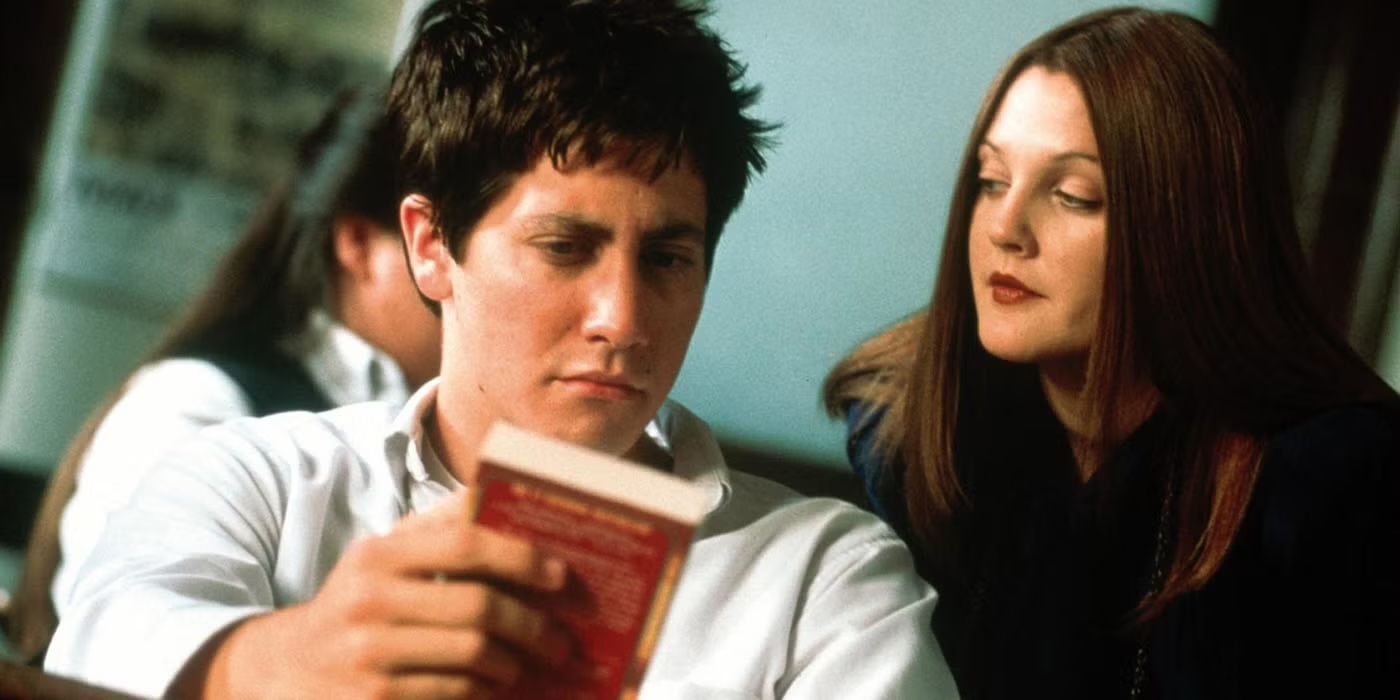
Seriously, look at this murder’s row of acting talent: An affecting otherworldly performance by Jake Gyllenhaal as Donnie with real-life sister Maggie playing on-screen sister Elizabeth. The sadly late Daveigh Chase — future voice of lovely Lilo of Lilo and Stitch and evil Samara of The Ring (2002) — as their little sister. The great and subversive Jena Malone. Swayze. Barrymore. Jolene Purdy. Noah Wyle(!) Child’s Play 2 victim/Flatliners/case study Beth Grant. DONNIE DARKO featured 19-year-old Seth Rogen in his first film role. Same for Fran Kranz, the clown in the Trans Am with Frank who would not only go onto roles in The Cabin in the Woods, The Village and The Dark Tower, but also to write and direct the 2021 poignant school shooting aftermath drama Mass.
“I was astonished at the incredible performances this case did in my movie — and I’ve been so proud and amazed to see all they’ve accomplished in the years since,” Kelly says. “I have to give a lot of credit to casting directors Joseph Middleton and Michelle Morris. Also, we were shooting in Los Angeles in the summer of 2000 when the city was just full of young, cool, amazingly talented up-and-comers.”
That Kelly was able to pull off the film he himself describes as “very ambitious and aggressively complicated” film at only slightly less-young age of 25 has, he admits, been something of a blessing and a curse. “Because DONNIE DARKO was the first thing out of the gate for me, it sort of set this benchmark,” Kelly says. “Perhaps I’m a bit haunted by it in a way because I just I don’t want to make something that feels like it’s not at least aspiring to that level of ambition and complexity.
“You know, at this point in my career, I probably would have made a lot more movies if I had pursued simpler projects. I’m not in any way criticizing simple! There’s nothing wrong at all with simple done in a smart, great way, which is beautiful in its own right and takes a huge amount of skill. But, for me, there’s something about creating stories that have a lot of layers and a lot of ideas that’s just really stimulating and interesting. And that might be me just still trying to hold onto the excitement that I felt when I was making [DONNIE DARKO] because it was a very special experience and something about it clearly worked since we’re still talking about it all these years later.”
Kelly pauses, then adds: “It could be an impossible thing that I’m trying to reach, but I’ve found that that it is very gratifying to try.”
Speaking of continuing to shovel coal into the wildly ambitious train engine, will Kelly ever return to the multiverse of DONNIE DARKO?
Well, he’s glad you asked. And the answer is, yes — and very soon.
In fact, the next chapter of the story will come this December in the form of a 600-page illustrated novel which borrows its title from the fictional Roberta Sparrow book in the film, The Philosophy of Time Travel.
The sequel began as a script for a film that would take place 28 years after the original. The muse, however, kept leading Kelly to flashback to the immediate aftermath of Darko’s death. Eventually, he took the hint, choosing to stay put in that timeline and tell the story from the point of view of Darko’s parents, Rose and Eddie, whose secret lives and gobstopping adventures were not even hinted at in the film. (When DONNIE DARKO hit theaters in 2001, Kelly was a little older than the film’s teenage characters; now he is the same age as their parents. Talk about quantum leaping!)
“It’s not, in any way, a rehash of the movie,” Kelly says of the narrative told through found documents, audio transcripts diary entries and more. “That’s the last thing I would ever want to do. ”If the movie was a collective dream that lasted 28 days, Kelly explains, then this novel is more a procedural look at how real life before that dream informed it and how life after that dream was irrevocably changed by it. “It’s the investigation into the why did this kid die? Why was this family chosen? Who are Donnie’s parents in reality? The answers open up an entire new universe and I’m so excited to introduce people to it. It’s now literally all one thing in my mind. The novel is so deeply, deeply connected to the original film in ways that I could never even have comprehended until I went through the process of writing all of it.”
If the book should be made into film — or, considering its scope, a series of films — Kelly envisions motion capture animation as the medium to account for the need of returning actors to inhabit younger age selves. Ultimately, however, that’s up to the movie going and book-buying public.
“What comes next is out of my control,” Kelly says. “For now, I can just say I did my best and at least put the initial chapter of what is theoretically an epic sequel into the world. My job is just to write it, be true to the story, the characters and myself… Writing a novel is definitely harder than screenplays. I won’t sugarcoat that. But I would not have spent all this time on it unless I felt like it was a necessary and worthwhile endeavor.”
It could be an impossible thing that Kelly is trying to reach — but it is very gratifying to try, no?
DONNIE DARKO is back in theatres for its 25th anniversary October 2-4.