
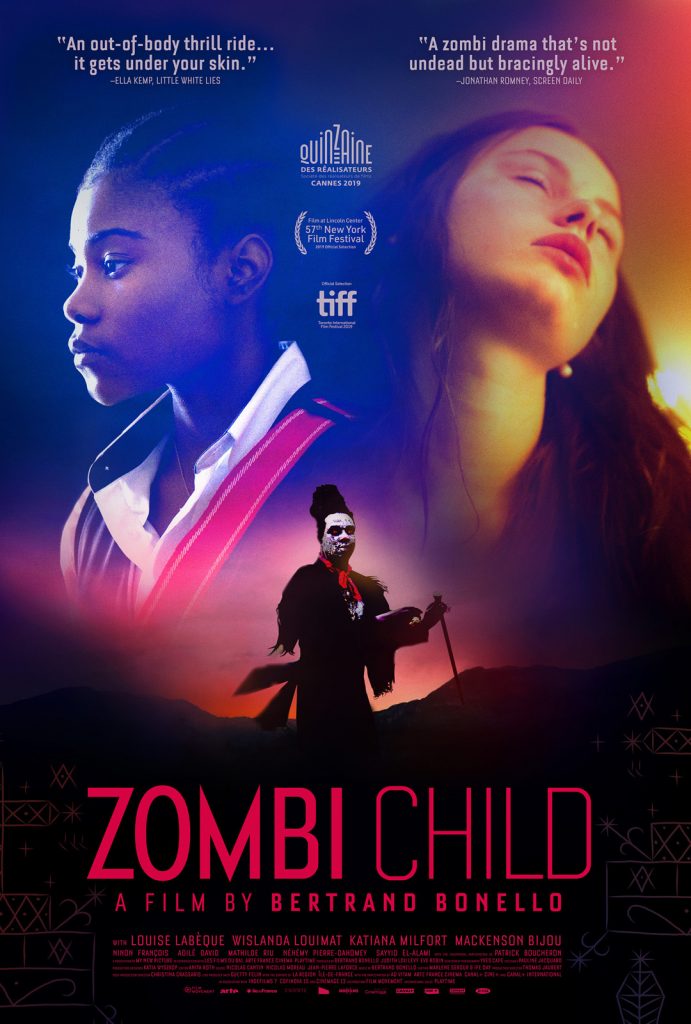
Starring Louise Labèque, Wislanda Louimat and Katiana Milfort
Written and directed by Bertrand Bonello
Film Movement
“Tradition means giving votes to the most obscure of all classes, our ancestors,” G.K. Chesterton wrote. “It is the democracy of the dead. Tradition refuses to submit to the small and arrogant oligarchy of those who merely happen to be walking about.”
This, in a sense, is where writer/director Bertrand Bonello’s affecting new film ZOMBI CHILD transports us—to the corner of our world in which the dead (and not quite dead) continue to cast ballots; to a reality in which a very real past and those who exist in realms beyond time tap the “small and arrogant oligarchy of those who merely happen to be walking about” and remind them of their power. Think Ingmar Bergman directing THE SERPENT AND THE RAINBOW—a film Bonello placed alongside CARRIE, THE GOONIES and I WALKED WITH A ZOMBIE in a series he curated of movies that had “informed and inspired” ZOMBI CHILD at New York City’s Quad Cinema—and you’ll be in the ballpark.
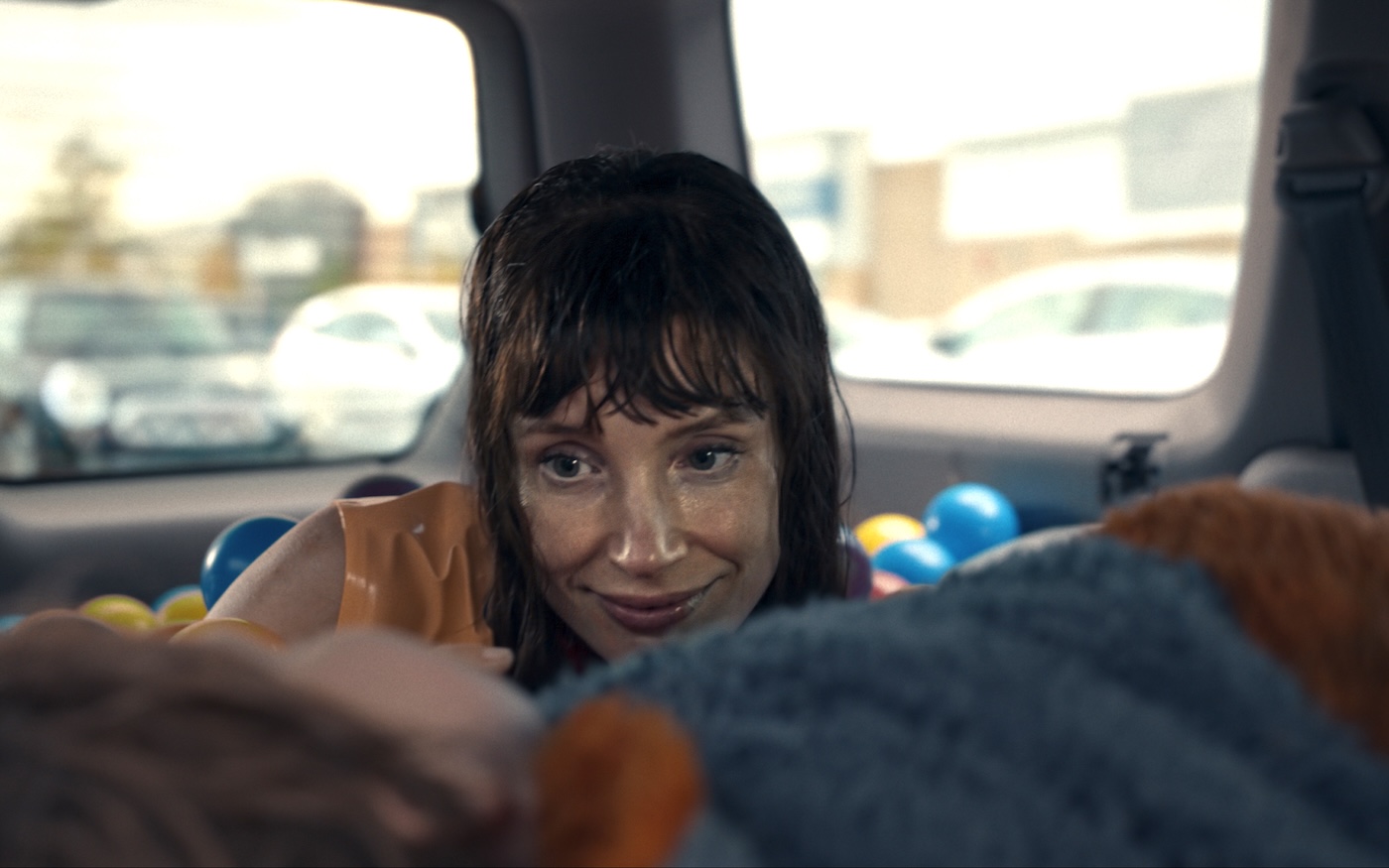
From the opening minutes of the film (opening in New York City and Chicago today, with more cities to follow; see schedule below), the juxtaposition of a soon-to-be intertwined past and present is front and center. First, a man in 1962 Haiti is poisoned, buried half alive, then surreptitiously resurrected, minus memory or desire, to join many other zombi toiling as slave labor on a sugar plantation. Then, we’re taken to present-day Paris amongst a gaggle of semi-angsty, privileged young women at the Légion d’honneur boarding school, deep in their search for self. It’s a “never the twain shall meet” setup until young heartsick Fanny (Louise Labèque) meets Melissa (Wislanda Louimat), a child of Haiti who immigrated with her aunt Katy (Katiana Milfort) after her parents and many other family members were killed in the 2010 earthquake.
An early, extended classroom scene signals that ZOMBI CHILD has no interest in shying away from the philosophical, cultural and moral implications of the story it is setting out to tell. The teacher tells his students that while France sees itself as engine of revolution, it has “at many moments and in many ways” not “always lived up to this promise.”
“In a way, liberalism obscures liberty,” he says. “It ensures that it never quite comes to pass… So we cannot write a continuing history of the 19th century. We have no right, as that is not how it happened. What I am suggesting is a history that is discontinuous, sputtering, hesitant. Or, rather, a subterranean history of the 19th century idea of liberty that would be seeking it reemergence occasionally resulting in experiences—experiences of liberty.”
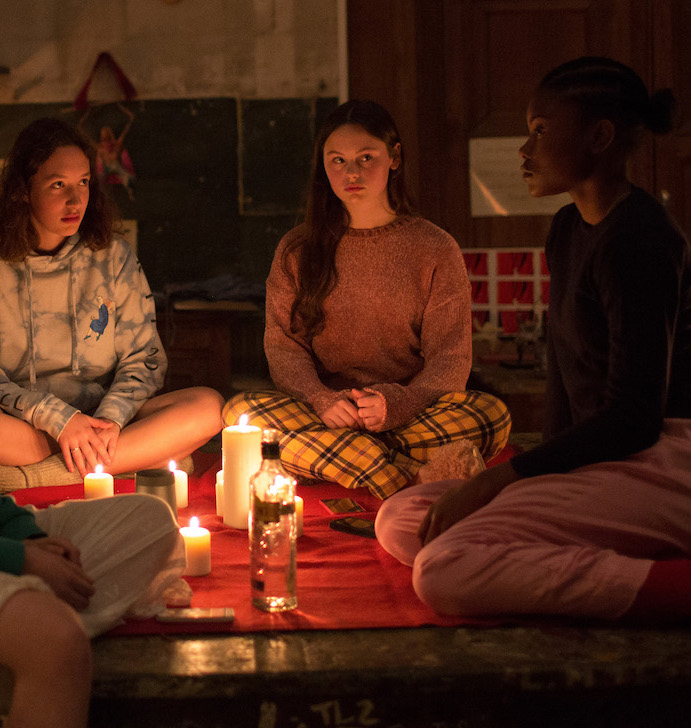
Sure enough, this subterranean history is eventually liberated when, after drawing Melissa into an informal literary sorority, Fanny and her small coterie get her to open up about her life. Which just happens to include a bloodline connected not only to the aforementioned zombie, whom we learn went rogue back into the world of the living, but also a tradition of voodoo that is still practiced by her aunt right here, right now.
No one needs to tell RUE MORGUE readers why this history would be highly interesting to teenagers. (At one point, Fanny and another girl watch a hyper-modern zombie television show on a phone between classes, and the seemingly interminable slow-vs.-fast-zombies debate is referenced.) And, yet, despite the draw, there are also strong indications that perhaps the girls should proceed with more caution than they are typically inclined to. For one thing, Melissa growls and snarls in her sleep-state wanderings. For another, she recites a harrowing poem to them that invokes a power and profundity that a posh school does not quite prepare one to reckon with, challenging the “white world” to “listen to my zombie voice honoring our dead.”
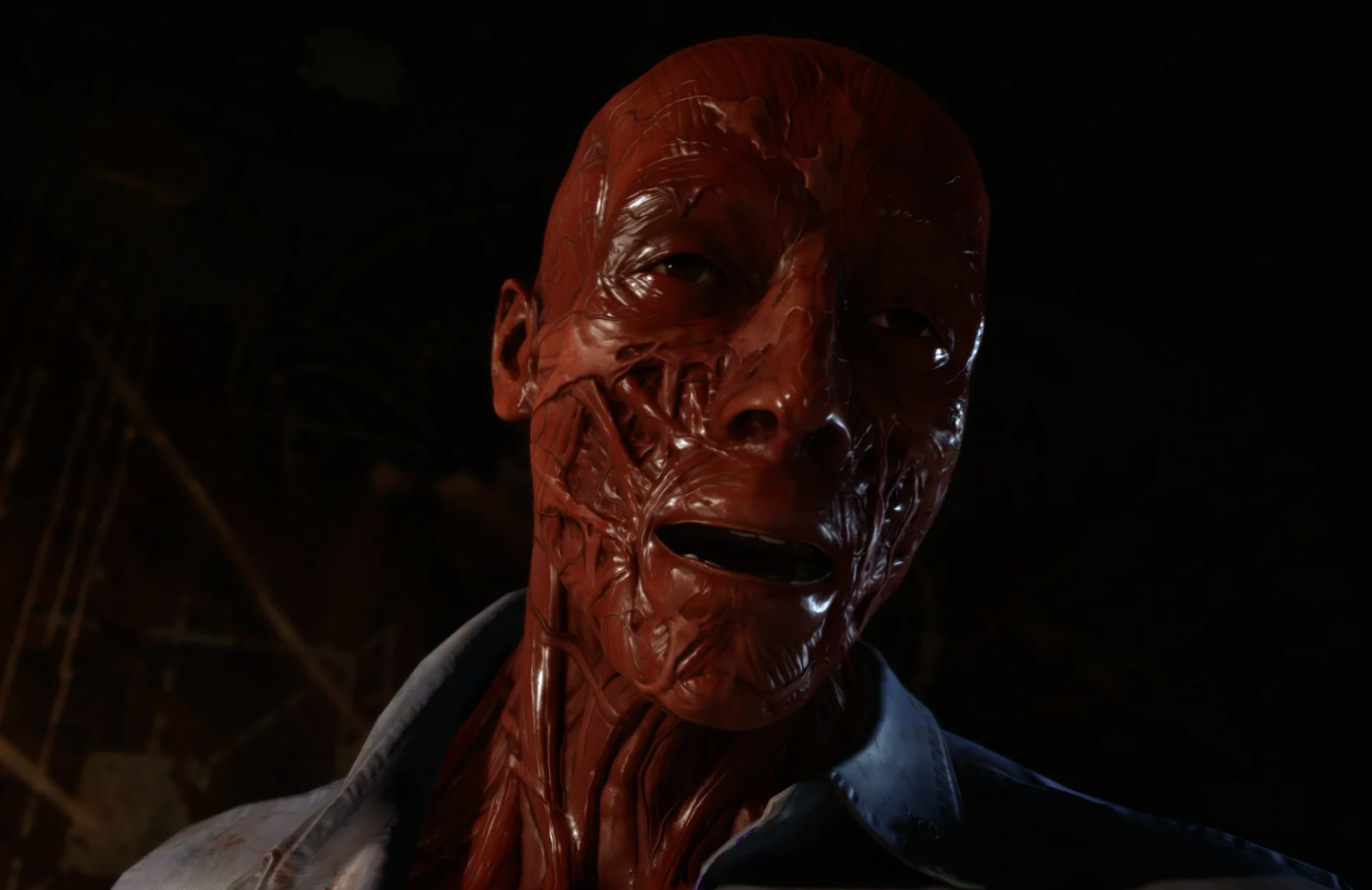
Alas, as the moth flies toward flame, Fanny can’t help but see in voodoo a tool to right some minor wrongs in her own life. She fakes a death in the family, tracks down Melissa’s aunt and offers a pile of money for a voodoo ritual…which just so happens to take place on the same day as an elaborate ritual honoring Melissa’s family back in Haiti. Katy warns her to “think hard before getting any closer.” She tells her, “You don’t need help or magic, you just need time.” When Fanny replies, “Don’t I count ’cause I’m white and wealthy? Can suffering be ranked?”, however, it is clear these small conflicts are part of a larger, unresolved drama playing out across generations and time, knotted up with colonialism and arrogance and ignorance and cultural disconnect and misleading historical power differentials and real, individual pain and struggle. This is where the film takes a sharp third-act turn from lilting, borderline dreamlike realism into extremely disquieting, surrealist, demonic horror that is all the more shocking for the calm before the storm.
ZOMBI CHILD is a gorgeously realized, deftly constructed, genuinely thought-provoking, highly empathetic film buoyed by the nuanced, powerhouse performances by Labèque, Louimat and Milfort. (All three should soon be inundated with rich roles, if there’s any justice in the world.) It is not a film for genre fans in search of body counts and constant scares, but if you surrender to it, ZOMBI CHILD will haunt you for a long, long while.
ZOMBI CHILD dates/venues:
- January 24: Film at Lincoln Center, Quad Cinema (NYC)
- January 24: Gene Siskel Film Center (Chicago)
- January 31: Alamo Drafthouse (Brooklyn; weekend shows)
- February 7-9: SIFF Film Center (Seattle)
- February 21: Nuart (Los Angeles)
- February 21: MFA Boston
- February 28: Cosford Art Cinema (Miami)
- February 28: O Cinema Miami Beach
- February 28: Landmark Opera Plaza (San Francisco)
- February 28: Landmark Shattuck Cinema (Berkeley, CA)
- February 28: Cinema Salem (MA)
- March 6: The Grand Berry (Ft. Worth, TX)
- March 6: Gateway Film Center (Columbus, OH)
https://www.youtube.com/watch?v=xEucEj1yqA4