
By MARK MATICH
Starring Allison Megroet, Jeffrey Shawn Miller and Yesmeen Mikhail
Written by Josie Eli Herman and Michael Alan Herman
Directed by Josie Eli Herman
Acorn Arts and Entertainment
An adaptation of Bram Stoker’s classic 1903 mummy story, The Jewel of the Seven Stars, HOUSE OF KA, directed and co-written by Josie Eli Herman, is a low-budget supernatural thriller about an Ancient Egyptian mummy that shows the intimations of a unique directorial voice. It uses its crowdfunded indie framework to explore some interesting feminist concepts. On that level, even if the sum of its parts doesn’t equal a completely satisfying whole, it still has something to offer. The film seems like an initial stab at what could eventually be a more fully formed rallying cry from Herman.
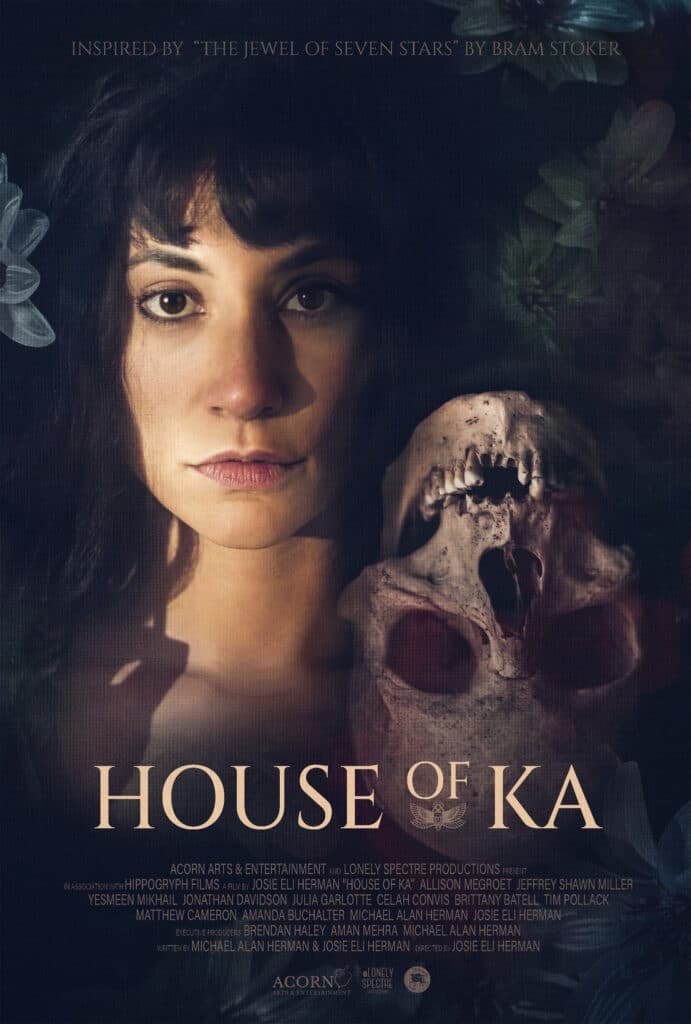
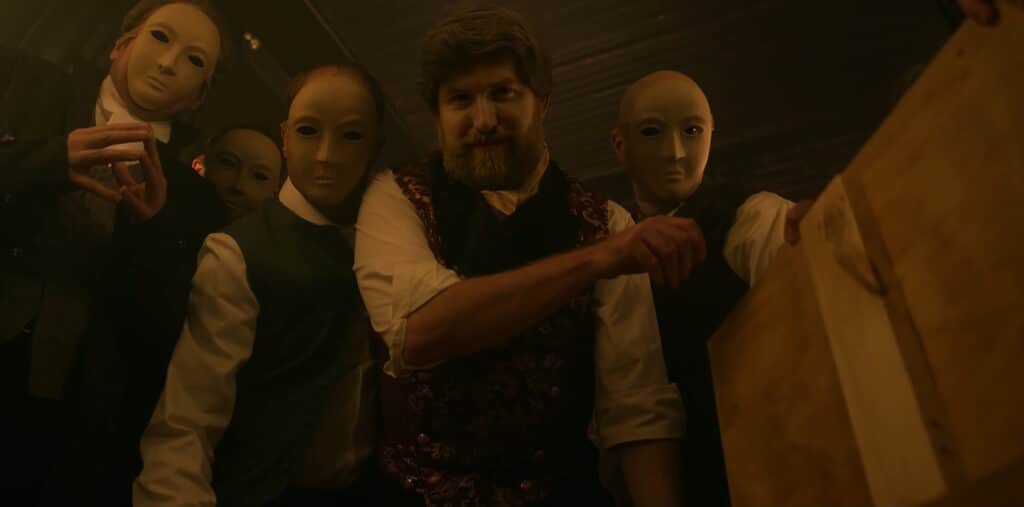
The story begins with Margaret Trelawney (Allison Megroet), a young Victorian-era woman, coping with her gentleman-scholar father Abel’s mysterious illness. When the nurse in charge of his care (Brittany Battell as Nurse Kennedy) can’t put her finger on what’s going on, further investigation reveals the respectable antiquities professor’s involvement in a secret society that uses the mummified bodies of Egyptian royalty as ritual offerings to attain immortality. With the help of a gentleman lawyer, Malcolm Ross (Jeffrey Shawn Miller), and intrepid amateur Egyptologist Eugene Corbeck (co-writer Michael Alan Herman in a fun, loquacious role), Margaret embarks on a quest to purge the household of evil. In doing so, she releases the spirit of Tiyehotep, an ancient Egyptian queen whose ancestry goes back to the powerful House of Ka. Tiyehotep’s mummified body (given life by actress Yesmeen Mikhail) was purchased by Abel for the society’s dark designs.
As Josie Eli Herman states on the film’s website, “While historically, the selling and unwrapping of mummies for entertainment was not unheard of, the film explores this through a modern, feminist lens. It mirrors the horrors of human trafficking, objectification of women, and male dominance over a woman’s body.” So, while not the blood and thunder story of ancient evil we might expect, Herman should be commended for trying to do something different.
However, it would be dishonest not to call attention to some of the drawbacks of the filmmaker’s approach. As Herman says in her statement of intent, “Our visual standards are very high, and our cost is very low.” This doesn’t hurt the cinematographic element, and, as lensed by Herman, the cinematography is compelling and intriguing. But to call a spade a spade, there are some limitations the film clearly can’t overcome, foremost is the barebones production design. Where are the cobwebs and forbidding, mystifying bric-a-brac of Abel Trelawney’s collection of esoteric antiquities of which so much is made in the film’s Victorian-era dialogue?
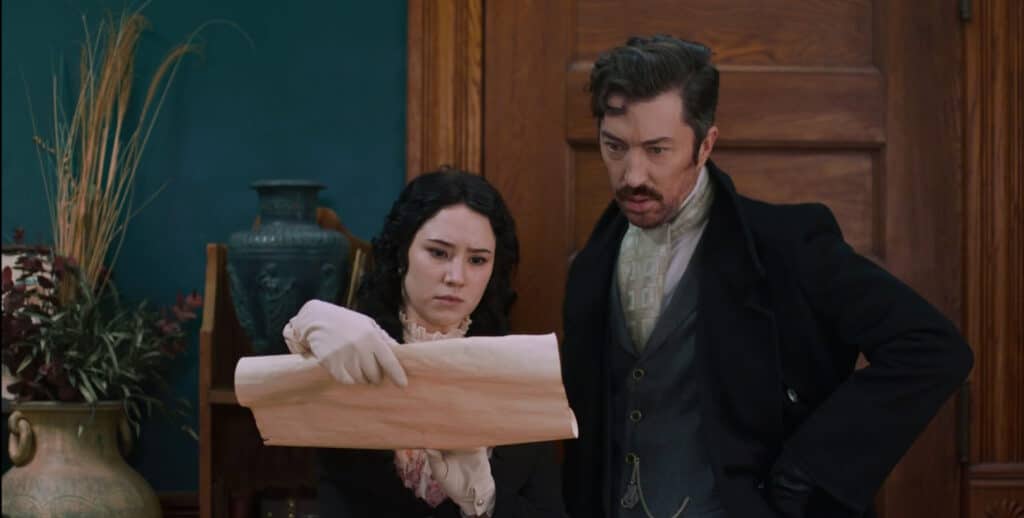
On the plus side, the purplish and orange-yellow color palette adds a lot of visual interest and distinguishes the film from the deep blood red/deep violet-indigo dynamic used by countless Argento wannabes. Much care has been put into the photography, giving the film a distinct look. (Using key motifs in the frame, like a stain glassed window, decorative grate, and the supine mummy herself, to give more shape to the compositions also helps to offset the bareness of the settings.) And as a whole, the film is well cast, with Allison Megroet winsome and believable in the central role of Margaret, counterbalanced nicely by Yesmeen Mikhail’s passionate take on the wraithlike, undead Egyptian queen Tiyehotep.
In terms of the feminist angle, although there are many scenes showing how Margaret is muzzled by the sinister secrecy surrounding her father (and by extension, male-dominated societal mores), Herman could have delved a bit further into her character arc. In a key scene between Margaret and Malcolm, in which the stage is set for her personal revolt, she frustratingly does not take action and passively mirrors the apathy around her by accepting it. Margaret complains, “When you speak, be it to a man or a woman or a tree, you have their respect; you need only walk into a room. When can I speak freely?” This rhetoric certainly points out the issue of society manacling her. Yet, leaves us wanting Margaret to take more of a stand, perhaps by flouting society’s conventions and completely dismissing her beau by the film’s end.
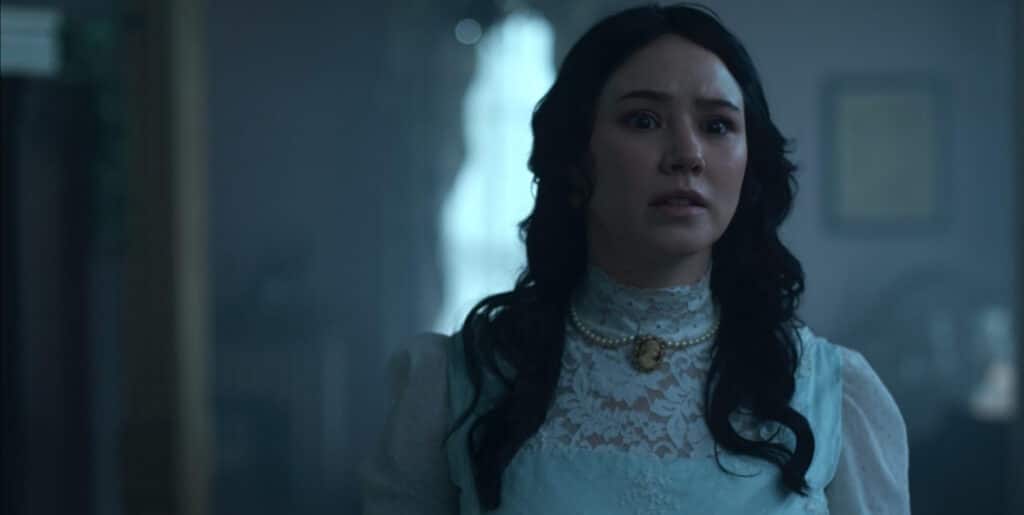
As it stands, the plot somewhat grinds to a halt with the unexplained reappearance of the father, but these highlighted scenes make for an interesting and, at times, thought-provoking ride. Some viewers may chafe at the old-fashioned, drawing-room quality of the film, but there is always an audience for this deceptively mild-mannered subgenre. There may not be major revelations here, but the filmmakers have tried to do something off the beaten track with what they have, and the commitment to the period, despite the lack of resources, is admirable despite the shortcomings of the film’s mise-en-scene.