By MICHAEL GINGOLD
Starring Madelaine Petsch, Gabriel Basso and Ema Horvath
Directed by Renny Harlin
Written by Alan R. Cohen and Alan Freedland
Lionsgate
“You’re still alive, huh?” is how Gregory (Gabriel Basso) greets Maya (Madelaine Petsch) as he catches up to her at the beginning of THE STRANGERS—CHAPTER 3. It’s a fair question, given the horror and brutality she experienced in the first two entries of this trilogy, and also considering that this ongoing scenario was on life support by the end of the previous movie. The good news is that CHAPTER 3 is something of an improvement on its predecessors; the bad news is that it isn’t nearly enough of one.
Picking up immediately where CHAPTER 2 left off, the new movie follows Maya through another long round of terrorization by Scarecrow and Dollface, now that Pin-Up Girl is out of the picture. But first, there’s an extended sequence set three years ago in which a young woman is abducted and slain by Dollface. If this setpiece has any significant connection to anything else in this triptych, I couldn’t detect it, other than that it sets up the killers’ apparent favorite slaughter site. This locale is, to randomly quote Belloq in RAIDERS OF THE LOST ARK, not a very private place for a murder, but they’ve evidently been committing violent, noisy crimes with impunity there for years. Perhaps the whole town of Venus, Oregon is aware of and complicit in their bloodshed? There have been hints in this direction scattered throughout the three chapters, but this one ends without paying them off.
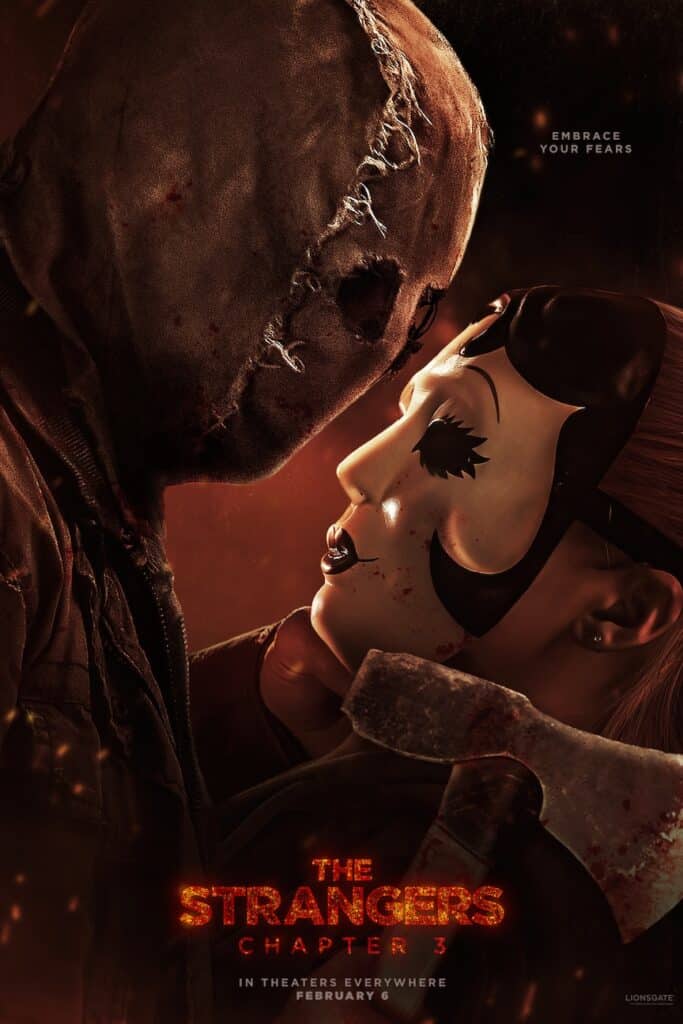
What CHAPTER 3 does offer are more flashbacks to the Strangers as kids and teenagers, revealing their pasts but not providing any particular insight into their deadly activities. There is a revelation about Sheriff Rotter, played by Richard Brake, that might be more surprising if he wasn’t named Rotter and wasn’t played by Richard Brake. To help fill this movie’s quota of potential victims, Maya’s sister Debbie (Rachel Shenton) arrives looking for her with husband and bodyguard in tow, and they’re given the minimum of characterization required for their functional roles. Their scenes and dialogue serve mostly to remind people who have sat through the previous two films of what they already know—but then, this is the kind of movie that thinks it’s necessary or meaningful to give us the dictionary definition of a serial killer as an opening text screen.
The bottom line is that nothing over the course of these three films has been done as well as in Bryan Bertino’s original, or even the first sequel THE STRANGERS: PREY AT NIGHT. This one just confirms that providing the Strangers a backstory robs them of their distinctive, motiveless threat. To give credit where it’s due, there are some positives among the cast. Basso conveys the right sense of menace and madness, though he doesn’t have as much screen time as his second billing would suggest. Finn Cofell has just the right look and demeanor as the Teenage Pin-Up Girl seen in the flashbacks. And Petsch, as she has from the start, brings her A-game to Maya, who has slightly more variety of things to do than the last time around. Even Petsch’s skills, unfortunately, aren’t enough to sell a key character twist that isn’t properly written or dramatized enough to be plausible. Just as damaging to the film’s credibility is the way Maya foolishly botches an escape attempt at a very early point in the story.
On a craft level, there’s a fair amount of atmosphere to José David Montero’s cinematography and the doomy music by Justin Burnett and Òscar Senén. On that note, this STRANGERS also apparently had a little more of a music budget than the first two, given the handful of classic rock songs on the soundtrack. None of these have anywhere near the impact of the needle-drops in 28 YEARS LATER: THE BONE TEMPLE, though, and the timing of “Nights in White Satin” here induces giggles rather than the intended mood. There’s one vintage tune not included that does, once CHAPTER 3 is over, sum up the feeling that both this movie and the entire trilogy leave you with: “Is That All There Is?”