By LINDY RYAN
From library stacks to blood-spattered bestsellers, Becky Spratford has spent years championing the power, diversity and emotional depth of horror fiction. Now, with WHY I LOVE HORROR, she curates a collection of essays from some of today’s most influential voices, writers whose work has reshaped the genre from the inside out. What began (and continues) as an invite-only blog series has evolved into a sweeping anthology that explores fear, catharsis, identity, community and the connective tissue that binds horror lovers across generations.
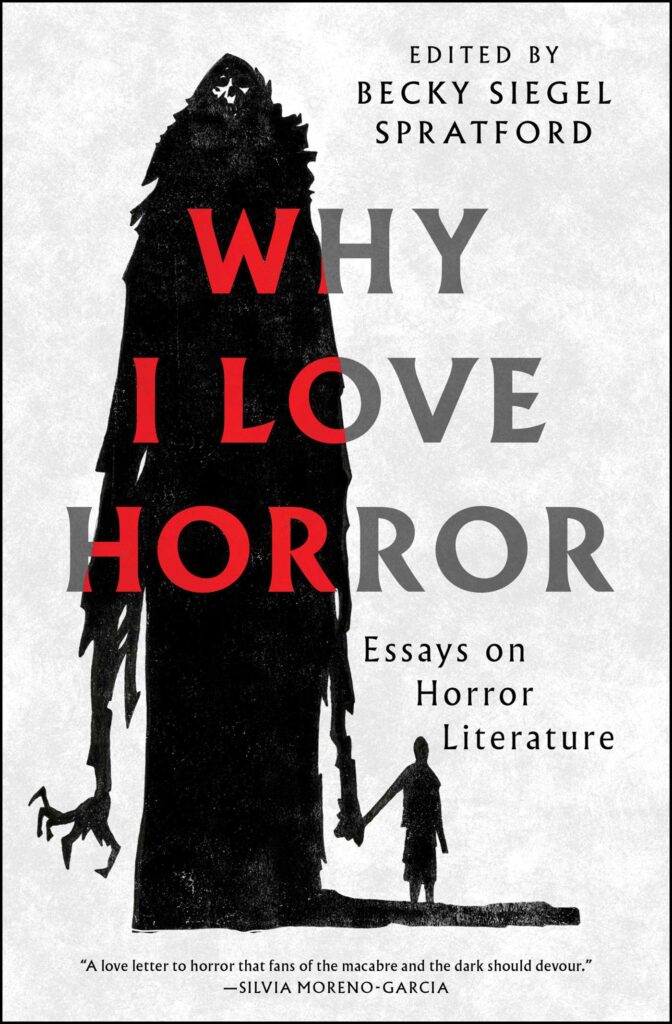
Spratford’s passion and expertise as a reviewer, librarian and genre advocate pulse through every page, guiding readers through a “mixtape” of insights, anxieties and celebrations that reflect the genre’s explosive growth and widening embrace.
RUE MORGUE recently had the opportunity to sit down with Spratford to chat about WHY I LOVE HORROR, now available from Saga Press/Simon and Schuster.
What inspired you to edit WHY I LOVE HORROR, and how did you decide which voices and essays to include?
WHY I LOVE HORROR began as all good things do, on the internet! (not) But seriously, I have hosted an invite-only blog series with this title for a decade. The original idea stemmed from my work writing textbooks for librarians about how to help their horror readers. The blog series was a part of my 31 Days of Horror every October. I invited horror people to share their love of horror with my library worker audience so that they could learn about a new voice and see an example horror reader. All of this was so that they could serve their readers better.
Over my years hosting this event while simultaneously becoming the leading professional reviewer of horror in America (approximately 70 paid reviews a year for the last 5 years), I have come to know many of today’s top horror authors and mostly through my appreciation for their words.
I alone made a list of authors whom I wanted to ask for this collection. I made sure my list was diverse in every way, not just in the author’s identities, but in the type of horror they wrote. I wanted this to be the generation that began with Brian Keene and is bookended by Stephen Graham Jones. I reached out to them and asked if they would be a part of a possible project. And then my agent, Lane Heymont, took that list out to see who would be interested in publishing it. Joe Monti [at Saga] and I have known each other for years, as we both worked toward growing the audience for horror from our different, but parallel, perches. When Lane brought him this proposal, he immediately made it clear he wanted to be the one to publish it. The only problem, I had to cut my longer list of confirmed authors down to 18.
You wear a nu,berof hats of hats, editor, introducer and occasional essayist. How did you balance your role as curator with your own voice and perspective?
That part was easy for me, as it is what we library workers do every day. We all curate for our readers. Some of us do it because we are the people in charge of identifying and then buying the titles we think are best for our libraries’ collections. Others do it by creating online lists for our patrons to browse, choosing what books to put face-out on display, or as we plan and execute our programming. I myself did all of these things at my library for fifteen years, so it comes naturally to me. I used my essay to talk about why asking, “Why?” is at the heart of the work every library worker does every day as we help leisure readers. The idea of that essay is to highlight the expertise of library workers all over the country and prepare readers for not only what is to come in the rest of the book, but also how they can keep the conversation going at their libraries, about horror or any type of book they enjoy.
My introductions to each author, introducing who they are, how they write and giving you a start with a title as well as a read-alike option, is also content that many library workers provide to their readers on a regular basis.
In terms of curating the “mixtape” order of this volume, that part was fun and challenging. I had to wait until I had all of the essays in hand and read them all at least twice. Then I used my canvas poster of the cover of The Haunting of Hill House (which hangs on my office wall) as my “storyboard.” I did a Post-it with each author and a sentence about what I thought was the main idea/concept in their essay, and attached those to the poster, looked it over and moved them around. A few were easy. Josh Malerman’s essay was on a train and made for a great middle piece. Paul Tremblay’s essay, with drawings by his daughter, Emma, also needed to be in the middle. From there, I moved the Post-it note pieces around to find a grouping that worked. And in my introduction to each essay, I help the reader move through the anthology by explaining a little bit about why the essays are in the order they are in. I feel that the role of an editor in any anthology should be to make the construction of the volume as a whole as transparent as possible. It unites the anthology as a single book and improves the reading experience.
In your view, how has the horror genre evolved over the past decade, and how do these changes inform how you asked contributors to approach the topic of “why I love horror”?
One of the best things about horror over the past decade is that it has been welcoming to new voices. Women and people from marginalized communities have always had so much to add to horror because by simply existing in their bodies in a world that is clearly tipped in favor of white men (even if those men are aware of this inequity and don’t agree with it), adds a level of real-life anxiety and unease, at best, and terror and violence, at worst. Their stories feed off the real-life horror in their lives, providing some of the best horror books we have seen in decades. We see this in the large number of books taking older tropes and telling them from a new perspective, such as in the works of Silvia Moreno Garcia, Eric LaRocca, Tananarive Due and Stephen Graham Jones – all authors who have seen critical acclaim and large sales numbers. The increase in the publishing of these voices has been a boon for every horror reader.
This is one of the reasons I made sure my book included writers of all identities. I did not direct them what to write, but I knew that the women and those from marginalized communities would not be able to not address this.
Many essays in the anthology explore horror not just as fear, but as catharsis, identity and community. What do you personally see as horror’s deepest emotional (or psychological) function for both writers and readers?
I think the deepest emotional function of horror is in building empathy. At its most basic, empathy is the ability to understand and share the feelings of another. Horror as a genre does not work if the reader cannot connect with the characters who are in mortal peril, who are struggling, who are being attacked, whatever the antagonist is in a specific story, if the reader cannot understand why the protagonist is struggling (first step) and then feel that fear, unease or terror, the book is a failure.
In the world we currently live in, many have posited (and I agree) that there is a noticeable lack of empathy in the world, especially here in America, as showcased by many of our leaders. Horror allows its writers to connect with their own empathy as they craft their works, and helps readers build empathy. And it must be said that this comes into play in my last answer as well. Because horror readers have developed their empathy muscles, we see the genre welcoming in marginalized authors with less backlash than has been seen in other genres.
It’s not just me who thinks this. Last year, Psychology Today even had an article about how being a horror fan leads people to be more compassionate and empathetic, and they used studies to show their work.
For readers or aspiring writers who are hesitant to claim or explore horror, what is your advice? What would you say their first steps should be, both as fans and creators?
The first step toward writing is always to be a reader first. If you want to write horror, read horror. I would start with the last few years of Ellen Datlow’s Year’s Best Horror. And not just the stories she picks, but also the essay she writes at the start of the volume that gives you a sense of the year that was for horror. This anthology allows aspiring writers to get a picture of the entire horror landscape, and then read stories deemed the best of the best by the genre’s best editor, which is the perfect place to start.
And then second, once you get something on paper, find someone to share it with. Once you write something and someone reads it (anyone, even if it is your partner or best friend), you are now a writer. Congrats. Everything that comes after is the hard part. Honing your voice and your craft takes time, and it is not a straight line of progress. You should find other writers in your area to share feedback with. Your local library is a great place to ask about that. Many libraries host writer’s groups and, if they do not, they know about ones in the area to connect you with. Another option is joining the Horror Writers Association. You do not have to have ever published a single thing to join. There are chapters all over the country where you can connect with other writers. And if your area does not have one and you don’t want to start a chapter yourself, you are welcome to join any chapter of your choice and participate virtually.
I cannot stress enough how important it is to keep writing and keep getting feedback. I have been writing reviews professionally for over ten years now, and my editors, their feedback and their strict word limits have made me an infinitely better writer. And I am still improving. Writing regularly, showing it to people, and using the feedback that you feel is most useful is the only way to reach your writing goals.