By BILL REICK
What a joy to find a new favorite horror writer. Whether it’s finding a newly published author or dusting off a well-worn paperback in a used bookstore, few thrills can match that sense of discovery. Although a few hugely well-known names dominate horror fiction, incredible work exists above and below the shelves marked “K” for King. Among the most exciting writers creating in our favorite genre is Nathan Ballingrud, who was kind enough to speak at length with RUE MORGUE about his novel CATHEDRAL OF THE DROWNED.
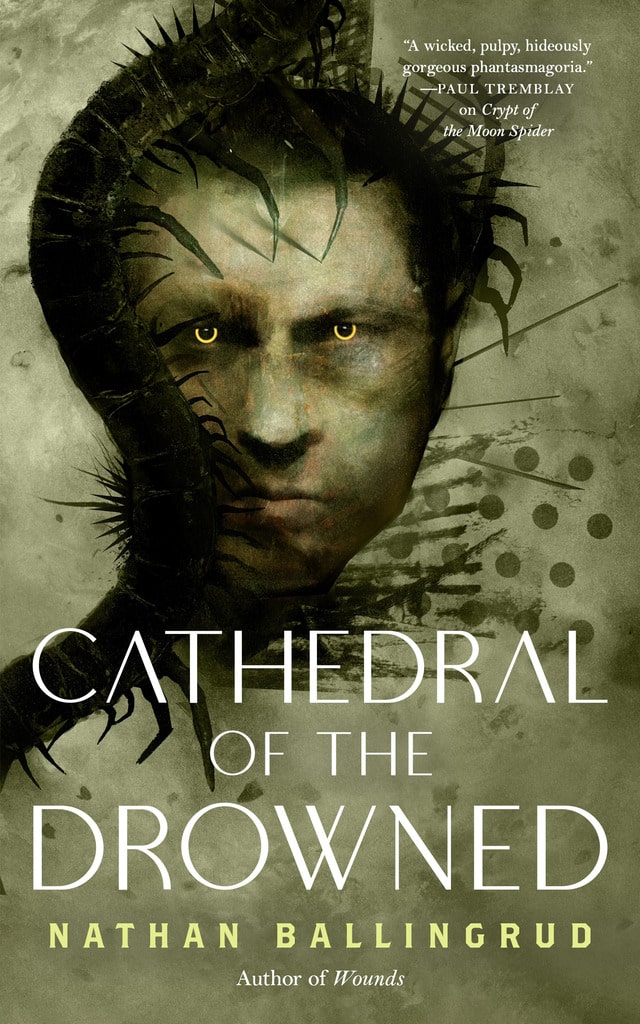
The novel is the mid-point of Ballingrud’s Lunar Gothic Trilogy, three books sure to unsettle even the steeliest of readers. Like many of his horror peers, Ballingrud is nothing like his characters and proves to be just as fascinating as the weird fiction he writes.
I was really delighted to read Crypt of the Moon Spider and CATHEDRAL OF THE DROWNED. I haven’t been captivated like that by new writing in a long time, so thank you for taking the time to speak with me. My understanding is you’re from Asheville, North Carolina.
I’m not from here, but I’ve been living here for a long time now. I was born in Massachusetts, but I was raised partly in South Florida, partly here in Asheville. I lived in New Orleans for a while, too. Just kind of ping-ponged around.
Do you feel like ping-ponging around like that informed your style or what you write?
I think so, in the sense that I don’t really feel I’m of a particular place. My parents are Midwesterners, but I was born in the Northeast and partly raised in the South, so I don’t really feel like I belong to a certain spot. The flip side of that is you also feel a little alien in all places. I think that definitely informs the imagination, the subconscious, if nothing else.
You write alien terrain really well. The stuff on the moon is very evocative. I had never considered it before. I’m not sitting around thinking, Oh, what if there’s a big old forest on the moon? And then, to read your writing, it was like, Oh, how could there not be? You were in New Orleans when your first writing was published on scifi.com?
Well, I’d been published before then, but it was a long time before then, and I don’t really consider it professional grade. I do consider that to be the first story that I feel was me, if that makes sense.
What do you think changed?
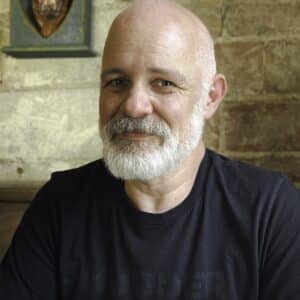
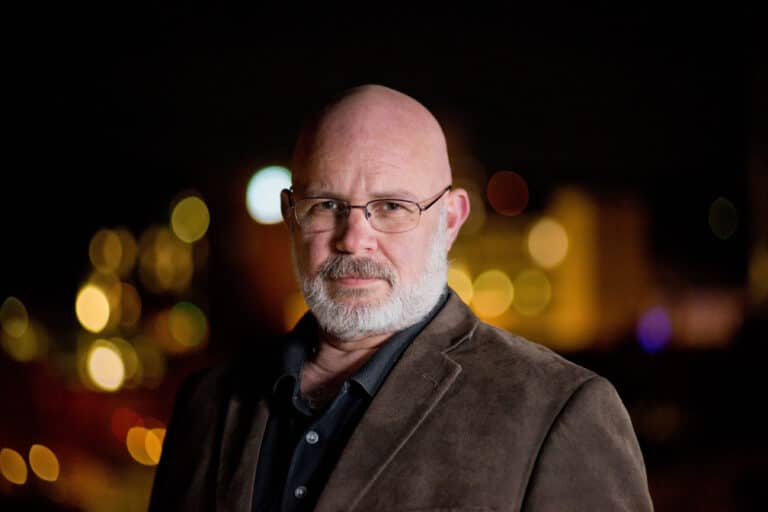
Author Nathan Ballingrud
Just time and experience. My first couple of stories were published in my early 20s. I really hadn’t done or experienced a whole lot in life. I was a suburban kid, and I didn’t really feel like I had a lot to draw from. I sold a couple of stories and was dissatisfied with them, and stopped for that reason. I thought I just didn’t have anything to say yet. I had no insight into anything. So, I just went out and lived for a while. That’s when I moved to New Orleans. I worked as a cook and a bartender. I spent some time cooking on offshore oil rigs. I never made a decision to pick [writing] up again, but it sort of felt natural one day. I felt like I had enough grounding and experience to try to make a go of it, to make an honest effort, and to have something to say other than whatever piece of fancy I could make up.
What were some of the first things you remember being scared of?
The thing that really lodged in my head was the TV movie Salem’s Lot, directed by Tobe Hooper. It came out in the ’70s. At the time, my mom worked night shifts at the hospital. She was a graveyard shift nurse, and she was the one who got me into horror. She was a Stephen King fan, and I picked up her copy of Night Shift one day. I remember we were watching Salem’s Lot, and then she had to go to work, and my brother and I were kind of spooked because of this show, which is very creepy – and it stands up, by the way. I watched it again recently. It’s still creepy as hell.
My mother made these little popsicle stick crucifixes that night, wrapped them up with nursing tape, and pretended to bless them. We had to go to bed by ourselves when she was at work that night, and we had our little popsicle stick crucifixes to keep us safe from the vampires. I remember being scared – but scared in the best way, thrilled at the same time. It was an addiction that I’ve really never kicked.
Asking a horror writer about Stephen King is like asking a filmmaker about Steven Spielberg. Whether you want it or not, he’s going to influence you. But Crypt of the Moon Spider is one of the few pieces of horror fiction where I don’t immediately see a throughline from King’s work. Was he somebody you enjoyed reading, just like your mom did?
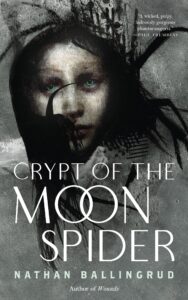 When I was in my teenage years, I just mainlined King all the time. He was definitely instrumental in my formation. Somebody, another writer, told me, speaking of writerly influences, that we have many fathers. We were talking about Ray Bradbury at the time, but King is definitely one of mine as well. But you’re right. There’s not a lot of King in Crypt of the Moon Spider or in CATHEDRAL OF THE DROWNED. The writer that I kind of held as my North Star – and still do, as I’m writing part three now – is Edgar Allan Poe. The sort of “The Fall of the House of Usher”/”The Pit and the Pendulum” feel is something that I just keep my compass calibrated by, my feeling of Poe. Even if it doesn’t always have a direct influence, it’s just how Poe makes me feel inside. That’s what I’m chasing when I’m doing the Lunar Gothics.
And I should say not just Poe himself, but also, to an extent, the Roger Corman Poe adaptations. It’s not just the stories first and foremost, but those hyper-technicolor, garish manifestations of Poe that Corman did with Vincent Price. That’s all part of it, too. I want that flavor of just a little too much – just a little over the top.
Some of those Corman films were kind of adaptations in name only. Some took the source material as a jumping-off point and then jumped off really far afield.
I find this with Lovecraft, too. I think the most successful adaptations are the ones that don’t feel the need to be confined by the source. They’ll take it as inspiration and then go off in their own wild direction, often to great effect.
You’ve had some of your work adapted on Hulu and elsewhere. Do you now write with that in mind? Has it informed you to write with a more cinematic approach?
No, not at all. And if I were, I don’t think I’d be writing the Lunar Gothic Trilogy, because I don’t think it lends itself to adaptation at all. I’d love to see it, but I just don’t think it’s realistic to hope for that. After the adaptations happened, I remember worrying about that very thing. Am I going to be influenced in a way that I don’t want to be? Am I going to feel that pull of gravity from that world? I wonder sometimes if the turn that the Lunar Gothic Trilogy took was in response to that – an almost willful walking away from that kind of influence. I don’t want what I do to be auditions for movies. I don’t want to say, “Well, I hope they like this. Let me do something I think they’ll like.” That’s a quick path to mediocrity. Not that the films are mediocre, but I think trying to write something hoping it’ll be made into a film steers you away from what you should be doing – trying to please some imaginary person. It’s not a recipe for good writing.
Has having your writing adapted for the screen changed your outlook at all?
Although it hasn’t changed me as an artist, these adaptations have been extremely validating. It made me feel real in a way I shouldn’t have, because the work was the same no matter what. The money was good. Not huge, but enough to see me through COVID and to pay for my daughter’s college. It’s mostly gone now, but it happened once, and that was pretty awesome.
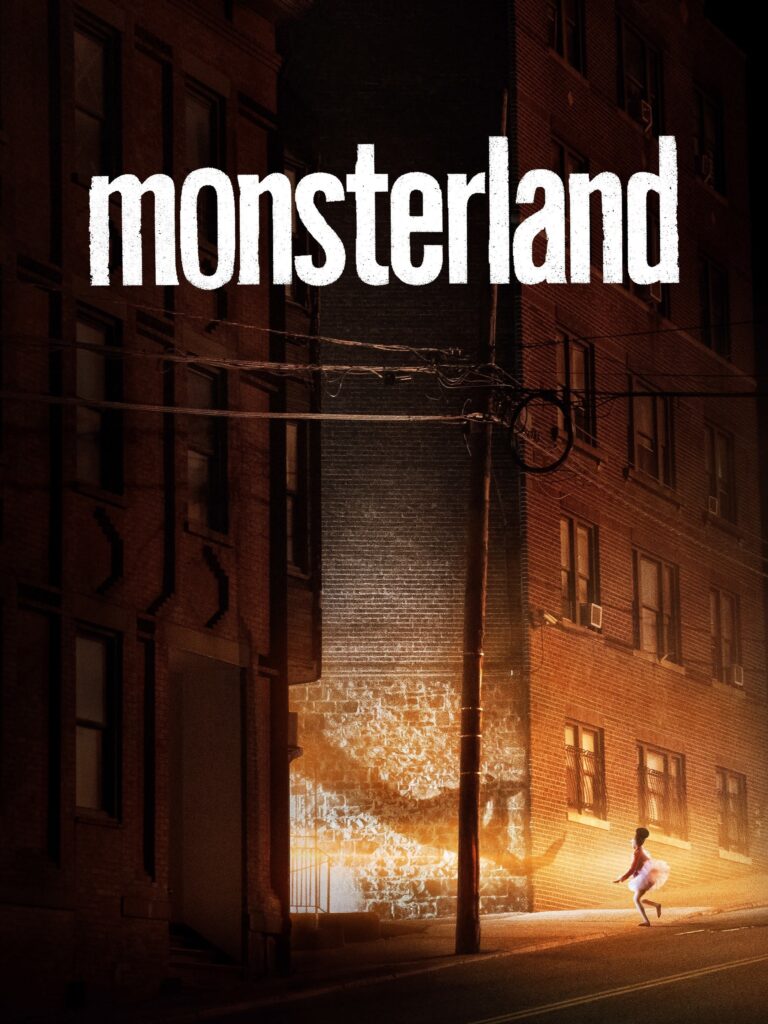
It was also interesting in that it was a window into a life I had always imagined. Most writers hope that Hollywood will come calling, especially for a TV show, like with Monsterland. I went to LA for a couple of weeks to be in the writers’ room as they got the ball rolling. Staying at a hotel someone else was paying for on Sunset Strip, walking down to the writers’ room and spending all day talking with other writers about stories, it was a very electric, kinetic atmosphere. Egoless. Just a lot of ideas being thrown into a mixer, turned around, pulled apart and reattached so quickly that you couldn’t remember by the end whose idea was whose. It was all a little bit of everybody, and it was invigorating.
I also realized that it was not my world. It was fun, a great visit, but that’s not the life I want. I don’t want to be a Hollywood writer. I don’t want to spend all my time in a writers’ room. As exciting as it was, and as clear as it is how people can love it, I’m too hermetic in one sense, too possessive of an idea. When it’s mine, I don’t want to share it or have a lot of voices in there. I like that control. I like that comfort. When it’s just me and the prose, I’m very possessive. I like that every decision is mine, and the story will stand or fall based on how I execute. That’s where I’m comfortable. Once that process is over and I hand it to an editor, then I’m open to some collaborative input, especially when I trust my editor, which I’ve been lucky to do.
Would I ever write for the screenplay first? I could see myself doing it. I’ve tried before. I wrote an audio script for something produced on Apple. That was interesting, especially because it was audio. It was a challenge, trying to tell a story through sound, which I had never tried before. That was fun. I could see myself being interested in writing a script, but it’s a different kind of project. A script will involve a collaborative experience with many voices, so you have to change your thinking from the get-go. You can’t be as selfish about it as with prose in the first stages of composition.
Would you ever write a book with someone else?
I don’t think so. Not because I’m opposed to collaboration. I have collaborated on one short story with my friend, Dale Bailey,” The Crevass.” But other attempts haven’t worked. I feel I’ve evolved down a very esoteric path. For something like the Lunar Gothic novellas, Crypt of the Moon Spider or CATHEDRAL OF THE DROWNED, they feel very personal and private. They’re on a very particular personal wavelength. I want them to go in my own bizarre directions. I may just be too selfish for collaboration in prose. That may be it. I’m too selfish with my ideas.
Let’s get into the nuts and bolts of the Lunar Gothic Trilogy. Did you know it was going to be three parts before you started writing?
Not at first. When I was writing Crypt, it was just going to be itself. About halfway through, there’s a break in the narrative where we leave one point of view and jump into another. Veronica is our point-of-view character for most of the story, but we break into Charlie Duchamp’s point of view, a supporting character up to that point.
When I was writing Charlie’s point of view, I was in a different part of the world with a different perspective. I loved writing his point of view. Once I saw the setting from his perspective, I realized there was more story to be told. That’s when I had the idea to tell the story further in each novella – three novellas, each a complete narrative from a different character’s perspective.
Crypt is Veronica’s story, with a beginning and an end – a contained story. Cathedral is Charlie’s story. It follows Crypt narratively, and knowing what happens in Crypt gives perspective in Cathedral, but it’s Charlie’s complete story. Part three will fulfill the same function for Dr. Cull, the antagonist. So they all relate to each other and fit together narratively, but they’re also a contained narrative for each character. Since so much of each story is about perspective and memory and the way one is seen and sees others, that kind of underscores the theme for the whole project.
That’s brilliant. So it went pretty quickly from one story to three without it ever having had a chance to be two. I love that. And I’m really excited for the third part. Do you have a title?
The title is Kingdom of the Conqueror Worm, which is a direct call-out to Edgar Allan Poe. “The Conqueror Worm” was a poem contained in one of Poe’s short stories, which stands on its own, but is about how eventually we all fall to the Conqueror Worm.
Beyond the Lunar Gothic Trilogy, do you know what’s next on your plate? Do you plan that far ahead?
Well, the way I work is that I have several slivers of things that I’ve been working on and then put away for years until I get around to them again. I’ve got a couple of things, two that are pretty well developed, about 25,000 words into each. I’m not sure which one is going to really catch fire after this is done. One is a sort of pulpy horror adventure using the character from a short story I wrote called “The Atlas of Hell.” The other is a novel set in the modern day, a supernatural novel about a man who kidnaps his young, kindergarten-age son and goes on a cross-country road trip with him.
Do you outline or let the story take you when you write?
Very much the latter. I’m not an outliner at all. So much of the story happens as I’m writing. If I’m stuck, I’ll just start writing, and if I can get one element down on the page, three more ideas will come out of that. They won’t all work. Sometimes, they’ll contradict, but I’ll have to pick one. The best parts of every story I’ve written were not planned. The ideas came as I was writing the rest of it. I trust that. I trust the subconscious implicitly.
I’m pretty confident when I start writing, even if I don’t know much at all, because I believe in the subconscious. I believe it’s going to be there. I feel like I’m a receiver for these stories. They’re there, and I’ve just got to get my apparatus tuned correctly – the satellite dish pointed in the right direction – so that I can pick it up, and then, it’s my job to realize it properly.
Is there any sort of ritual or routine that helps open yourself up to those stories? Is it a fresh pot of coffee, or are you cloaked in furs in a deep, dark cave?
Nothing like that. I don’t really have any rituals. I like silence. I don’t like music or noise of any kind. If I can get silence, that’s best. I do like a cup of coffee, but that’s just something that makes me feel comfortable when I sit down. It works best when it’s quiet, often later in the evening. It’s the last thing I’ll do. I feel like you’re just one step closer to the dream state, the boundary between wakefulness and sleep starting to erode a little. Maybe that helps. Maybe that’s just nonsense, but if it feels that way, that’s good enough. Sometimes, if I’m having a hard time getting something going, just getting pen and paper – doing it the old-fashioned way and writing slowly on a yellow pad – always works eventually. It always breaks through whatever blockage there might be.
With that in mind, I’d like to add one thing, especially for other people who want to write. I used to disdain all writing advice because most of it’s subjective, but there’s one bit that’s actually very important. Any writer would be well served by minimizing their time on the internet. It stirs up surface thoughts; you’re scrolling, getting all these quick posts, one after another. It’s like a churn at the surface of the water, a white froth. You can’t get any long thoughts happening that way. You’ve got to let that water quiet and get still, so you can sink deeper and think long, quiet thoughts.
David Lynch used a fishing analogy. He talked about waiting for the big fish. You have to be patient and put your line out in deep water and wait for it. It’s the same thing. You’ve got to avoid the mental churn of too much short-term thinking inspired by the internet and be comfortable with silence and long periods of inactivity. Even if that means not writing for a while – just thinking in quietude. Any writer would be well-served to keep the internet at the length of a ten-foot pole.
What about reading? Do you read a lot while you’re in the midst of a project, or do you save reading for between projects?

Poe – an inescapable inspiration for Nathan Ballingrud
I read all the time. I can’t not. I read while I’m writing, absolutely. I tend not to read things that are too similar to what I’m writing unless I need a jolt of inspiration, like now, when Poe is the North Star. If I’m feeling like I’ve lost connection with the vibe, I might read a page or two of his poems or “The Fall of the House of Usher” just to say, “Oh yeah, that’s the feel, that’s the rhythm.” Otherwise, I read things that are not like what I’m writing. I don’t read a lot of horror anymore – not because I don’t love it, but because I worry about becoming too insular. If all you’re reading is horror and you’re writing dark fiction, you start sounding like everything else. You need other kinds of input. I read a lot outside the genre because it feeds me in a way I need to stay interesting to myself.
Outside of the genre, who are some literary figures who’ve had a profound influence on you, stylistically, or in how you approach a story, or even just someone you like?
Stylistically, not so much lately. I’m in what I think of as my maximalist phase, indulging in Baroque prose and bonkers ideas. As far as influences, Richard Ford was a big one early on. I haven’t read him in years, but he was important when I started. A writer I’ve read recently, whom I loved, is Sigrid Undset, a Norwegian writer from the early 20th century. She wrote a trilogy of novels called Kristin Lavransdatter about a woman’s life in medieval Norway, her marriage, children and struggles with religion. It sounds dull when I describe it, but it’s beautifully written, endlessly rich and rewarding. I loved it thoroughly.
Another writer outside the genre I like a lot lately is Claire Keegan. She wrote Small Things Like These. Amazing. Dan Chaon is another one, genre-adjacent, especially his last couple of novels. His new one just came out, and I’m reading it now. One of Us.
I’m excited to check him out. I loved Small Things Like These. There’s a real truth to it. I don’t know if it’s that Irish sensibility, but I really connected with it. Another Irish author I connected with this year was Paul Lynch. He wrote Prophet Song, about a political party rising to power in Ireland – very similar to what’s happening in America right now. It came out a couple of years ago, so it kind of prophesied what’s happening – everybody’s rights being stripped away one by one.
I’ll look that up.
Outside of reading, what kind of media do you come back to?
 Film. I love horror movies – and all kinds of movies. I watch a lot of films. Music too, though I’m not into metal like a lot of horror writers. I like folk and mellow music. I love comics. Hellboy is the pinnacle of the art. Hellblazer – John Constantine is a big influence on my writing.
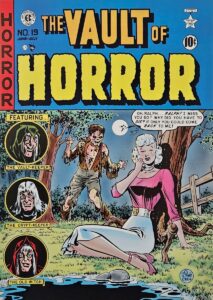
And art in general, especially pulp art. A lot of my ideas are influenced more by cover art than actual pulp books – the art of Wally Wood or Frank Frazetta, Mike Mignola. I could look at pulp art all day. It sets my brain on fire. The little boy in me just responds to it. A lot of my writing is influenced by covers of old EC horror comics – garish, over the top, silly – and it makes me happy.
What do you do to keep that little boy in you alive when you write?
I embrace it. I embrace the over-the-top aspects. I used to be shy about it, but now I’m the opposite. I keep that little boy happy by being honest – by embracing the excess of genre and making it work. I keep the adult in me happy by treating all the characters as three-dimensional people, not caricatures. I can have mad houses on the moon or pirates sailing to hell with Satanists aboard – those make the little boy jump up and down – but I treat the people as psychologically real. Their problems are as serious as if they were in an Updike story. That keeps both parts of me happy. You can tell human stories and still have a great time.
One rule I set myself is that if it’s in the title, it has to be in the story. You can’t call something Crypt of the Moon Spider and not have a moon spider. If you have a werewolf in your title, you’d better deliver a werewolf. I take it all seriously – no winking, no coyness, no embarrassment. Full steam ahead on all of it.
Are there any other rules you set for yourself when you write?
Not specifically, those are the main ones. I do keep the reader in mind. Every work of art is a collaboration. I provide the blueprint, and the reader fills it in, makes it three-dimensional. I can’t anticipate what psychological apparatus the reader brings – biases, emotions, whether they’re visual thinkers or not. I put down the blueprint, and they fill it up. That’s when the story lives. It doesn’t live on the page. It lives when it’s read. I’m not writing to please a reader, but I’m taking the reader seriously as a collaborator. I don’t want to half-ass it. I don’t want to be condescending or didactic. I trust the reader to be as capable and smart as I am. That gives me permission to go as far as I want, trusting the reader to meet me there. Not to do so would be condescending.
Every once in a while, on a smaller scale, I’ll set little challenges for myself, like playing with point of view or writing a story without flashbacks. Things no one will notice, but it keeps me on my toes.
I love all of that, especially writing with the reader as a collaborator. What you’re saying is that it’s my fault I had nightmares about spiders in my head.
You could have made those spiders pink and fluffy.
Who is your reader? Do you have a first reader in mind when you’re writing, or is it an idea of somebody?
It’s not a person. It’s an abstraction. There is a first reader I envision, but I don’t know anything about them. They’re just a kind of presence. They’re the one who gets me, who understands. Not necessarily the one who always picks up what I’m trying to say, because I’m not always clear, but the one who reads with the most grace. The one who isn’t willfully misinterpreting.
You can’t get caught up worrying about being misunderstood. You have to anticipate a good-faith reader. That’s who I’m writing for, a reader who’s hungry for the same kind of weird I am, who has the same appetite for darkness and for sadness and sweetness – that weird mixture I crave. I’m writing for my own good-faith reader.
If you ever need a face to picture, you can think of mine because you’ve made me a good-faith reader. I’m thrilled to add you to my list of authors whose work I’ll always pick up. I’m really excited for the conclusion to the Lunar Gothic Trilogy. Nathan, you’ve been more than generous with your time. I really appreciate it. Is there anything else you’d like to share with the RUE MORGUE readers?
Specifically, no. I was stoked to get this interview request because I’ve been a RUE MORGUE reader for years. Love the magazine. It’s a personal bucket-list item to be in it in any capacity. I’m so grateful for anyone who follows me down my weird little path. I want them to know they can’t imagine how valued they are. They are very much loved, and I’m grateful.
CATHEDRAL OF THE DROWNED is available now from TOR Publishing Group/Nightfire.