

Starring Jimmy Dempster, KateLynn E. Newberry and J. Gaven Wilde
Written by Desiree Hansen and Scott B. Hansen
Directed by Scott B. Hansen
Epic Pictures
Perhaps the worst sin in horror film is to create without passion. If you love camp, go forth and make a film that would make John Waters himself puke happiness. If you love gore, beat your heart dry and make Herschell Gordon Lewis proud. And if you like strange sex and body horror, dance like only Julia Ducournau is watching. Do what you do, but care about what you are doing, dammit. Films like DEVOUR are prime cautionary tales of exactly what happens when a horror film does not care about itself or its audience. It delivers a hollow, regurgitative experience that adds no joy or passion to our beloved genre.
The film purports to be a monster-laden heavy metal journey of an all-woman band on tour who encounter a variety of classically defined monsters. While some of this might be true to a certain extent, it should not be described as these women’s stories. They just happen to be in it. The actual film focuses on their “roadie” and his long existence as a vampire throughout history. Through voiceover, Jerry (Gus Langley) introduces and steers all the exposition and lore in the film, and acts like more of a band manager than one of their helping hands.
While on the road, this metal band plays a little, but does not seem bound for stardom or even financially breaking even from their small gigs. One night, they encounter a woman who needs to be rescued and a wealth of monsters who want to take them all out of commission.
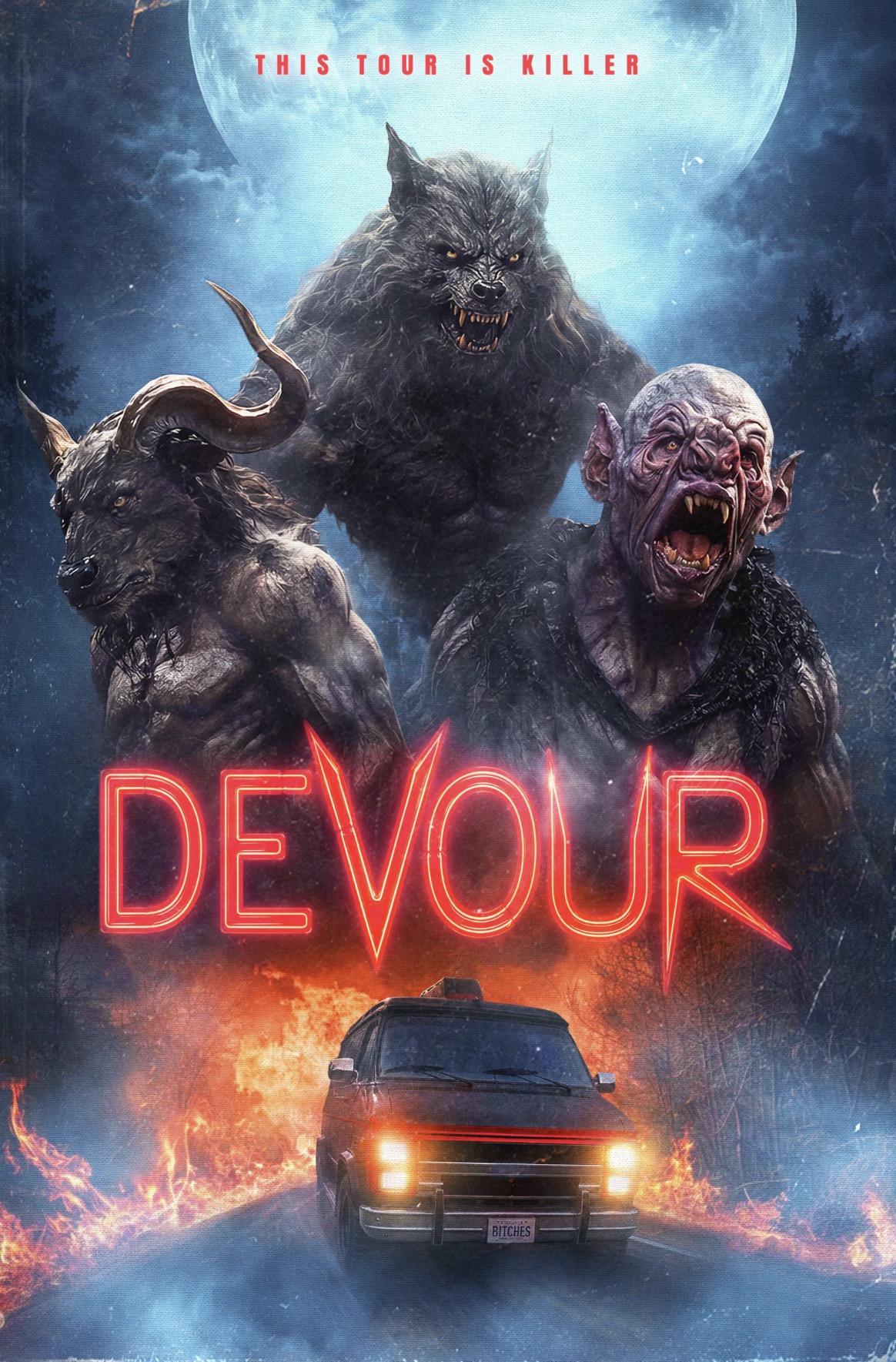
The characters are as thin as the overall plot, but that need not be the reason DEVOUR fails overall. Afterall, plenty of delightful films throughout the annals of horror are more about the kills and effects than the story. But DEVOUR fills nearly all of its action with AI generated images, and poorly rendered ones at that.
There is of course a debate to be had about the use of artificial intelligence in the world at large, and in creative endeavors specifically. AI denies artists opportunity and wages, negatively impacts the global environment on a catastrophic level, and generally contributes to the enshittification of our current society. But DEVOUR adds insult to injury by using plain bad AI and uses it too dang much. What could have been a radiant bloodbath of fangs and viscera is instead a soulless and uninventive creation. The images all have that overly-smooth, oddly-lit look to them, and has yet to climb out of the uncanny valley.
The disappointment in the saturation of AI in DEVOUR is not meant to convey a get-off-my-lawn energy. New tools in filmmaking arise all the time, and the same comments were made about CGI when that first settled into cinema’s toolbox. However, the fact stands that anything used poorly deserves criticism, regardless of all the additional negative context. Bad filmmaking is bad filmmaking, no matter how shiny the new toys might be.
‘Tis a pity too, because the headcount and inventive kills in DEVOUR could have been such fun. One specific scene has 22 head explosions in a row (I counted). That’s ripe for cheering from horror fandom, but not when it looks so uninteresting, repetitive and predictable.
One positive note is that all of the real humans in DEVOUR understood their assignments. Langley absolutely chews the scenery, whether it be on-screen or via narration, and perfectly sets the tone for what was being attempted here. This lack of subtlety and nuance is befitting of the material and the rest of the cast seems to follow his lead.
Unfortunately, all of this adds up to a tedious and generally charmless experience. DEVOUR feels hollow and without any concrete evidence of passion or affection for either movies or their audiences. A sad trombone sound, made into a 112 minute slog.