By PAYTON McCARTY-SIMAS
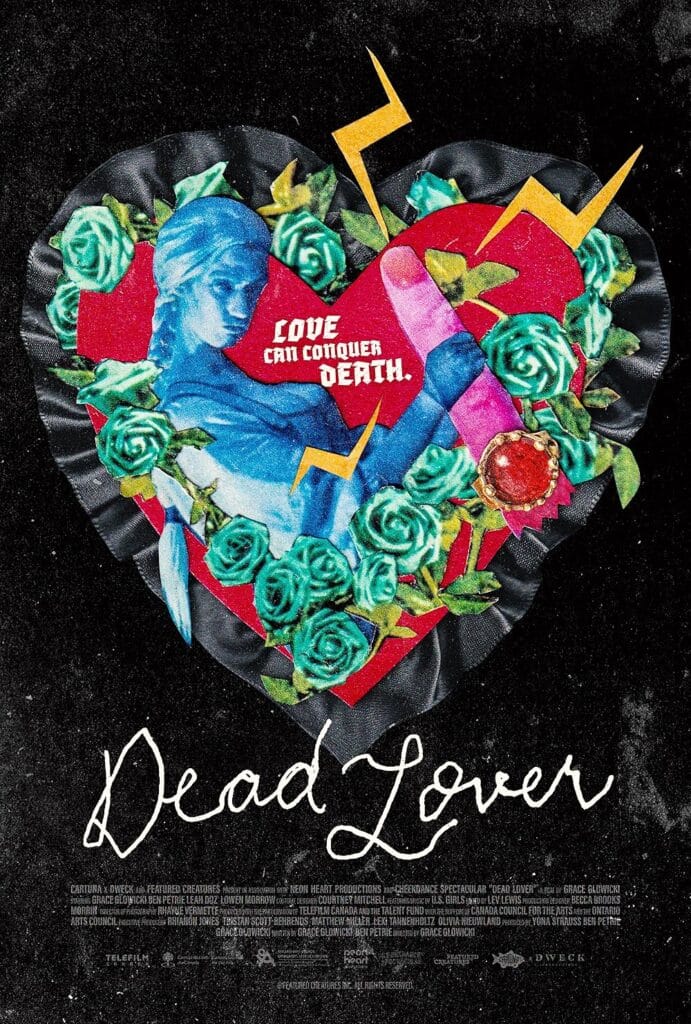
It’s been a banner year for Grace Glowicki and Ben Petrie. From their co-starring roles in Dusty Mancinelli and Madeleine Sims-Fewer’s sci-fi mindbender Honey Bunch to Petrie’s prominent performance in the explosively successful new comedy Nirvanna the Band the Show the Movie, the filmmaking couple behind Tito (2024) and The Heirloom (2024) have been all over the indie film scene in 2026, And that was all before the two brought Glowicki’s latest directorial turn, DEAD LOVER, screaming from the dirt, three-foot-long finger first. As RUE MORGUE learned over the course of a long, freewheeling conversation, this raucous, raunchy horror comedy about a smelly gravedigger willing to literally raise the dead before losing her first love is an experimental, feminist Frankenstein tale fashioned from free-association, Freud, Sims characters and Amazon wigs. It’s also a testament to the power of romantic partnership when it’s blended with a shared commitment to art. Creative collisions and artistic syrup abound!
It’s also been such an amazing year for you two personally, between DEAD LOVER and Honey Bunch. Congratulations! How are you both feeling? This must be so exciting for you.
Grace Glowicki: It’s pretty sweet, and it’s obviously colliding with a big time in our life story, too, becoming parents and stuff. So multiple babies are going on! I think it makes us feel pretty happy about where we’re at in the sense of our careers, but also, location-wise, I think we’re pretty happy to be in Toronto right now with a bunch of these people.
At the same time, it’s funny. DEAD LOVER, we shot in 2021; Honey Bunch, we shot in 2022, and so all of these films are reaping the fruit of those past efforts at the same time. I think, for us, it’s a mix of gratitude and excitement for the fact that those films are getting seen, but there’s also a champing at the bit to make something new. Those films are coming out right now, but they’re in the rearview mirror at the same time from a creative standpoint, you know? Relics of the past. Like, I’ve changed! I’ve learned so much! I want another kick at the can! But movies are so freaking slow! It might be another couple of years before one of us gets to direct again, which is so sad. It’s hard to wait between movies, but it’s also about trying to learn patience and enjoy the writing process and act in other people’s movies.
How are you finding the process of talking about DEAD LOVER now, and what do you wish that people asked you about more? How are you thinking about this film in the rearview, even as you’re still actively promoting it to new audiences?
GG: What I most like to talk about is the forward-looking stuff, stuff that I’ve learned from this process that I want to apply moving forward. Sometimes, the hard thing about doing press is that you do feel this dissonance. You’re trying to talk about yourself in the past tense quite often. The most common question that I’ve found for this film is, “How did this come about? What caused you to make this movie?” And the truth is, you can’t remember the specifics! With Honey Bunch, it’s always, “What did you think when you first got the script?” I can’t remember! So it’s this effort of trying to get back to this memory of understanding who you were then, but it’s kind of an unnatural way to discuss something.
Ben Petrie: It’s funny, I mean, the first question that I want to ask anybody when I’m hearing about their movie is, “Where did you come up with the idea?” But as you said, Grace, it is kind of like trying to articulate the exact moment something emerged from your subconscious and coalesced into something material. And the way that Grace generated this project, particularly, was by having conversations with a lot of different people –very freewheeling conversations with collaborators and friends. I feel like the idea initially coalesced for her out of the centrifugal energy of all of those conversations at once, so it does always feel like a really elusive thing to try and pinpoint. As for what I like to talk about with the project, I got to view it from a different vantage point, watching Grace go through all the stages of making this movie. So, none of it feels quite of my artistic past because a lot of it was actually just stuff that I was witnessing in Grace’s process that I was learning from and inspired by.
What is the nature of your artistic processes, and how do they overlap? Do you think it’s evolved?
BP: It varies project to project. On DEAD LOVER, Grace started out having conversations with six people, and I was one of those people. I didn’t know what the conversations were like she was having with the others, and it was really free-associative dialogue. She would call it “popcorn talk.” We were just letting kernels of ideas pop around in a free, unstructured way, and she was guiding the process according to her own interest and curiosity. Then, at a certain point, once she had taken all those conversations and distilled them into the essential syrup of the story and the character and the movie and the world, we sat down at our kitchen table and took the material that she had put together and drafted the version of the script that we turned into the movie.
I feel there’s some kind of productive tension between the way that we approach material. When we would have those free-associative conversations, for example, I found it extremely difficult to relinquish the desire to try and nail down the story and to really just let things be free and associative. For me, that was much more difficult than when we sat down to take all of that syrup and put it into the shape of a screenplay. There was some productive tension there between a more associative way of thinking – the network of ideas that Grace has – and perhaps the more linear approach that I took to the drafting process. It works well together. When we actually wrote it, one of us would do what we call the “downhill ski” of the scene, which is like, “No looking back, do a draft of a scene without any kind of impulse towards revision entering your minds, just put a blindfold on and roll down the slope.” Then we’d pass that draft to the other person, who would go through and architect the scene with a little bit more structure. We would go back and forth and back and forth and back and forth on scenes that way.
GG: I think we’re so different, and that’s at the heart of it. We think differently, and at the end of the day, we just have so much respect for each other’s brains and differences. That’s what holds us together. But we’re both equally obsessed with the work, so that’s at the heart of it too. When we’re home, probably an hour doesn’t go by until we find ourselves talking about something related to movies. So the experience of being a person in this marriage and this collaboration all just sort of blends. It feels quite natural and conversational. It’s pretty cool. Then, sometimes, of course, when we’re both on a project, and it’s crazy, or we’re both in this interview now, and we have the baby here with us. It’s so crazy that we work together, too, because we’re fusing all our commitments in some way. That can be challenging and nutty, but beautiful too. There are pros and cons, but I don’t think I’d have it any other way.
BP: One very last thing I would add about it is that when I first met Grace, it was on a film set. She was acting, I was AD’ing [assistant directing], and we started talking about movie ideas a little bit. I’ve thought before about, “Okay, what kind of a person would I want to be my cinematographer as a director?” And the temptation was to say, “I want someone who thinks the same way I do. When I say what I’m thinking, they know exactly what I mean. We speak the exact same language.” But ultimately, I’ve always found that the best cinematographer complement to a director is someone who thinks a bit differently. And when I met Grace, my curiosity was so piqued by what she was saying. I was so interested.
It seems like there’s a profound throughline of a kind of freewheeling collaboration between you that is very much at the heart of DEAD LOVER. Some of the dialogue has an improvisational tone. I’d love to hear a little bit more about how it came together. Can you tell me a little bit more about that process?
GG: The whole thing developed through improvisation in the development process, so I think that’s why it feels like there’s improv in the film, whereas the truth is, the only thing that’s truly improv is the sailor characters. Everything else is pretty much word-specific in the script. But I started spitballing with my friends Matthew Devine, who’s a therapist, and Haya Waseem, who’s a director, Ben, and Harry Cepka, also a filmmaker. We just talked and spitballed. Then, we took that oral story, and I brought it to Adam Peloza, Carrie Peterson and Lowen Morrow in Toronto in a rehearsal studio, and we workshopped it and developed it on its feet. Then, Ben and I took what I had learned in that process and committed it to the script.
Is this process how you typically operate as a writer-director, Grace, or was this your first foray into this method?
GG: This was the first time I did it like this, but I fell in love with it so much that I’m writing my next movie doing a really similar thing now. I’ve collected this little weird group of friends, some in film, some not, and we’re just spitballing and talking about stuff! They’ve been coming over once every couple of weeks, and we’ve been reading a Sam Shepard play out loud because there’s something about Sam Shepard that I think might help this movie get written. So, we read the play aloud, eat pizza, and drink wine, then afterwards we all talk about whether anything in the play made us think about this character we’re developing, and we just free-associate. I’m taking that forward with me because it allows things to be free. Follow your curiosity, follow your desire, follow your intuition. You know, when you meet someone and then for some reason you’re suddenly thinking about someone you went to, like, grade seven with? I’m interested in why that person came into your head when you met this other person. I’m trying to support the group to trust anything that comes to them, and to trust that there’s a reason why we’re having these associative thoughts, as random and inappropriate or anti-social as they may seem.
I’m using that in myself and in my friends as a way to build a story that feels really exciting and kind of nerdy to me. It’s also been such a treat to have an excuse to hang out with people I think are really smart and to poke their brains. It feels so generous that they trust me to do that with them.
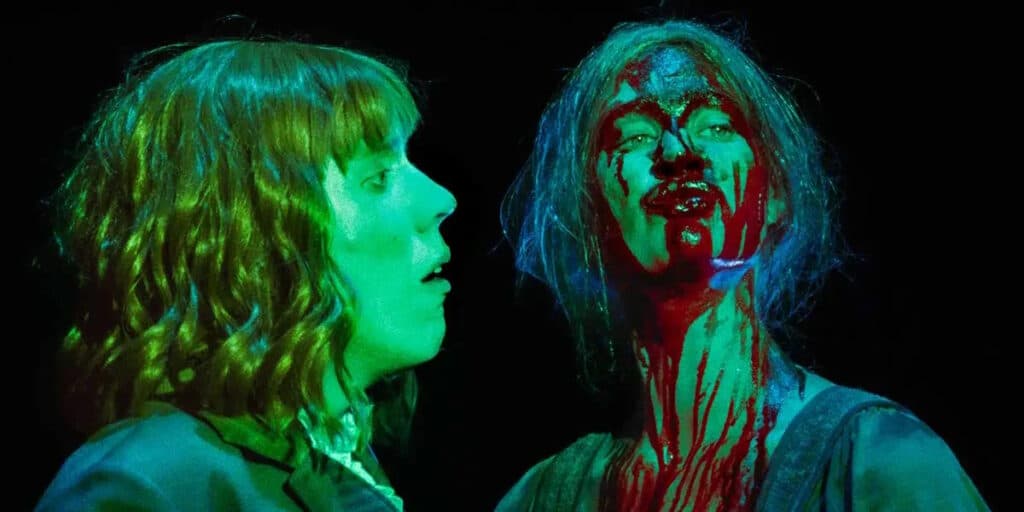
Something I really appreciate about DEAD LOVER is that in its signature, freewheeling way, its erotics are very queer and loose and wonderful. I’ve seen this film twice, and all of my friends have talked about The Widower, who’s very androgynous, like, “That is the hottest person ever!” Talk to me a little bit about the way eroticism works in this movie. It’s a beautifully raunchy, horny film.
GG: When I think of the erotics in the thing, I think I just allowed my sexual imagination to be completely untethered. And I think so often when we label things, our imaginations become restrained by these boxes. I wanted to approach it with a spirit of free expression, and it’s so interesting that when you let yourself do that, it does come out queer, because queer, to me, means free and fluid, and that’s what I believe sexuality just is inherently. We like to confine it and stuff it into these labels, but also, there’s a really fun history in comedy of playing different genders and being sexually inappropriate in all these ways. There’s this imaginative freedom, but then also there’s honoring and getting to play in this history of comedy like Monty Python and Mel Brooks movies. I think it came out that way because when you want to make inappropriate jokes, you do things that you’re not supposed to in normative culture.
BP: The sexuality is also a product of the hive mind of people who helped to generate the syrup, so there are a lot of different people’s sexualities in there. That gives the movie this queer feeling because there’s a broad color spectrum of sexual impulses and gender orientations.
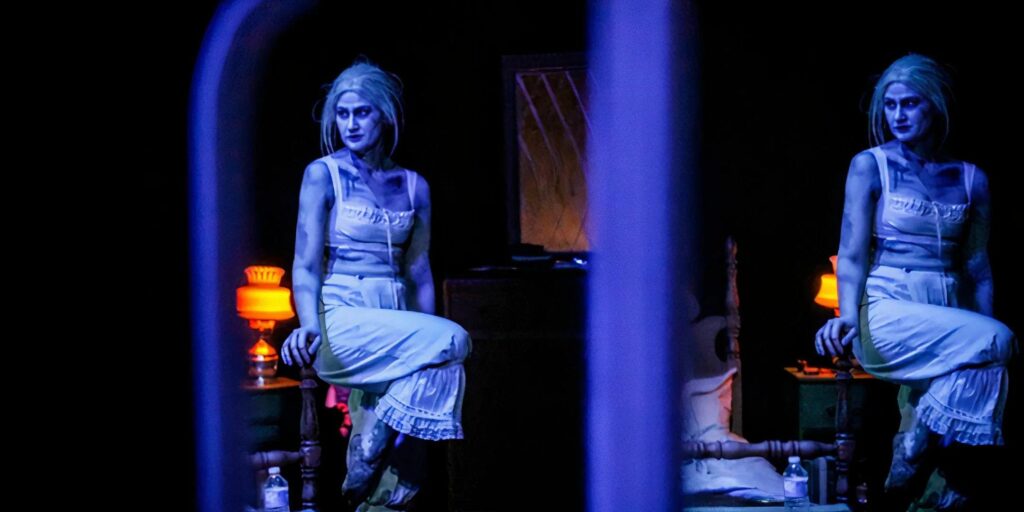
DEAD LOVER also has such a beautiful multimedia aspect. I remember during a Zoom Q&A that you guys did for a Stink-o-Vision screening recently, you were talking about how one of the actors is a circus performer. Combining the perspectives of a therapist and a circus performer is so unique, but the Stink-o-Vision itself speaks to that, too. Can you talk to me about your favorite collisions of multimedia? T
GG: One of my favorite collisions was some of the practical camera effects that we were doing. Like, for the rainstorm, they had a cookie tray above the camera with holes punched in it, and then they would just pour water through, and it would come through in front of the lens. That felt like a collision of the dollar store and the camera department, which was really cool. Or for the scene when we’re swimming in the ocean, it was just us in a kiddie pool on the studio floor. Again, the dollar store and filmmaking!
BP: On the dollar store filmmaking collisions, too, the costumes versus the wigs…
GG: Yeah! The costuming is like high art, like, hand-sewn corsets for example, with a wig that, like, slid back to here!
BP: A $5 Amazon wig! Yeah, not to say that the hair department wasn’t also pouring their artistry into it, but… Well, it takes a lot to make an Amazon wig look good!
GG: Oh my God, totally! We did get the wigs from Amazon for like 30 bucks a pop. But then someone in our makeup department was at the Oscars last night for Frankenstein! Meanwhile, for us, they’re spraying the Amazon wig. So, the collision is this $30 wig with this person who’s worked with Jim Henson painting it. It was a really cool collision of high art and low art.
There was a similar contrast with Meg Remy, who scored the film. She had never scored a film before, and we were using public domain, 1920s wax cylinder tracks that are free from the public archive and scraps from her old hard drives of unpublished songs. The score felt like a collision, too, between this movie that I had made and this woman’s bits and bobs that she hadn’t used, as well as her inventive ideas of how to take other things that we had access to that weren’t classic scores. And even within that, there’s the collision of wax cylinder, hyper-analog recordings with her 2010s digital original tracks recorded on tape.
BP: There’s possibly a collision going on as well between the old-timey setting of the movie with the Looney Tunes editing and cartoon sound effects, plus the 16-millimeter film and all of these digital zooms and effects.
GG: It’s such an exciting question because the whole film is a Frankenstein of these parts coming together that shouldn’t be together.
DEAD LOVER exists in such a classical genre tradition, but it does feel so unique for that reason. It’s got so many flavors and smells to it. Are there other things that you guys were pulling into the soup as you were developing these characters?
GG: I really don’t know that much about Iggy Pop, but there are these photographs of him performing from the ’70s, where it’s him with a silver glove, and he’s just pushing into the camera with his eyes bulging and his heart full of emotion. At least performatively, for the Gravedigger character, looking at pictures of him, spotlit, surrounded in blackness with that minimalistic prop and this manic longing for connection and inability to get it, helped me find a childish approach to love in the world.
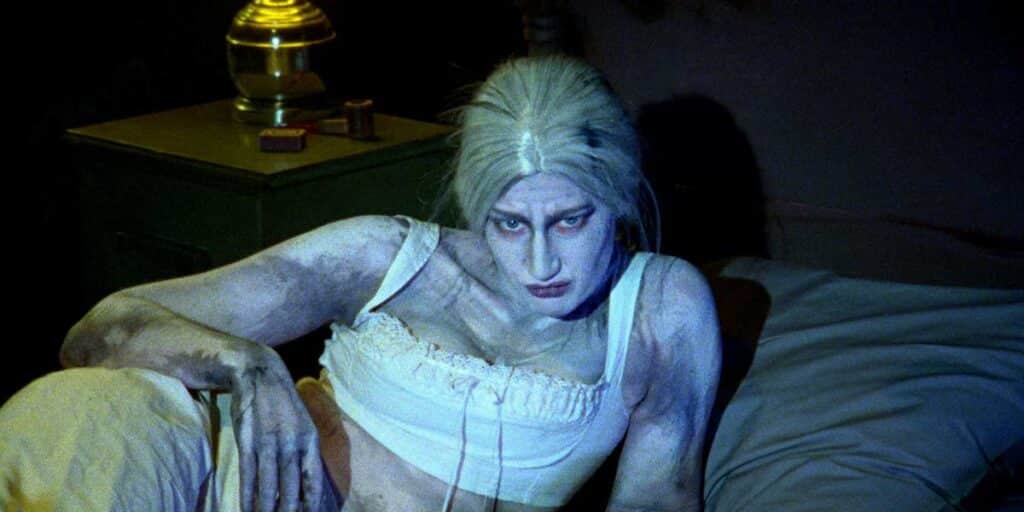
BP: When I first put on the wig and had the makeup applied, I looked into the mirror and immediately saw my mother! [Laughs]. The face of my mother looking back at me unlocked something about the character for me. Then, another reference that I remember drawing some inspiration from for Lover’s sexuality is a letter that Napoleon sent to his mistress, Josephine. He’s been away at sea for some time, and he sends Josephine a letter that says, “I’ll be home in three days, darling. Don’t wash.” “Don’t wash” is literally in the movie! That idea of someone who is going to be driven wild by the rank, natural smells of the other person unwashed really hit the spot for me and unlocked the character.
GG: Ew! Eeeeew! Ew! Ew! [Laughs]
By the way, do you guys still have the finger?
GG: Yeah! It’s in our storage locker. It’s covered in hairs… It’s disgusting right now, but it’s around!
DEAD LOVER arrives in theaters on March 19.