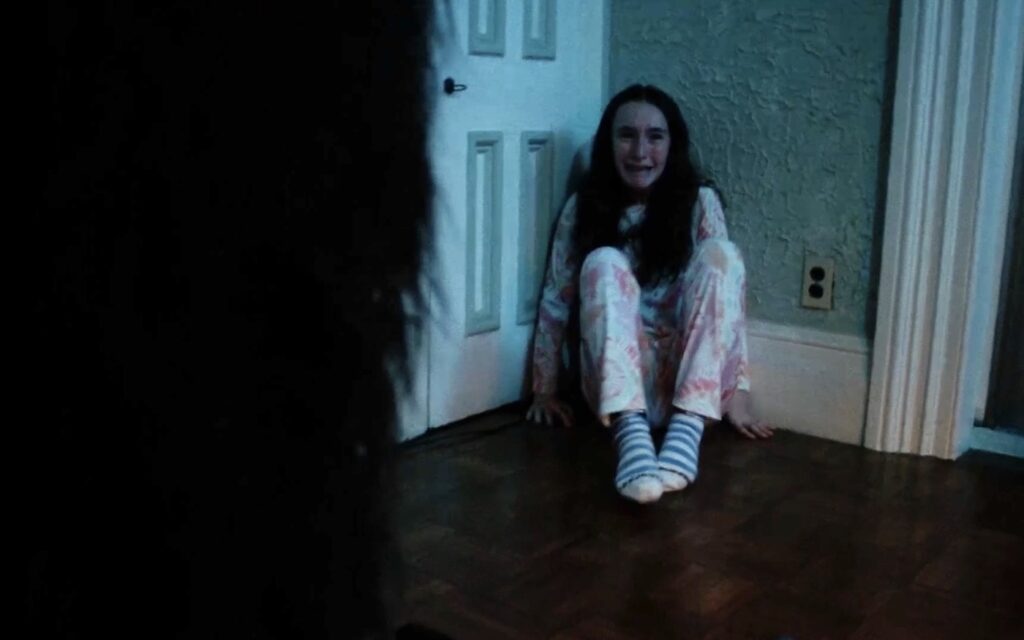


Starring Scott Poythress, Johnny Sibilly and Alexis Louder
Directed by Josh Lobo
Written by John Lobo and Rowan Russell
Restricted Pictures
Ambiguity in films can feel like a lot of different things. There is sometimes the sense that the filmmakers themselves do not know what is happening (which can be unfortunate and disappointing). There can also be situations where the characters are not aware, but the audience knows everything. And—a more difficult cinematic feat—there are films whose creators deftly pull the puppet strings, and the audience has no choice but to anchor themselves to the unknowing characters on screen in hopes of figuring out just what in tarnation is happening here.
Director/co-writer Josh Lobo is only two feature films into his career to date, but he has swiftly established his flair for toying within that final category of disclosure. In both 2019’s I TRAPPED THE DEVIL and now in NIGHT AFTER NIGHT (which just played the UK’s Tubi FrightFest), he teases the tension between truth and fiction, and makes everyone around him work hard to suss out the difference.

NIGHT AFTER NIGHT is structured around characters and their experiences, not the typical linear timeline. Andy (Scott Poythress from THE SIGNAL, whose co-star AJ Bowen also appears here) is up first, and is the movie’s emotional and story anchor. A night watchman at what seems to be a private academic institution, he goes in and out, day by day, without much general fanfare. He lives in a motel, and it is clear that he is running away from his old life and not necessarily running toward his new one. His sole social moment each day is having a cigarette in the atrium with the other security guard, Willis (Johnny Sibilly), before they trade duties. Clock in, clock out, rinse, repeat.
The building this institute is held within is a tidy metaphor for the work within the academic body itself. It appears to be out in the open, with transparency and clear glass across every eyeline and story. But in actuality, the intention of openness is an illusion. The building is dark and guarded, with no easy way to see what is around each corner. It just wants you to think you’re not being lied to.
The building is also undergoing construction on its top floor, and appears in black and white whenever a guard stops by during their shift to check up on it. A room at the end of the hallway up there soon becomes of interest to Andy and Willis after they hear noises up there one night. Even more peculiar, those sounds become nightly occurrences.
While it would be accurate to describe the following encounters and incidents as a continuation of the body-horror tradition in our beloved genre, it is the reaction and interpretation of these encounters that truly shapes the commentary within NIGHT AFTER NIGHT. What Willis and Andy find is quite natural. In fact, what they find is one of the most natural things you can imagine. (And yes, I’m being intentionally vague.) But their reactions to it call drastic attention to their different experiences in the world and needs within their current states. Trust, lust, violence and fear are all primal reactions that these men leap to without thought or planning. Lobo has created within the world of the film a mirror to reflect back human nature, and we may not like what we see.
This is not to argue that NIGHT AFTER NIGHT is an exciting thriller with gore and sex at every turn. That would be misleading, and lead to nothing but disappointed audiences. Rather, it is a film that carefully drips questions faster than it oozes answers. It intrigues and envelops, but it is not the kind of movie that has any interest in tying itself up in a neat bow. The process and processing of what is happening is the point, and it absolutely delivers on providing that journey.
Poythress delivers a quiet but purposeful portrayal of a man who may be broken, but is not completely lost. It would be too much of a stretch to say that Andy has hope, but Poythress never plays him as a caricature. He brings depth and care to the complex and private role. Simon Waskow’s score deserves the accolades it has earned as well. The composer previously worked on LUZ and CUCKOO, and for NIGHT AFTER NIGHT his music keeps the film moving right along.
NIGHT AFTER NIGHT is uninterested in telling anyone everything. It is not here to dazzle or to excite. Rather, it takes its time to slowly submerge the characters and the audience into scenarios where the very nature of human connection and reactions is questioned.