
The road trip of vengeance is given a distinctive spark in IS GOD IS, which pulls into theaters this Friday, May 15 from Orion Pictures and Amazon MGM Studios. Aleshea Harris makes her screen directorial debut on the film, based on her award-winning play, and talks below about that process, along with a few words from her leads.
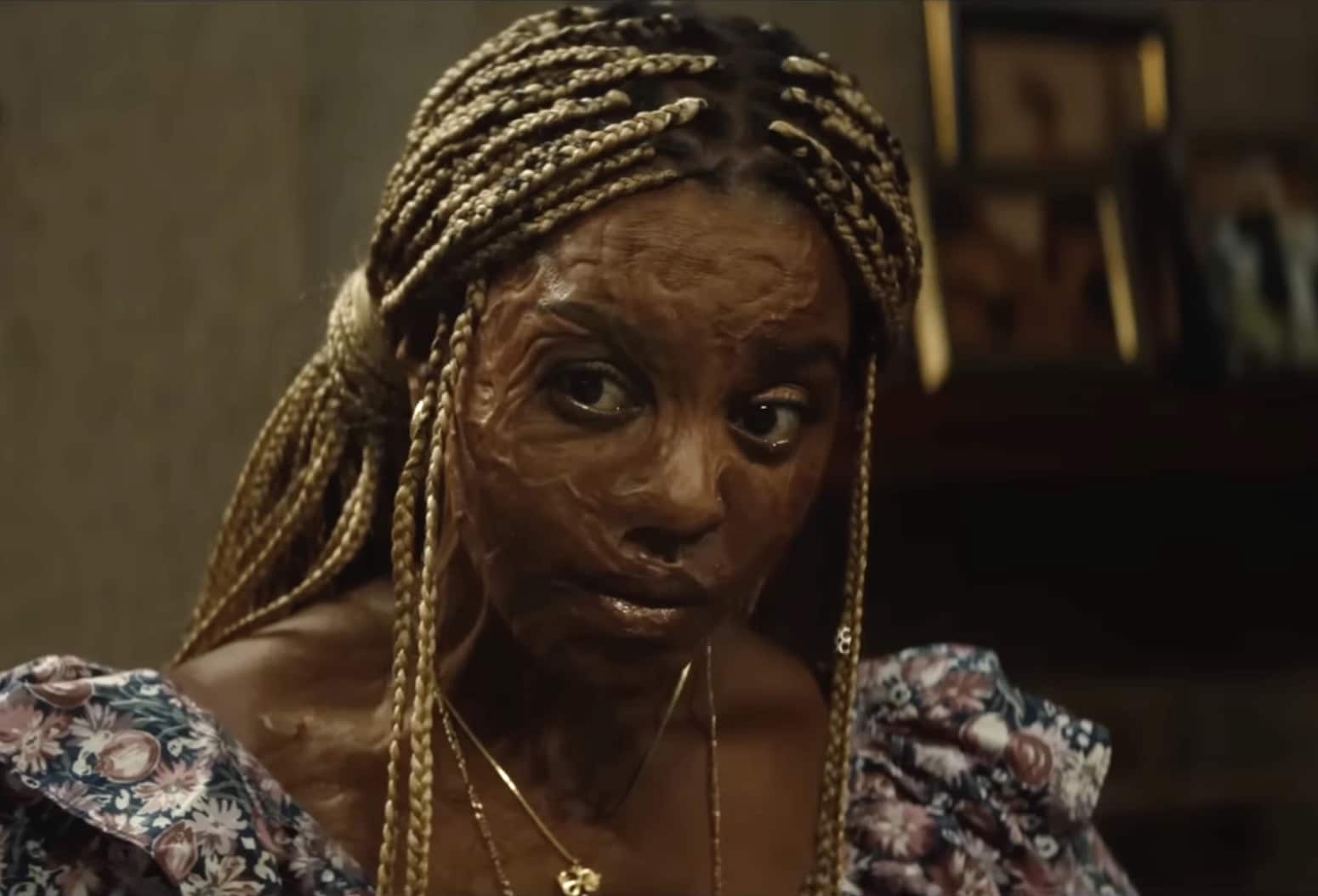
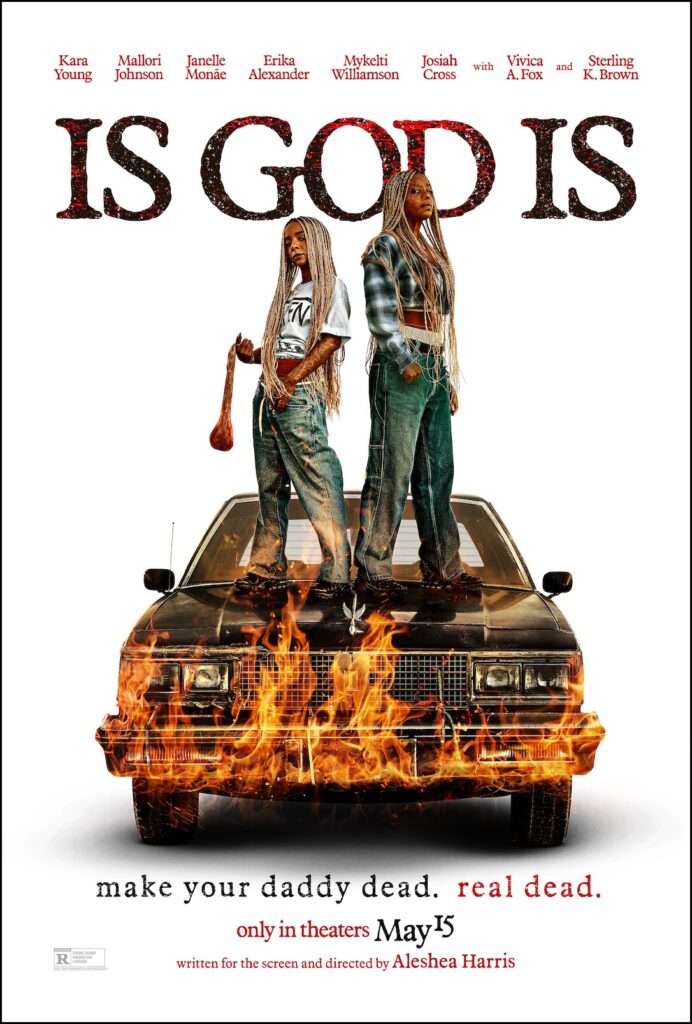
IS GOD IS stars Kara Young and Mallori Johnson as Racine and Anaia, twin sisters bearing extensive burn scars: Racine on her arms and body, and Anaia more visibly on her face as well. Racine has been ferociously protective of Anaia since their childhood, and a letter from their mother Ruby, who they refer to as “God” (Vivica A. Fox), leads them on a mission to avenge those wounds. Calling the girls to her deathbed, Ruby—who is similarly scarred—reveals that their long-absent father was responsible for their disfigurement, and she has called on her daughters to “Make your Daddy dead. Real dead.” Thus begins an odyssey of encounters—some violent, some darkly comic—with others who have crossed their father’s path, on the way to a reckoning with the Man (as he is credited, played by Sterling K. Brown) himself. Harris brings a heightened, mythic and at times playfully offbeat tone to her gritty narrative, establishing herself as a individualistic storyteller who’s also a born filmmaker.
IS GOD IS plays out in the great tradition of revenge cinema. Were there any past films that inspired you?
ALESHEA HARRIS: For sure. In the very beginning stages when I was writing the play, I definitely went back and looked at KILL BILL, as well as LADY SNOWBLOOD, which inspired KILL BILL, ONCE UPON A TIME IN THE WEST, THE GOOD, THE BAD AND THE UGLY. I looked at OUR FATHER, THE DEVIL at some point. MOTHER by Bong Joon-ho, I watched again. There was a lot that I looked at as I was trying to find my way into my own version of the revenge story.
What was the journey of taking your play to the screen? It’s not often that a playwright gets to direct the film version of their work.
HARRIS: Yeah, I feel very fortunate that one of the producers, Janicza Bravo, said, “You know, you should direct this. This is your story.” And then the other folks around me, the other producers at the studio, were supportive of that. That’s the only reason I got to do this; any one of them could have said, “No way,” but I had the backing of all these other people.
IS GOD IS is a very sprawling film, so what was the process of translating something that was previously stagebound into a screen story where you could go anywhere?
HARRIS: You know, I had to think deeply about where the sisters went, what the look of each place was, and how it deepened or enhanced the story. In the stage version, we have actors pretending that they’re traveling, but to actually have a car, then it begs the question, what is the car? What are the implications of that, right? Where do we go? What do they see on the horizon as they journey? So getting to think about the car, and what we learn about them socioeconomically from their car, was an invitation to think more deeply about time and space and what it meant to move these women through time and space.
The movie runs an emotional gamut; there’s a deep love between the sisters, as well as intense scenes of violence and confrontation. How did you deal with balancing those out?
HARRIS: That was something I thought a lot about on the front end: how to land the tone. I think it helps that this story has a mythic register, which allowed us to do more than if we were strictly going for realism, right? I tried to establish for the audience at the outset that there are many things that can happen in this universe, and that its contours are wide. I mean, we have examples of movies where the humor is there, but also the pathos, and the audience is invited to take them both seriously, if you will. So it was a matter of paying attention to what was happening and how it was connected to the story.
I believe proximity is important when you talk about balance. Like, how you can’t do something that’s meant to be hilarious right after something terribly tragic. So where are those moments placed inside the narrative? Also, speaking with the actors about what we were doing and why, and what this line or that line was supposed to do. Getting hyper-specific really helped to keep that balance.
You also worked very heavily with prosthetics, so can you talk about that experience?
HARRIS: Shout-out to Vincent Van Dyke, the makeup artist who designed those prosthetics with his team. I got to go to his studio, and we talked about character. He’s very collaborative, very sweet. He let me help with the shape of the prosthetics and where the burn scars would live specifically. I remember telling him that I wanted the scars on Anaia to look like a mountain range, and he was down for that kind of weird artistic and poetic gesture inside of creating the scars for these women. It was a great process. The actors spent a long time in those prosthetics, especially Mallori, and they were real troupers. I’m so glad that they turned out the way they did.
What was the process of casting the leads—finding not only the right people individually, but a duo who had the proper chemistry as sisters?
HARRIS: That was a bit of a journey, but it was fun. I’d worked with Kara before, I’d directed her in a workshop of a play of mine, and remembered her and was like, “We need to bring in this young woman.” And casting called Mallori in. There was a lot of auditioning them with other people; we started out having them in scenes with other folks. And they would kind of dominate the scenes, each of them. Whoever they were with, they would dominate. And then when I put them together, neither could best the other, if you will. So I knew this was a great pairing. They had tremendous chemistry—they were just in sisterhood, in sync, and really took care of each other from the first time they were in a room together playing out these scenes. They did a tremendous job of being the spine of this story. It was a lot to hold, and they did it well.
Mallori and Kara, how did you get into the headspaces of these complex, intense roles?
MALLORI JOHNSON: I felt a huge responsibility when I was doing this movie to honor Aleshea’s words, to honor her story, to honor her integrity as an artist, because I deeply respect her so much. And I respected what I was doing. I was so grateful to be there that I was compelled to put my all into it. And every time I had to do a scene that was touching on something higher than me, it was already in the language. It was not difficult to access, because Aleshea is so brilliant that it was right there, from the moment I first read it. It just permeates you. I went to those places with the help of Aleshea, with the help of Kara, with the help of feeling connecting to something higher than me. That’s what the story is: It’s all these different voices. It’s the voices of a thousand women being poured into one vessel through one center point.
KARA YOUNG: I feel the same way. I was absolutely carried by Mallori, and by the script. The thing with great writers is, you can read one line and it can crack you open in ways where you’re like, “Whoa!” It’s an indescribable kind of feeling. And also, what was required was for us to enter those places. I believe there is a spectrum of thought and feeling we all have access to, and our instruments are trained, I guess you would say, in the ways in which we can access certain things. I don’t want to say it’s with speed or ease by any means, but with research and intention and love at the forefront of it, we could get there. And also, with the help of Aleshea as a director. These are her words. This is her baby, and we are in service to the work.
Aleshea, can you talk about casting Sterling K. Brown, who’s terrific as the Man?
HARRIS: I knew Sterling was an amazing actor who could pull that off. It’s just a matter of showing these actors love on the front end, sending them the script and crossing your fingers. And lucky for me, Sterling responded well with a lot of enthusiasm for this role. And I’m so glad; I mean, he’s exactly who we needed. It was similar with all of the other actors who surrounded our beautiful breakout leads. All of them, I sent a nice note to, and we talked about it, and they got on board.
What would you say was the most intense scene to shoot?
HARRIS: There were some that were scary for me, but weren’t the most intense or violent scenes in the movie, you know? But as a director, technically, trying to figure them out was tricky. I would say maybe the culminating scene; I don’t want to give anything away, but when we were using real elements that could do actual damage, I would get a little nervous. That climax was really intense, because it was a real concern that something could actually happen.