By MICHAEL GINGOLD
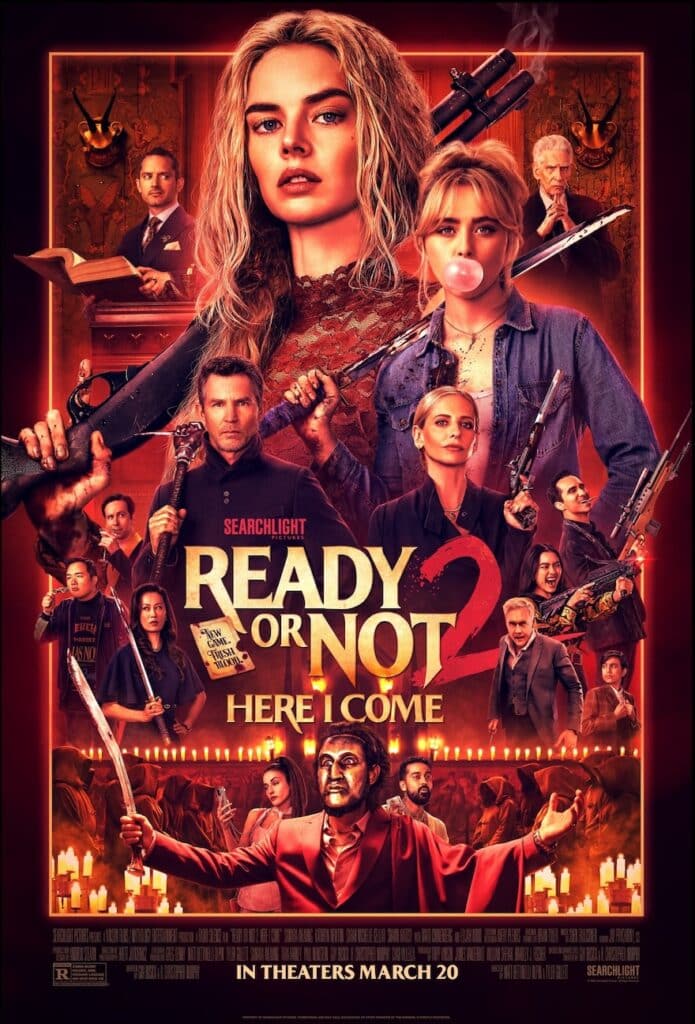
Samara Weaving is fighting for her life again, this time joined by another fright fave, FREAKY and ABIGAIL’s Kathryn Newton, in READY OR NOT 2: HERE I COME. Returning directors Matt Bettinelli-Olpin and Tyler Gillett discuss the eagerly awaited sequel below.
Once again scripted by Guy Busick and R. Christopher Murphy, and opening Friday, March 20 from Searchlight Pictures, READY OR NOT 2 picks up exactly where the 2019 horror sleeper left off. Grace (Weaving) has survived her bloody cat-and-mouse game with the Le Domas family, only to find herself and her sister Faith (Newton) at the mercy of several human-hunting families. The sequel’s cast is stocked with famous genre faces including Sarah Michelle Gellar, Elijah Wood and David Cronenberg, and ups the splatter quotient while introducing new sides of the diabolical Council. Bettinelli-Olpin and Gillett here return to their own creation following their direction of 2022’s SCREAM reboot and 2023’s SCREAM VI.
Is there a difference in approach from sequelizing someone else’s established property and following up your own success?
MATT BETTINELLI-OLPIN: There is, but it’s not much. Our approach to SCREAM VI was, we did SCREAM and played to what that was historically, and when we got into the next one, we wanted to challenge that in every way we could, and make a movie that really pushed those boundaries. We had a similar kind of ethos going into READY OR NOT 2. We had such a great time making the original, we’re so happy that people found it—how do we make a sequel that doesn’t just rely on being good, but has to be good in its own right?
A lot of that had to do with, well, let’s find ways to subvert it; you think we’re going to do the thing we did in the first movie, but we’re going in a different direction here. It’s a fine line, it’s a tightrope, because you don’t want to throw the baby out with the bathwater. You want to give the same energy, the same tone, the same vibe, but without just repeating things. That was paramount for us.
When you made the first one, did you ever have it in the back of your minds that you’d want to continue this story?
TYLER GILLETT: No. I mean, we felt so lucky to even be making the first one that we never would have assumed there’d be an opportunity for a sequel. And one of the things we loved about the first movie was that it has such a definitive and decisive conclusion. It felt like all of the possibilities of that story were explored in that one story. There was an end tag that Guy and Ryan had written, that we couldn’t shoot because of limitations, that was a bit of an expansion of the world. It was essentially a conference hall where you realize there are countless families that have made a similar pact with La Bail. We loved that just as a texture, but I don’t think we ever imagined it would be the beginning of designing a larger mythology that could carry a sequel.
So that was kind of your MCU moment that wasn’t, in a sense?
BETTINELLI-OLPIN: Yeah, exactly!
Obviously you were going to have Weaving back. How hard was it to find an actress who could keep up with her through this scenario?
BETTINELLI-OLPIN: Extremely easy, because we had worked with Kathryn on ABIGAIL, and that was what actually sparked this idea that Grace should have a sister. When we were with Kathryn, we kept feeling that there was something she and Samara had in common, that they have a similar energy. So we became obsessed with the idea of them being sisters in something, and when READY OR NOT came back into our lives, that was the first thing we pitched to the bigger team, the writers and the producers: What if Kathryn played Grace’s sister? And that’s the emotional core of this movie.
You also have a great ensemble of genre people in there—Elijah Wood and Sarah Michelle Gellar and David Cronenberg. Was that your dream cast, and did you write the characters with those actors in mind?
GILLETT: I can say now that they are our dream cast. You know, when working on something like this, where the limitations are very real, you always have pie-in-the-sky ideas of who could play these roles. But we also don’t ever let ourselves get too excited about a single person, because we know the reality of getting that dream cast; it’s usually a challenge at this scale. The fact that we actually ended up with them is truly miraculous.
And, by the way, some of them weren’t even in our minds when we were designing the film. David Cronenberg was a casting-director idea. That had a big, big asterisk of it being an absolute Hail Mary pass, and David just happened to be available and liked the work we’d done. Our goal is always, at the end of making something, to be able look at the finished product and say, “Wow, we can’t imagine what this movie would be without all of these people playing the parts they’re playing.” And I think we’ve ended up in that spot with this ensemble.
How was it working with Cronenberg—directing a man who has made so many classic films?
BETTINELLI-OLPIN: Nerve-wracking—no fault of his, entirely us [laughs]! Just working with a legend, and doing what he’s legendary for. But he was very welcoming and open and wanted to do whatever was best for the movie. It was a special experience.
One thing I appreciated about READY OR NOT 2 is that so many horror films end with the survivor or survivors in a bloodbath scenario surrounded by a bunch of dead bodies. And you always wonder, what will the cops think when they come upon this scenario? These people are probably in big trouble. And this is one of the only films I can think of that actually addresses that.
GILLETT: Yeah, we loved that: the idea of the very grounded nature of what immediately happens next. There’s no huge jump in time. It’s, OK, how would the real world respond once they’re let into the very closed loop of READY OR NOT? And we knew, after the release of the first one, that was a question a lot of audience members had: How do you explain this to the cops? And what happens with all the bodies? The first big question of the movie was, what would Grace do? And of course, she would end up in the situation she finds herself in, in this film.
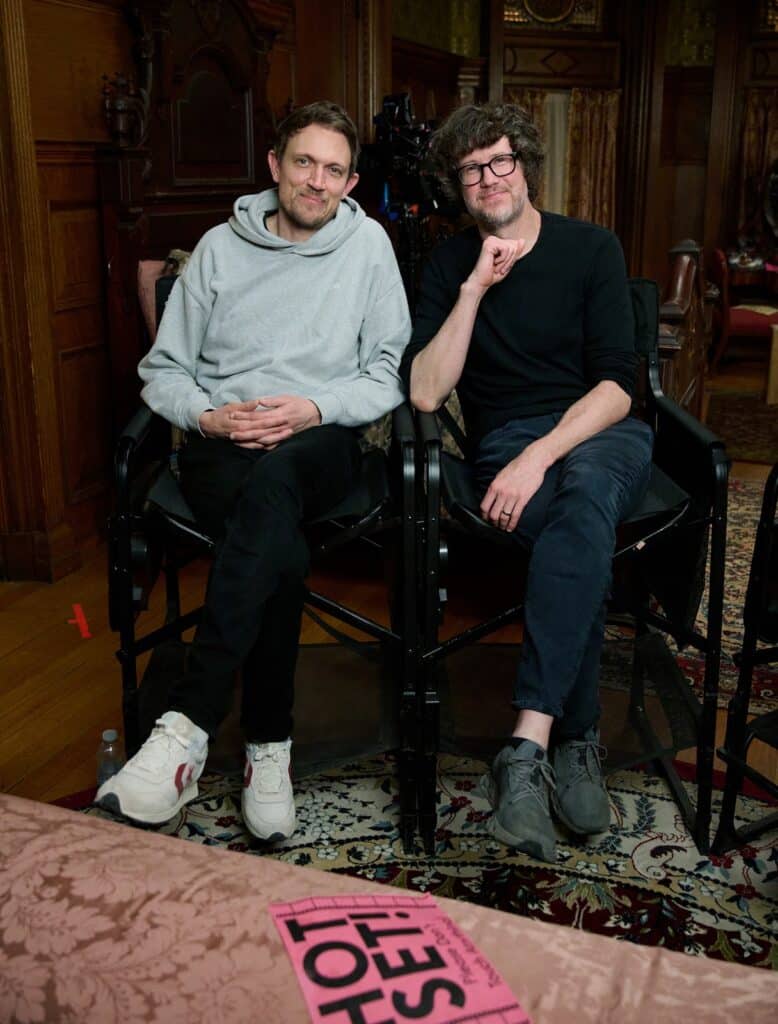
Directors Matt Bettinelli-Olpin and Tyler Gillett.
By the same token, the film does kind of remain grounded in the real world, yet it has an over-the-top approach to the violence. How did you balance that?
BETTINELLI-OLPIN: I feel like that’s our whole approach to everything: How do we do something that’s hilariously over-the-top in the most earnest, grounded way. That’s what we love, finding that balance throughout the process. The guys work on it in the script, the cast and crew work on it when we’re filming it and then it really finds the lane where it belongs when we’re in post. We always end up cutting the edges of stuff that feels like it’s trying too hard to be funny, and it takes you out of the movie. Or if it’s too mean or too harsh or too bloody.
It’s a fine line, and we always want to choose our moments. It’s like, does this moment need to push you over the edge? But if we choose the right ones, it’s very effective. So it’s just finding those moments in the script, on the day and then in post.
GILLETT: Being willing to get rid of stuff we love is actually really great, right? The craft is terrific from all the people involved. It’s the challenge of the edit when you’re working with really talented people. They give you great stuff.
Was there anything you were especially sorry to see go—any moments we might see on a special-edition Blu-ray later?
GILLETT: There are definitely some fun deleted scenes, though not many, because there was very little fat on the process.
BETTINELLI-OLPIN: There were no notes forced on us by the studio, though. The theatrical cut is the version we love. There’s no alternative edition.
GILLETT: But there’s a lot of wacky, silly stuff on the blooper reel. You can tell we had a very good time making the movie.
I have to ask: What is the fascination with spontaneous human explosion? We see it so often in your films.
BETTINELLI-OLPIN: [Laughs] It’s a great question. I don’t know. When you make something, it tells you something about yourself. We learn in the process; there’s a sense of discovery. We’re not filmmakers who set out to make a diatribe that says, this is our thing. It’s a little bit more of, we’re in conversation with what we’re making, and it informs us and we inform it.
But to your point, there’s something so funny to us about blowing people up. We have done in three movies now, and to be fair, when we did it in ABIGAIL, we didn’t think we were making another READY OR NOT [laughs], so we were like, “Oh, let’s take one more stab at this; it was so much fun on READY OR NOT.” And then READY OR NOT 2 came along, and we were like, “Oh shit, here we go.” But it was great, because it made us focus on the fact that people are going to know these are coming. They know there are going to be explosions in this movie. How do we make them each different, in a way that hopefully the audience will not quite see coming, so that they’ll still be fun?
GILLETT: And they serve the story in a different way than they did in the first movie.
On a practical level, how hard is it to maintain the continuity of blood being repeatedly splattered on your leads?
GILLETT: It is very hard. We always try to schedule those events in a way where we know we can shoot the event itself and then the immediate aftermath as well—up to the moment where there’s a blocking change or a dramatic angle change. I’m thinking specifically of the hospital scene, and how we wanted to capture the little bit of dialogue between Grace and Faith right after they’re splattered, knowing that we would be able to use the real continuity of the event itself in that dialogue. And then eventually, we were going to jump back down the hallway, and we’d be able to reset, and there’s a bit of a cheat in the continuity once you have a big dramatic reset like that. A lot goes into planning that, because you don’t want to have to do those events more than once. They’re incredibly messy for every department—the cleanup, the reset.
BETTINELLI-OLPIN: And you lose the whole day.
GILLETT: Yeah. So a lot of planning and a lot of testing goes into making sure that those events go off without a hitch.
You have some great settings for READY OR NOT 2’s action. How much of the resort was a real place, and how much of it was sets?
BETTINELLI-OLPIN: That is extremely pieced together from locations in the greater Toronto area and Niagara Falls. But they’re all practical, all real places. The exterior is just outside downtown Toronto, and then the golf course is an hour away in Hamilton. We were all over the place; room to room, it changes. Andrew Stern, our production designer who also worked with us on the first one, really took pains to tie them all together in such a way that hopefully, when you’re watching the movie, you never feel it. It seems like one giant, expansive resort. The casino is inside the Royal York in downtown Toronto, as is the lobby and the laundry room. And the exterior of the lodge where Sarah and Sean’s characters are, that’s way down by Niagara Falls.
GILLETT: We wanted to find real places, because mapping the action and the blocking into an existing space weirdly helps you move faster. It helps you narrow the scope of what you’re aiming to achieve, right? When you can just dream up a space and have it designed for you, typically you build something and only end up using a small portion of it, and it is hard to do when you don’t have a lot to spend. So having that laundry room, and getting to design the action to something that exists, is not only creatively gratifying, but it helps you shrink the sequence down in a way where you get all the fun and the spectacle you want out of those setpieces. You aren’t having to design outside of what you’re capable of achieving on the budget and the schedule.
Any chances of a third film?
BETTINELLI-OLPIN: Why not? We didn’t think there’d be a second one, so we’re here for it!
https://www.youtube.com/watch?v=jczr0KCloXk