By MICHAEL GINGOLD
Fans have been waiting for a sequel to BEHIND THE MASK: THE RISE OF LESLIE VERNON, and filmmaker Scott Glosserman has been working on one, practically since the original first emerged in 2006. Now the follow-up movie is finally becoming a reality, and RUE MORGUE has first words from Glosserman about it.
BEHIND THE MASK: THE RISE OF LESLIE VERNON attracted a great deal of attention and praise for its deconstruction of slasher-film tropes. The title character, played by Nathan Baesel, is a young man determined to carve out a place in the pantheon of screen psychopaths, who in the movie’s world actually existed. A documentary crew led by journalist Taylor Gentry (Angela Goethals) follows his every move and interaction, including assorted kills and encounters with psychiatrist Doc Halloran (Robert Englund) and Leslie’s mentor, Eugene (Scott Wilson). Glosserman and co-scripter David J. Stieve are back for BEHIND THE MASK II: THE RETURN OF LESLIE VERNON, as are Baesel, Goethals, Englund…and others.
“This has all come together really quick,” Glosserman tells RUE MORGUE, “and all of a sudden we’re back in touch with a bunch of folks who’ve been with us since the beginning. It’s just so gratifying.” Aaron B. Koontz and Cameron Burns’ Paper Street Pictures, which has backed films like SHELBY OAKS, the SCARE PACKAGE duo and THE ARTIFICE GIRL, is producing. The BEHIND THE MASK II team have also launched a Kickstarter campaign to increase the budget already in place, to allow for more (and more elaborate) kills, cameos, shooting days, etc.
How did things come together at last for BEHIND THE MASK II?
They came together very quickly. Toward the end of last year, through tax credits and whatnot, we had some seed capital. We also had some very committed folks, a couple of investors and all of us, who thought, it’s been 20 years. We need something to be able to hang our hat on. It’s now or never. We’ve been working on the script forever, and we now have such a great draft, and we have to break pencils. We’ve got to send it out, get people on board so that we can release something for the original’s 20th anniversary.
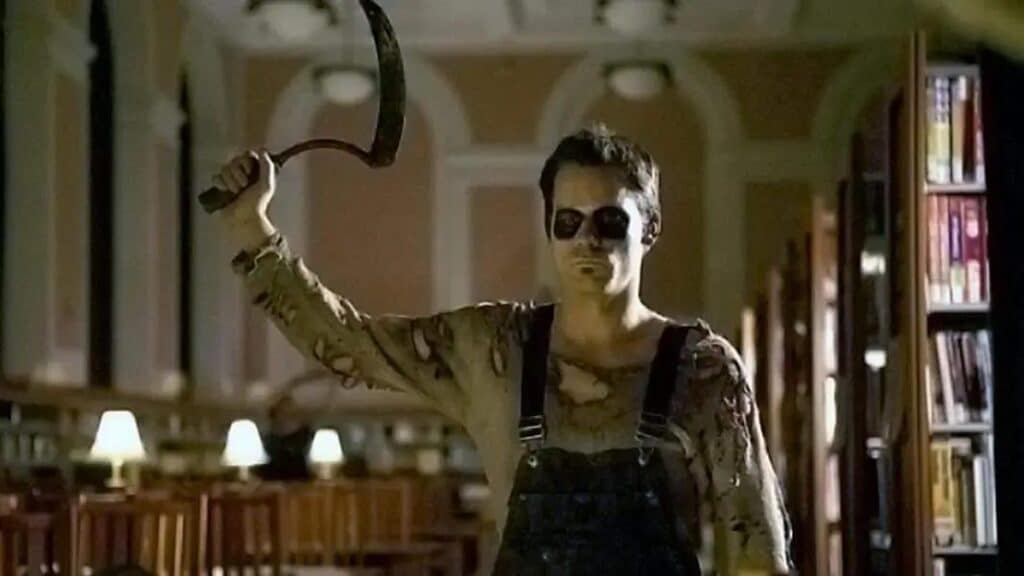
Nathan Baesel as Leslie Vernon in the original BEHIND THE MASK.
Fortunately, with this intellectual property, and the ability to comp what this movie might be able to do, we were able to use those tax credits to raise the initial capital, and could then afford to run the crowdfunding campaign, and bring the community with us. And we have investors willing to bridge the gap between what we can do with the crowdfunding and what we’re going to shoot it for. Not only are we going to raise the production budget, but also a P&A budget so we can pursue consumer marketing, go direct to the audience and do the theatrical release ourselves the right way. We’re very excited about being in control of the IP, the story and our destiny.
And the script is really strong, so we were able to attract the entire team, the entire cast—aside from Scott Wilson, who is no longer with us—and the crew as well. I mean, some of our crew have gone on to really big things. Jaron Presant, our cinematographer, is in Rian Johnson’s camp; he has been ever since USC, but he’s been off doing [2nd unit on] STAR WARS and the KNIVES OUT films and all that, and he’s coming back to DP our movie. Gordy Haab, our composer, has done all the STAR WARS and INDIANA JONES video games, and he’s back to score the film. To a person, everyone’s returning after all this time, and that couldn’t be more gratifying.
What can you say about the storyline?
Not much [laughs], other than that we’ve worked really hard iterating and iterating and iterating. So much of what we were doing in the aughts, and even in 2010, 11, 12, it was like we would write something in the sands, which then shifted underneath us. You know, in 2006, what we did was very novel. But then the whole meta self-referential thing not only super-saturated horror, it permeated myriad other genres. So it’s not enough to just be self-referential; we have to dig a lot deeper now, while preserving that commentary about the conventions and archetypes of what we’re exploring.
Fortunately, we have entire cycles of horror over the last two decades to pontificate about. And also, we can reflect on our own lives, what we’ve been up to for the last 20 years and how that corresponds to our characters and what they’ve been doing. You know, who has succeeded? Who has not achieved their goals yet? Was Leslie a success, and according to what benchmarks? Did he become the next Michael Myers? Well, not commercially, but he’s respected by the community in his world, as he is in the real world. So a lot of the narrative focuses on what has happened since then, and that can also be a commentary about life imitating art.
Since the BEHIND THE MASK II script has gone through many revisions since you first wrote it, are any of your initial concepts still in there, or did you completely overhaul the storyline?
It’s a totally new story, but some of the gems from even the very first iteration are preserved—one-liners, jokes and particular scenes. Things that can still work, but within a completely different narrative. We’re taking the greatest hits and keeping them in then. But the story is unrecognizable, I’d say.
The whole culture, and especially social media, has evolved so much in the last 20 years. How does the new script address that?
That is challenging on one hand, given that the original film was about a documentary crew, and now technology permeates everything, and it’s all instant recognizability. In terms of the commentary, what has that done to a generation? What type of epidemics permeate culture now? How polarized we are, what social media has done, how desensitized we are—these aren’t things we need to comment on directly, but we can comment on them indirectly, because they’re reflected in horror films themselves. The horror canon keeps up with the zeitgeist, and it is our job to reflect what the genre is doing. And therefore, it will comment on what’s happening in society, if we do it right.
There has also been so much more meta-horror since the original BEHIND THE MASK, including the last few SCREAM movies. Is it a major challenge to do something truly distinctive in that form today?
It is so challenging. That’s one reason it has taken 20 years. I mean, the scripts we were pitching to Dimension and Shudder and AMC and MTV Films, and the ones we were trying to get off the ground independently, and the stuff that finally made our comic books… Keeping up with and staying ahead of the zeitgeist, while also commenting retrospectively on it, has been a very difficult thing to do. But I think we’ve cracked the nut. I believe we do have something interesting to say.
Leslie was looking a little crispy at the end of the last one. What is his physical state now?
A lot of fire retardant, right? I think he was amply prepared for anything that came his way. And he’s also had 20 years to recuperate.
So is he going to be a Freddy type, or is he going to be looking like himself?
Ah, I see what you’re getting at! These are things I can’t really talk about.
The culture has also become even more accepting of graphic horror in the last 20 years. Is BEHIND THE MASK II going to reflect that as well?
It’s funny. Back in ’07, ’08, ’09, when we were first working on the second film, that was when THE HILLS HAVE EYES and everything else was returning. And of course, the convention and archetype of the sequel and remake is, you sort of lose your soul while you go big with your setpieces, and we were going to comment on that. But we needed three times the budget to pull that off. And I think something different is happening now. There’s something really dark and grisly about the time we’re living in, kind of harking back to the torture-porn era where movies were reflecting what was happening post 9-11. Now we’re reflecting the desensitization, and that’s really where the gratuity comes from, not the size of the setpieces. Those are distinct; they’re two different things to comment on in what we’re doing.
And you have Robert Englund back…
We do. He’s super-excited. Twice in my life I’ve gotten to call Robert Englund and discuss the film and whether he would participate, and those are two of the most memorable phone calls in my career.
Can you say anything about how his character has evolved in the sequel?
Well, for sure, he has a more substantial role. He will be a more consequential character in this movie, whereas in the first one he was a cameo, albeit an important one. This time, he’s more significant. I’ll leave it at that.
Who are some of the new actors who will be involved?
Ah, wouldn’t you like to know?
Yes!
I’m not prepared to reveal that, but knowing what we do and how we do it, you can rest assured we are going to go after and secure some pretty exciting people who are going to be totally fun and gratifying and also potentially quite important to the plot. In the crowdfunding campaign, part of our stretch goals will be some of those cameo reveals, so hopefully we’ll be able to reveal them sooner rather than later.
One last question: What is the one thing about the sequel that will be most different from the original?
Oh, man. That’s a great question. I would say, technically speaking, that BEHIND THE MASK II is going to be more sophisticated, because we all have 20 years’ more experience in what we’re doing. It will also be a heck of a lot more challenging to decide how we’re going to shoot, in what formats. It was much easier to go from a documentary style to an omniscient cinematic approach in the first film, and that conceit really worked. In this one, it’s going to be more difficult to achieve an omniscience throughout the entire running time. It was novel back then, but shooting with cell-phone cameras or selfie sticks now, it’s going to feel done before. So my biggest challenge as a director is figuring out how to tell this story. That’s something we’re working on that I can’t reveal right now, but I think it might be the biggest departure from the original.