
By MICHAEL GINGOLD
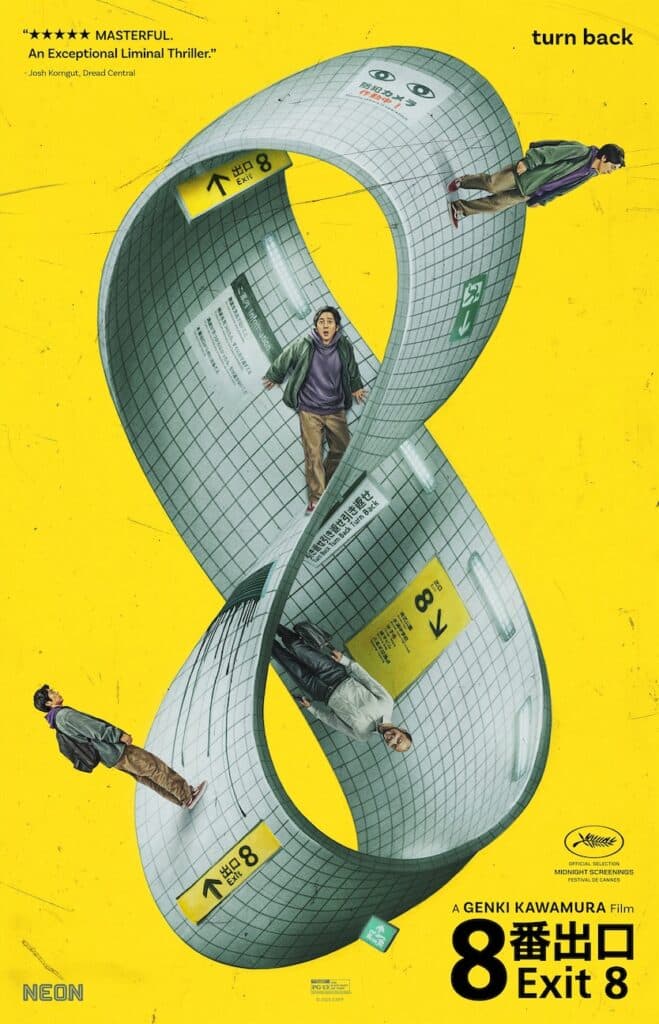
While THE SUPER MARIO GALAXY MOVIE dominates the box office, a smaller, more intimate and more intriguing video-game adaptation hits theaters this Friday, April 10 from Neon. EXIT 8 translates the popular playable puzzle from Kotake Creative to the big screen, and RUE MORGUE spoke to director/co-writer Genki Kawamura about the process.
Scripted by Kentaro Hirase and Kawamura, EXIT 8 stars Kazunari Ninomiya as “The Lost Man,” who gets that way after he exits a subway train following a distressing smartphone call from his ex-girlfriend. He finds himself in an endlessly looping tunnel, where instructions on the wall advise him to look for “anomalies” in the signs and other decor. If he sees an anomaly, he is to turn back the way he came; if he doesn’t, he should proceed forward. If he successfully does so eight times, he’ll be able to escape—but this doesn’t prove easy. As he encounters a couple of other wanderers through the tunnels, and his surroundings sporadically turn nightmarish, EXIT 8 becomes an existential horror experience with undercurrents of social commentary.
Were you familiar with the game when it first came out, or did you learn about it when this project was brought to you?
Initially, when the game went on sale, the producer [of the movie] knew about the game and said, “Hey, this is amazing. You have to check it out.” So, not long after the game came out, I played it myself, and I was really enamored of the world-building and the general feel and vibe.
How did you go about translating the game into a feature film—a more passive and less active experience?
I really liked the setting and the game design and mechanics, but one of the challenges was that the game had absolutely no story to work off of. So rather than approach this as a movie adaptation of a video game, one of my primary goals was to blur the lines, the border that defines a movie vs. an interactive entertainment experience. And in interpreting the space, one approach I took was from Dante’s DIVINE COMEDY. I drew inspiration from this idea of purgatory. I believe we all, living our daily lives, have some kind of sin. So we imagined, what if these people had to face their sins in this purgatory-like space? And that’s represented as the anomalies you see, which are also in the game. So looking at that space and putting it through a lens and making it a metaphor for something larger was the approach.
Is the movie also intended as a commentary or critique on Japanese society?
Certainly—not necessarily limited to Japanese society, but I wanted to consider what the meaning of sin is. In our daily life, at the very least, we don’t see murder or theft as everyday occurrences, or very common occurrences. But I think there are other, smaller crimes that we may observe or see, but pretend they don’t exist. I mean, myself included, I’m guilty of this. I’ll take the train and I’ll notice something that is a little borderline, but I might just go back to my smartphone. Or we might be looking at our smartphones and, on our timelines, see all kinds of bad news and wars happening around the world, and swipe to the next item. So there are a lot of small sins or crimes that I believe we commit on a daily basis. And this film is intended to reflect on that.
Since the game doesn’t really have characters as such, how did you come up with the people who would inhabit this environment?
Yes, the game itself is quite simple. The player has two choices: If they notice an anomaly, turn around. If not, they keep going. And those two choices elevate themselves over the course of the movie. The main character is lost in this purgatory, and these small choices of turning back or not at each exit accumulate into a big life choice that he will ultimately have to make.
Likewise, the main character isn’t any one person, but almost the embodiment of the social lens as a whole. I wanted to capture this sort of vibe and have the protagonist serve as a representative of our society at large. And that’s why the people in this film don’t have any names.
Fatherhood is a very strong theme in EXIT 8. Can you talk about how you arrived at that as a central theme and developed it in the film?
This issue is definitely prevalent in Japan, but there’s also a worldwide phenomenon as well, where we’re all very self-centered right now. I think as a species, if we, just as individuals, are OK, then everything is OK. That seems to be the general mentality. And you look at passengers on the train: There are all these people sharing this car, going from point A to point B together, yet everyone’s on their own smartphone. There’s this sort of passing on of responsibility, whatever it is. It could be something very small or very large.
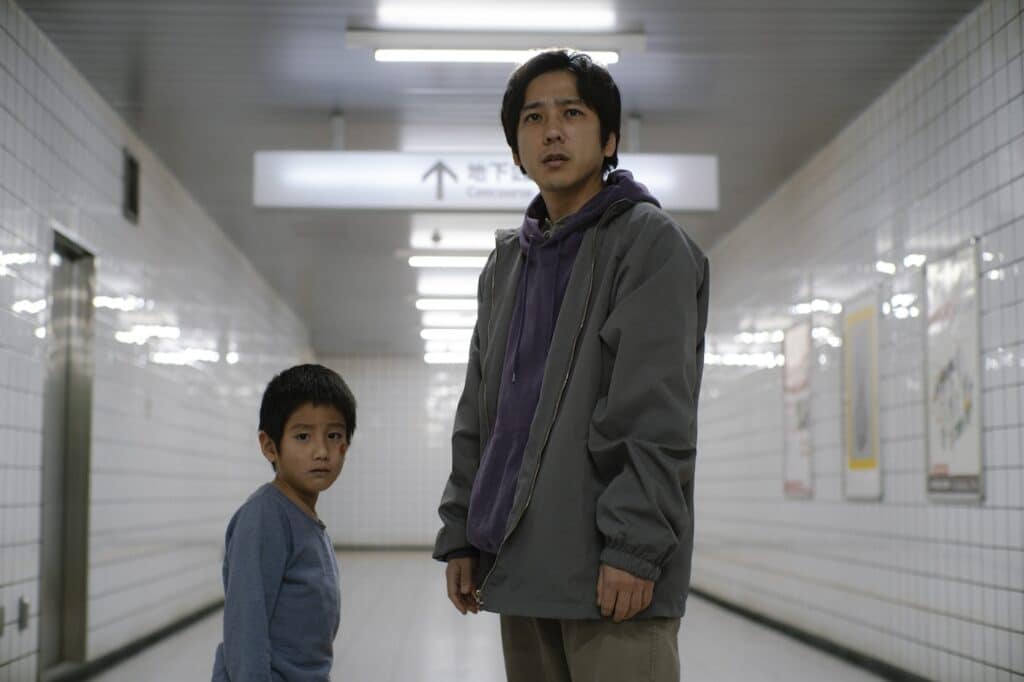
And I think parenthood is sort of the ultimate symbolism of this epidemic, so to speak—the ultimate relinquishment of responsibility, that if I can figure out my issues, then everything is fine. And fatherhood, and the fear of undertaking that final selfless act, was a good central theme for us to explore this issue.
Did game creator Kotake consult on the movie?
I did have conversations with the creator, and we talked a lot about the tone we wanted to establish. What type of horror were we going for? We agreed that we didn’t want there to be any jump scares, or creatures or monsters, so to speak, which would have taken over the core of the horror. It was very much supposed to be about that mirror showing the inner sin we all have, and bringing that to the surface was the visual approach we wanted.
I assume that the main tunnel was a set. Can you talk about its creation and shooting there?
The set was crazy; it was like walking into THE SHINING. I was very adamant about not using CG for this movie, so we actually built two identical corridors that the actors would walk through. We were physically looping this, and we wanted to make sure that the edit points were blurred to the point where the audience couldn’t tell when a certain set ended and the other one began.
There wasn’t any soundstage in Japan that could house two corridors of that scale side by side, unfortunately. We actually went to Yokohama, where there were two warehouses connected by this very small door. So we had to build the sets and aim, as though it was a hockey goal, to get them to join up exactly at this door. That’s how we created this seamless two-corridor set.
I also assume that the opening sequence was shot on an actual subway. What were the challenges of doing the long point-of-view take through that location?
It was absolute chaos. That single cut is about 10 minutes, and thinking about all the extras and the choreography… When we were working with the subway network, they allowed us a three-hour window between the last train of the day and the first train of the next day. So in the middle of the night, we had to go during this three-hour window, set-dress everything, bring in over 100 actors, and then get the POV shot just right.
How did you find the right actor to play the Lost Man?
Our lead, Ninomiya, is a very famous actor in Japan. He was actually discovered internationally by Clint Eastwood for LETTERS FROM IWO JIMA. What really sold me on him was his eyes, because I knew that this film wasn’t going to rely on much dialogue. His ability to gesture and pantomime and use his eyes to communicate was what convinced me he was the perfect person for the part.
He’s also a gamer, and in between shots, I would see him playing on his smartphone. So for the type of movie experience we were trying to create, where we’d blur the lines between interactive and linear media, he had a very high understanding of what it was we were trying to achieve.
Yours is one of the more successful adaptations of a video game. What do you think are some of the mistakes that people have made in the past in translating these games to the cinematic form?
That’s difficult to comment on [laughs]. I think it’s really, really hard, and I’m sure there are going to be a lot more people in the future who will struggle with that challenge. In video games, oftentimes the player is supposed to embody the main character and kind of take on that persona themselves. So that’s what throws people off whenever you adapt that for linear content, when you have to clearly define characters with background stories, because it doesn’t overlap with what the players thought.
In our case, I go back to a quote from the very famous video-game creator Shigeru Miyamoto from Nintendo; he invented SUPER MARIO BROS., among a lot of other megafranchises. He said, “With a good game, the person playing it obviously has a great experience, but even those watching them play will also have fun. The fun should be shared equally in the room.” So my film, at times, places the audience into the player’s point of view, literally, with the camera. And at other times, we present the visuals in ways so that the audience feels like they’re watching another player play through a game. It’s almost like the Twitch-streaming or YouTube-streaming culture where people watch other people play video games. We thought very hard about how the audience would interface with and engage with the experience on the screen, and how they would enjoy it.