By PAYTON McCARTY-SIMAS
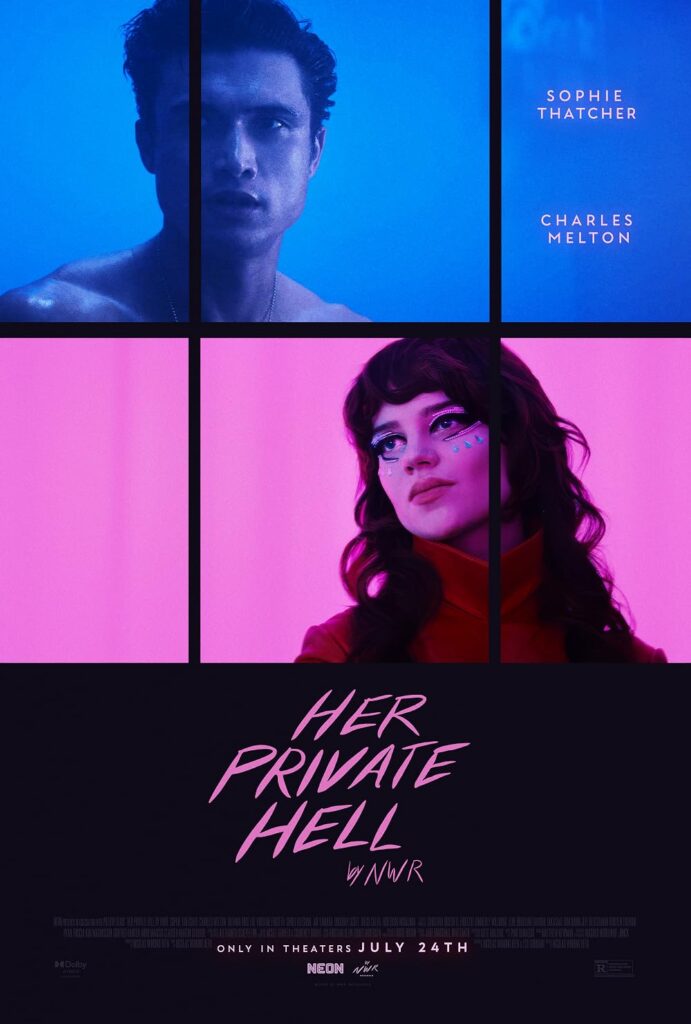
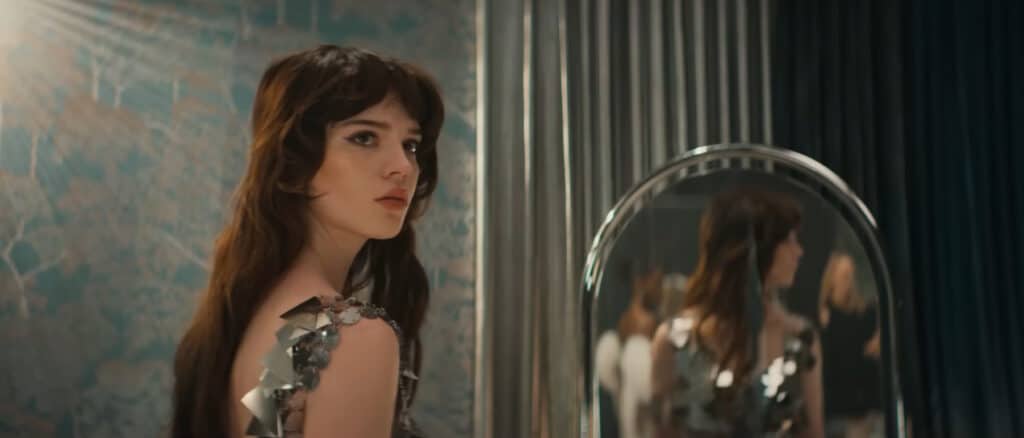
Nicolas Winding Refn’s movies are full-body experiences. The Drive director returns to theaters this summer with his first film in a decade (having spent the interim making miniseries like Copenhagen Cowboy and restoring older films by distinctive high-low artists like Paul Morrissey and Ulli Lommel). A blood-and-glitter-soaked leather party called HER PRIVATE HELL, this one’s the amped-up story of an ingenue named Elle (Sophie Thatcher), her film director daddy (Dougray Scott), his wife – Elle’s best frenemy, Dominique (Havana Rose Liu) – and their penthouse suite worth of issues as they start production on a cinematic comic book adaptation somewhere between Fantastic Voyage and Charlie’s Angels. Soon, this incestuous nocturne collides with a big bad macho villain intent on carving up beautiful girls and a Kenneth Anger-inspired WWII drama about a GI (Charles Melton)’s own paternal trauma. This retro, psychedelic genre pastiche, a hazily tangled tale of sex, cinema, and psychological scars inspired by the director’s near-death experience three years ago, combines everything from Barbarella to Mario Bava with arch irreverence, high drama, and haute couture.
RUE MORGUE joined Refn and some of his stars on a hot July day to discuss horror, fetishes, music and the unique pleasures of moviemaking.
Nicolas, you’ve said that HER PRIVATE HELL is influenced by Douglas Sirk, but there’s a lot of giallo going on, too. There’s also that great De Palma nod with the Pino Donaggio (Carrie, Blow Out, Body Double) score. Do you think there’s a relationship between melodrama and horror?
Nicholas Winding Refn: Oh yeah, there’s a connection within anything and genre in a way, and spicing things up with as many different genres in one film is exciting. I was saying to someone that I was making my own private television: I could click channels inside of me and get what I wanted to see that day. So, I like all those elements. I like all those things very much, and I like genre in general. I think it’s a beautiful world to work in.
Sophie Thatcher: Kenneth Anger was one of our first reference points. That’s hard as an actor, because it’s experimental and it’s abstract, but understanding that gives you freedom to play. I feel like there’s a ‘70s or ‘80s air to it. [The film] feels like a Greek tragedy with a larger-than-life quality to it, while also remaining heartfelt. There’s so much longing and romanticism, and I think understanding that tone was the most important thing. The Brian De Palma films within Charles’ storyline, the Kurosawa… There’s also an anime, manga feeling to it within the film-within-a-film. There was a lot! It was kind of everywhere. It was such an acting challenge in that way, trying to find something that felt authentic and true, but also stylized. But I understood his references, and I knew the world that he wanted to live in. You see his other movies, and you’re like, “Oh, I get it!” It’s that specific.
In terms of the more slasher-esque elements of this plot, what goes into making a compelling villain for you, Nicolas?
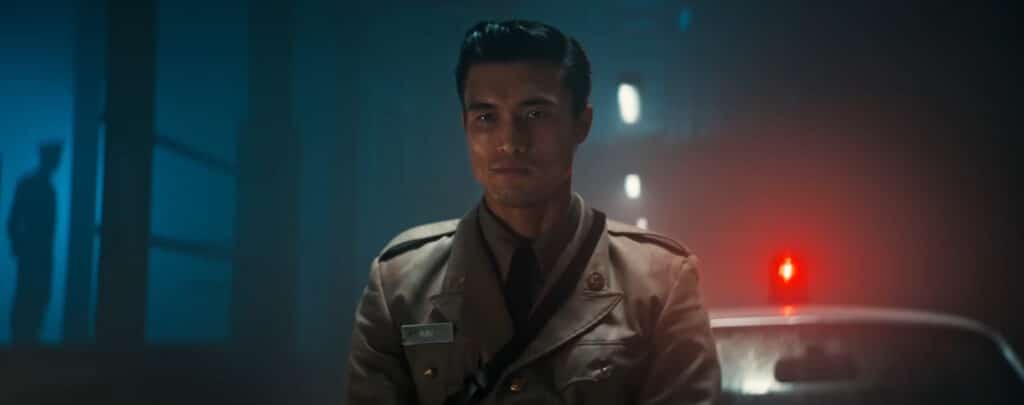
NWR: I had this idea of a “glam monster,” something that sparkled, then had a lot of leather, and obviously. Leather Man became his name. You can say that a lot of the film is about my ability to play with dolls, because all the characters are about iconography. You have the Leather Man with his leather and sparkles, you have Private K in his uniform, and you have the Candy Floss Girls with and without their ray guns. It’s a lot of those things that I personally love to fetishize. It’s like working in a dollhouse.
Charles, in terms of genre, what kind of movie did you feel like your character was living in? You’ve said that this was a really intuitive project for you, but how did you keep yourself grounded within that?
Charles Melton: I think by just really trusting Nick in the process. The world Nick created, every time I came to set, it was easy to drop into and exist in, you know? And it helps so much when you shoot in order, right? Because you’re not jumping into different time zones of the story and the narrative. You’re existing as it’s growing. It has this pulse, and he painted this world where there’s so much. As an actor, you realize that nothing is everything in the world of Nick’s films. The slightest thing can be so grand and so subtle. So yeah, it was really complete trust in Nick, and he played so much music on set. He says the movie is his TV with all these channels. He would flip through and find songs. It was very atmospheric, very beautiful.
What song do you remember playing on set most?
CM: M83, I think it was “Sisters.” Oh my gosh, I can’t listen to that song anymore [laughing].
ST: Music, always. Depending on the day, it always started off with the Brian Palma Pino Donaggio Dressed to Kill soundtrack. “Laura’s Theme” from Don’t Look Now, which is also Pino Donaggio. I remember he started playing Suicide. He played “Cherry,” which is one of their more famous songs, and then we just kept going down that kick halfway through filming, which was noisier and more synthy and a bit more abrasive, which I think helped with my character’s trajectory into crashing out [laughs]. It helped to play against that chaos. It’s a fun world to live in for me, too.
And I actually listened to more music like that. A lot of the time, I don’t have words, especially on set when you’re just trying to be in the moment and trust your intuition. You don’t want to overly intellectualize or overly talk about things. So, he would just play a song. We’d sit in silence, listen to the song, and almost all the time, I understood what it meant. Sometimes he would play ABBA. That was mainly towards the end when I’m running [miming, pumping her arms], like, “The winner takes it all!” and just trying not to laugh.

What did you all love most about being on this set?
NWR: What was really great on set was coming to work every day and being able to ask the actors what they would like to do. That kind of freedom is incredibly powerful because of the collaboration and the intimacy that you build within that collective universe. You know, directing is very easy in a way because your main job is to inspire everyone else, who are all experts at what they do, to do their best. You’re the kindergarten teacher, the psychologist, the friend, and sometimes, the military commander. All those things are in service of something that’s inside of you, but that will only come out if everyone else is following you. I think we were incredibly lucky with the people we were working with, both in front of and behind the camera. That’s something always to remember: that film is a collective medium.
ST: It was definitely one of the most surreal experiences of my life –and the most strange – but also very gratifying. I was following my character’s arc in ways where, at the end, I was able to just let everything out. I felt very drained, but free at the end of it, which is beautiful. I’ve never really worked with an auteur director before, so I didn’t know what to expect. But I was surprised by how collaborative he was! He really brought me into his family. We were in Copenhagen. It was three months. We’d go to dinner every night with his family, and there was a lot of lightness there, which was important because you can’t always live in darkness. He felt like a father figure in ways, too, and because I was able to feel vulnerable around him, I think he got something interesting out of me by just letting the camera sit in between dialogue and find moments of silence and stillness.
CM: One of the best places to exist. I kind of miss it, you know, doing this film. Talking about it, I’m thinking about Copenhagen. This isn’t the last movie Nick and I are gonna do together.
HER PRIVATE HELL arrives in theaters July 24.