By PAYTON McCARTY-SIMAS
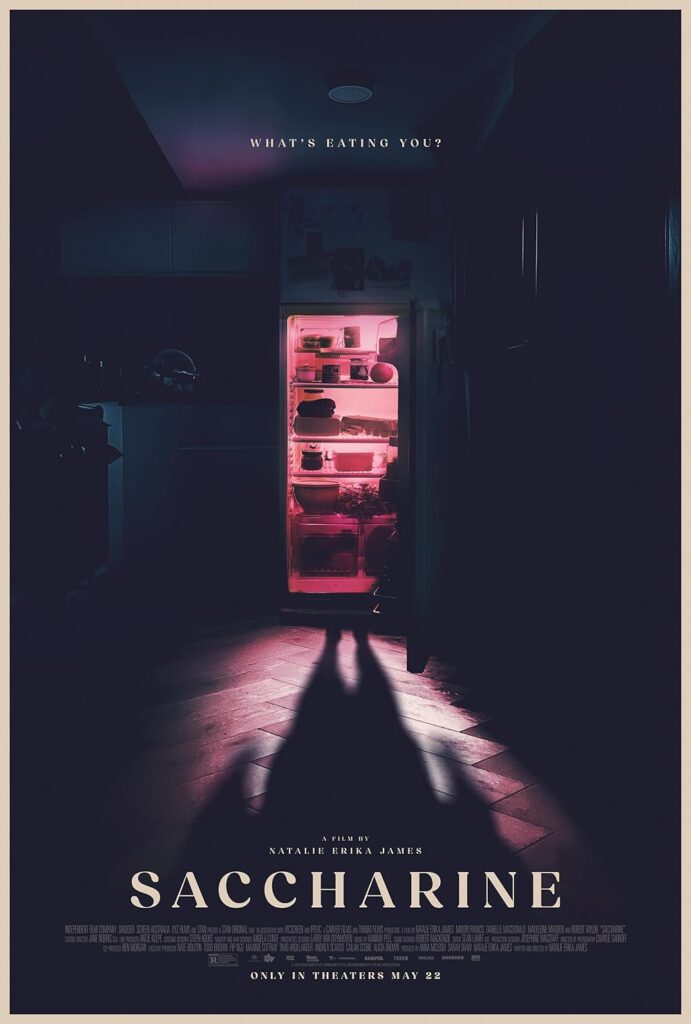
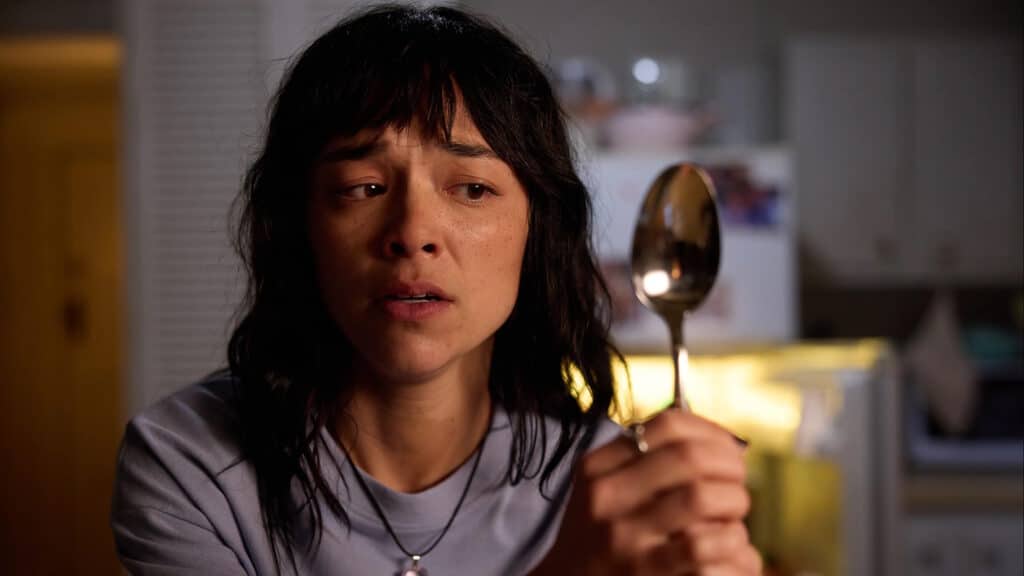
SACCHARINE, from Natalie Erika James, director of Relic and Apartment 7A, is a new, hauntingly empathetic take on eating disorders. When medical student Hana (Midori Francis) runs into an old classmate who offers her an infernal (and off-label) Ozempic equivalent made of human ashes, she’s triggered into a surreal, squishy spiral of self-destruction that’s one part psychological horror and one part ghost story. RUE MORGUE sat down with the film’s director and stars the week of its release to talk about beauty standards, possession, and sugar rushes.
I’d love to start with the idea of “beauty horror,” The Ugly Stepsister director Emilie Blichfeldt’s term for horror movies like Grafted and The Substance. Does that concept resonate with you and your film as an offshoot of body horror?
Natalie Erika James: That’s a great term, and I loved The Ugly Stepsister as well. There’s so much nuance in the particular brand of beauty horror that those films are all pursuing. Across the board, though, there’s a character who’s dealing with intense societal pressure, and in the case of SACCHARINE, it’s diet culture, weight stigma, fatphobia and also this pursuit of perfection in an attempt to fill some sort of void within herself. So I can see that as a thread between all of the beauty horrors that you’re mentioning. I’m all for it. There’s so much violence that we all experience as a part of being under the thumb of these kinds of subcultures.
Yours is a very unique angle on this kind of story – the relationship between body monitoring and the more controlling tendencies of eating disorders blending into the paranormal. How did you come up with the haunting angle?
NEJ: I definitely had the idea from early on that trying to convey the experience of an eating disorder can feel like there’s something inside of you that’s also external and trying to take control. So that darker presence, that sinister something-lying-in-wait feeling, I knew I wanted to convey through this figure. The link to the ash was very Picture of Dorian Gray in my head, in terms of the ghost getting bigger the more that she ate, and the painting getting older. That parallel, when it clicked, tied me back to the notion of hungry ghosts, those beings with insatiable hunger. There’s already so much literature out there that ties ghosts to addiction and that kind of compulsive drive, so it felt like the right fit for the story.
For the actors, what was it like being in this kind of queer horror movie?
Danielle Macdonald: It was cool to see a script where queerness was just completely normalized. It wasn’t like, “Oh, what is society going to think about this?” It was like, “This is normal. Girls can like girls, and it doesn’t have to be something that people should have an opinion about.” We should be able to like whoever the hell we want and have it be that simple. I loved that.
Midori Francis: My opinion on this has always been that it is inherently queer, and I celebrate that, but yes, I didn’t think of SACCHARINE as explicitly delving into issues of Hana’s sexuality. I’ve read many of those scripts. I’ve been in many of those scripts. It is awesome and rad that it is such a queer movie, but to me personally, I didn’t think of her sexuality as being key.
Was that refreshing?
MF: Yeah, it was. It was wonderful. I liked that there were undercurrents of sexuality and sexual hunger and repression, but that it wasn’t about, “Oh, I am denying myself a woman, and I need a woman,” it was her sexuality, her repression, her desire – and it happened to be for a woman.
NEJ: I do think, though, there was something in what Josie says in the film: “Do you want to be with her or do you just want to be her?” That was definitely specific to being a lesbian, and sometimes, that projection of desire onto someone can get to the point where it turns into a possession, you know? And then, if you take that even further, then it becomes consumption, and so, that was my endpoint there. Any time you outsource your sense of value or okayness onto a person or habit or addiction, it has very violent, disastrous effects. For me personally, the story wouldn’t have worked if her trainer had been a man, just because it’s precisely that mirroring effect that makes the projection of desire all the more compelling for Hana.

What drew each of you to this project as actors?
Madeleine Madden: I was a fan of Natalie’s work before working on this. I really love the way Nat tackles very real human experiences through the horror lens. She can flesh out these very real horrors that we experience in our lives, whether it’s grief, body dysmorphia, or eating disorders. I just love Natalie’s style. Also, I felt like this was a story that I could connect to and see myself in. I just felt like the way this story handled such heavy subject matter with such empathy was really refreshing. It felt really important and right to be a part of.
MF: I had never read anything like this in my life, and I was quite frankly blown away by the imagination of it. I read it in one sitting. It really got my heart rate up; I couldn’t put it down. I love a good adaptation, but I really respect and appreciate when someone just makes something up, and it’s like, “What? How did you come up with this?” That’s how I felt while I was reading it, and I was like, “I definitely want to talk to whoever wrote this. This is crazy and amazing.”
For me, deciding whether to do a horror movie is like, well, what are we doing this for? And I appreciated that this was as much about externalizing a very real internal horrors that other people might feel seen by as much as it was about scaring people. I really appreciate it when a movie strives for both of those things.
DM: Yeah, I am a big fan now of Natalie’s work, but I remember when I first met with Nat, I was like, ‘I’m not gonna lie, I haven’t seen your last movie because I’m a big scaredy cat!’ But having seen just the lookbook that Nat sent for SACCHARINE, I was like, “Oh, wow, this is visually so cool.” Also, reading the script made me uncomfortable; it made me think. I think that art should make you feel things. It should make you question things. It should make you reach inside yourself and figure out where you’re at with it all, and this script really did that for me. That’s what was most exciting about the film: people are going to relate to this in very, very different ways.
Natalie, can you tell me about how you built this visual landscape? There’s so much surrealism to it.
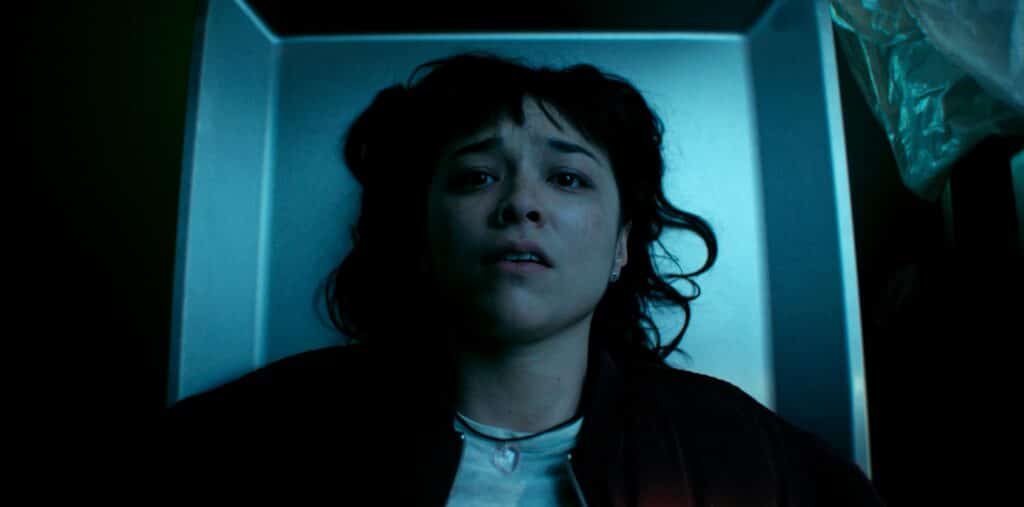
NEJ: Comparing this to something Relic, which has a very heavy, oppressive Gothic kind of atmosphere, we knew in this we wanted almost the opposite. We wanted it to be poppy. We wanted the colors, the lighting, to be driven by Hana’s internal state and be a little bit heightened. We wanted pops of color that felt almost like candy and the dopamine hits of a sugar rush. I think the phrase we used was that we wanted candy and grime, like the rot of the body, as well as the sugar rush. Even in the design of Hana’s apartment and the dissection halls and all the bodies, we wanted something that felt very tactile, whether it’s high gloss or the prosthetics themselves, keeping the camera incredibly close and feeling every detail.
Is there anything you’d like to tell audiences before they see this movie?
NEJ: The most important thing first: Trigger warning. I don’t necessarily think this is the film that someone at the height of their struggles should watch.
DM: Don’t bring snacks.
MM: Lean in and just go on the ride with the character and the movie: It’s a hell of a ride.
MF: You’re going to want to have your Shazam ready, because the soundtrack and the score of this film are epic.