By MICHAEL GINGOLD
A woman confronts her own troubling and frightening history in I LIVE HERE NOW, which arrives on VOD tomorrow, April 21 from Utopia. RUE MORGUE spoke with its first-time feature writer/director, Julie Pacino, following the movie’s world premiere at last year’s Fantasia International Film Festival.
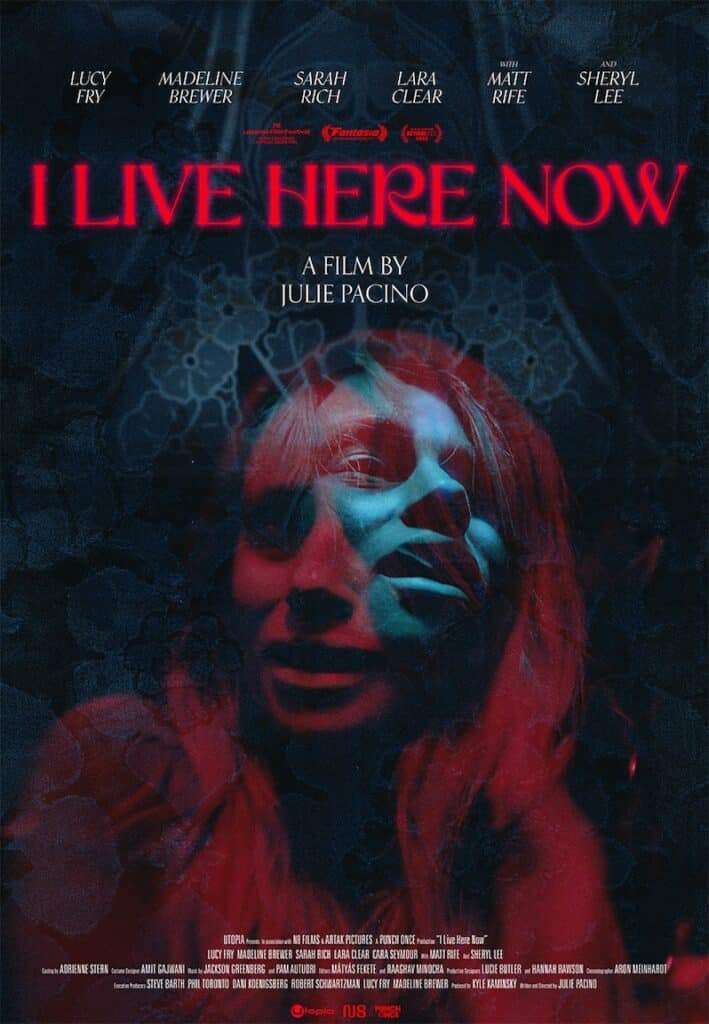
Shot on 35mm and 16mm film, I LIVE HERE NOW stars Lucy Fry (VAMPIRE ACADEMY, TV’s WOLF CREEK) as Rose, a struggling actress who seems to be on the verge of her big break. When this and other forces in her life threaten to emotionally overwhelm her, Rose flees to The Crown Inn, a remote motel where her past begins to bleed into her present reality. Co-starring alongside Fry are Madeline Brewer (CAM, THE HANDMAID’S TALE), as Lillian, a seductive and threatening presence in the Crown Inn; comedian Matt Rife as Rose’s boyfriend Travis; and TWIN PEAKS’ Sheryl Lee as Travis’ domineering mother Martha. Pacino, a successful photographer and award-winning short filmmaker (and the daughter of actor Al), has frequently tackled themes of identity and self-reflection, and certainly does so in I LIVE HERE NOW, combined with riveting, surreal and shocking imagery.
You’ve said this is a very personal film for you. Can you talk about that connection, and how your own experiences informed the film?
Yeah. I LIVE HERE NOW started off as a short film I wrote during the pandemic in June 2020. At that point, it was more of an allegory about being stuck in a place, because I had gotten stuck in Los Angeles, and so it was about trying to reconcile with the fact that, like, I live here now. I was born and raised in New York, and I never thought I would be living in LA.
It started as this 10-page thing, and then as I was thinking it and living with the material, it grew into this larger allegory about being stuck in an emotional way and not knowing why. I started digging within myself, having revelations of stuff that happened to me as a little girl, and a lot of feelings and aspects of myself were coming up, and I was confronting them. Those were the seeds of the feature, when I realized there was a much larger story I wanted to tackle about childhood trauma and reconciling that as an adult woman in today’s world. The process of healing and reconciling those different aspects of myself was really fun to figure how to do in a cinematic way—being able to use all the aspects, the colors, the wonderful performances, the soundscape.
Also, I was so excited to have the opportunity to make a first feature, and I didn’t take that for granted. I didn’t know if I’d get the chance to make another one, so I figured, why not take a big swing on my first one, and pour everything I could into it and be as vulnerable as possible? That, to me, is what art is really all about. There have been times, even before last night [at the premiere], when I was like, why did I make such a personal film? I’m terrified right now. But I think that’s good. It’s why we’re alive, to put ourselves out there like that.
You could have done this in a straightforward, dramatic way, but you chose to take a surreal approach, with some striking imagery. What was behind the decision?
I just like surreal movies. I like surreal art. I enjoy leaving room for the audience to fill in blanks for themselves, and to stimulate conversation. Certainly, every surreal element in the film has a very specific intention and meaning for me, and for the actors. We were all really on the same page about what these things meant for us. And I knew that as long as I could have Rose be a grounded force the audience could latch onto, I could trust that people would go on the journey and take the ride. That’s what’s so cool about being at Fantasia. It feels like the audiences coming in are willingly signing up to go on this trip.
And obviously, I’m a big David Lynch fan. I love Jane Schoenbrun too. I SAW THE TV GLOW is one of my favorite movies of all time. Artists like that have really inspired me to follow that passion within myself.
There’s a thank-you to David Lynch in the credits. Did you ever consult with him about anything before he died?
No, David wasn’t involved in any official way. I added that after he passed away, just to memorialize his meaning to me. It just felt like the right thing to do, since his art and his influence have changed my life so much.
How did you weave the genre elements into the personal story you were telling?
Well, I think the dark subject matter easily lent itself to the horror safety net. I also love using humor; it’s very important to me. I just like to laugh, and I love making people laugh. I think in my next life, I want to be a standup comedian [laughs]. But being able to use camp and surreal, absurdist humor is something I love about modern horror movies, especially. Jordan Peele, for example, does such a great job with it. And I believe healing is like that. It’s often circular and nightmarish, but it’s also sometimes sweet and strangely funny and ironic. So it was cool to be able to do all those things.
You have a lot of evident visual influences. You’ve mentioned Dario Argento and SUSPIRIA…
Definitely a lot of visual inspirations. PERSONA was a big one we all watched. Aron Meinhardt, my DP, is so talented when it comes to lighting and use of colors. He lights all the photos I shoot, so there’s a nice shorthand we have when it comes to symbolism and colors and how to use them. That saved a lot of time.
Rose checks into The Crown Inn, and the crown as a symbol that recurs throughout the film. Can you discuss that particular object as it relates to the story?
Yes, thank you for bringing that up. Rose deals with a lot of shame; that’s a big theme in the movie, her reconciling that. And to me, the meaning of the crown is quite layered. It’s about accepting and embracing your trauma instead of being ashamed of it. So as Rose goes on her journey, she’s maybe a little distant in the beginning; there’s shame and nervousness about it. And her journey is about understanding that the traumatic things that happened to her are nothing to be ashamed of—that, in fact, they are the reason she is who she is—and instead of running away from them, she can quite literally wear them as a crown, and be proud of them. That’s really the message that I hope people can take away from this.
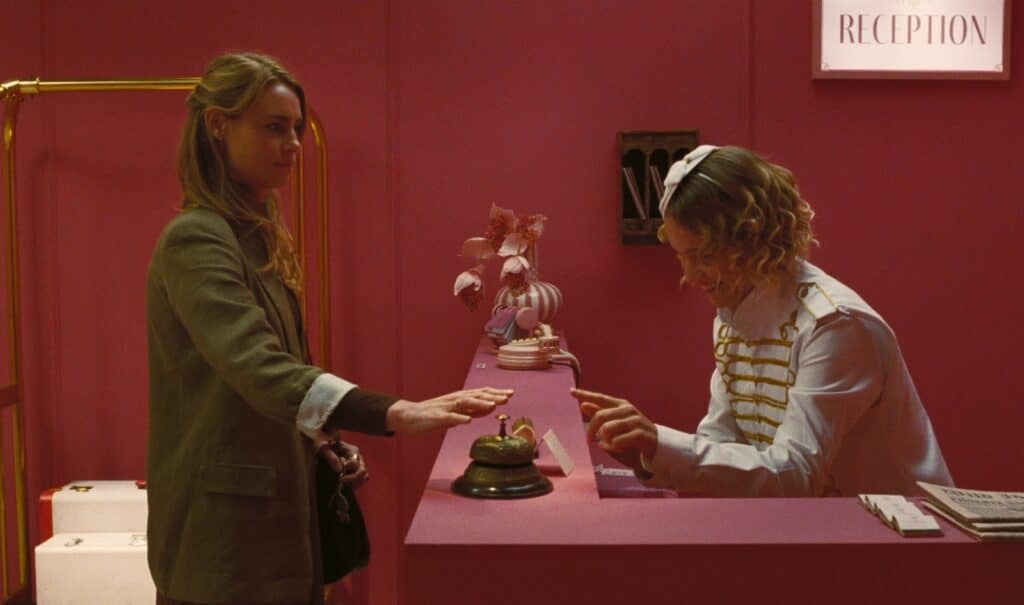
What went into designing and creating the Crown Inn? I assume all that was on sets.
It was, yeah; the motel was entirely built on a soundstage. We had amazing production designers, Lucie Brooks Butler and Hannah Rawson. They pulled it together with really limited resources, and a lot of work went into it. It was a dream to be able to build it completely from scratch, because that enabled us to plant little subconscious Easter eggs in the wallpaper, in the markings on the armoire. We were able to personalize and tailor-make the space to be reflective of Rose and her psyche and her body. We leaned on the pinks and the reds and, you know, the femininity of that. I never thought I would have the opportunity to build stuff on a soundstage, but I’m spoiled now. I don’t ever want to do it any other way.
How did you find the right two leads for the film?
Casting Rose was really a journey. The screenplay was quite detailed and abstract, and a lot of actors need to have it on the page. The answers need to be there. And in a lot of this script, the answers weren’t there, you know? So it was challenging, finding the right partner, because that’s really what I required. I couldn’t just have someone come in and play it exactly the way it was written. I needed someone to help me take it to another level. And Lucy Fry did that. I had a general meeting with her and from the jump, she said, “I don’t normally do this, but I have a lot of thoughts and I want to share them with you.” And we started collaborating even before she had been cast. It was a pretty instant home run with us.
And then Maddie Brewer, we met in a coffee shop, and she’s such a firecracker. She’s got so much energy. What she’s able to convey with just her eyes felt right for Lillian, because Lillian needed to be this piercing, pointed thing. And I loved the ideas Maddie had about what she wanted to do with Lillian. She had strong opinions about Lillian’s outfits, and her free-flowing spirit and the smoking—all these things she was excited to bring. They both were amazing, and it was really fun to watch them go at each other on set.
There are some very physical scenes between the two of them. Did they really go for it, or was that all choreographed and coordinated?
It was definitely choreographed and coordinated. But they’re both such trusting actors, and the three of us had a strong trust between us. So they were down, you know?
Speaking as we were of David Lynch, you have TWIN PEAKS’ Sheryl Lee in the film. Is that your homage to Lynch’s work?
Yeah, obviously I learned about Sheryl through David’s work, and her performance in FIRE WALK WITH ME is one of the all-time greats. I know it has become quite popular since it first came out, but I still feel she should get way more recognition for her work in that. But when we were trying to cast Martha, it was actually my producer, Bob MacCready, who suggested Sheryl for the role. She did not come to mind at first, and when Bob brought it up, we were all like, whoa, that’s kind of brilliant.
I sent her the script and she had a strong reaction to it, and we had a very long first conversation about the themes. She asked a lot of questions about the feelings and the ideas beneath them, and it just went beautifully. And she brought so much to that character.
How did you make the transition from photographer to filmmaker?
I’ve always used photography as a tool to help find my vision for my movies. Even if it’s just in rehearsals, playing around with actors and shooting some pictures, it helps me wrap my head around how I want to approach something visually. And it was a dream come true to shoot on film for I LIVE HERE NOW. I shoot a lot of film as a photographer, so that was a pretty smooth transition as well. And again, just having that stability with my lighting designer, who’s now my DP, allowed me to kind of let go of the reins when it came to the technical aspect of shooting the movie and work with the cast, which is my favorite part of the process. I love to be there for my actors on set, especially with something this intense.
Have you always known that you wanted to get into the family business, so to speak?
I actually have, yeah. I have early memories of being on my dad’s film sets, and have always been intrigued by the ability to create alternate realities. That just ties back to when I was 10 and had a little Handycam, and I would always get my friends in the neighborhood to come over and we’d do little scenes and make short films. They were like, “Can we just go play hopscotch?” and I was like, “Yeah, I guess, but this could be fun.” It’s been cool to preserve that as an adult, and genre filmmaking especially allows for that. We all get to come together and make weird and freaky shit. So filmmaking appeals to the little girl in me, and I try as much as possible to preserve that sense of fun and experimentation and exploration, because that’s really what it’s all about. Anytime things get stressful or overwhelming, I try to remind everyone why we’re doing it and sort of follow the fun.
I noticed your father has a credit for archival footage. Are there shots of the younger you in there?
I’m so glad you caught that! There are at the end, when she’s walking down the hallway. The home video footage that plays a couple of times in the movie is shots my mom and my dad captured when I was a little girl. So when we were building the credits, I thought it would be funny to give both of them that credit.
You also thank actor David Corenswet (PEARL, SUPERMAN). Was he involved at any point?
Yes, he was involved early on. He and I have the same agent at CAA, and he gave me incredible feedback on the screenplay. He gave me about 12 pages of notes, and they were incredible because they were like, “Here are issues that I’m seeing and here are solutions I think you can use.” He’s got a brilliant mind for storytelling. Obviously, he’s massive right now, and his acting is incredible, and I’m not sure what his plans are for the future in terms of filmmaking. But he’s definitely super-talented when it comes to that, and his notes were instrumental to the story. The scene in particular with Lillian and Rose, where they’re smoking the joint and having that conversation, was crafted based on ideas and direction he gave me. It was just so cool to get his thoughts on everything.
Now that you’ve done this very personal genre film, what’s next? Do you have another genre project that may not be quite as personally rooted?
[Laughs] I do, yeah. I’m writing the next one. I LIVE HERE NOW is a very internal movie, and the next one definitely deals with personal themes, but I would say it’s a lot more external in its execution. It is in the horror genre, and it blends in a lot of dark humor. And it’s primarily about women; I think there are only a couple of male characters in it. So I’m excited about it. It’s going to be wacky.