By MICHAEL GINGOLD
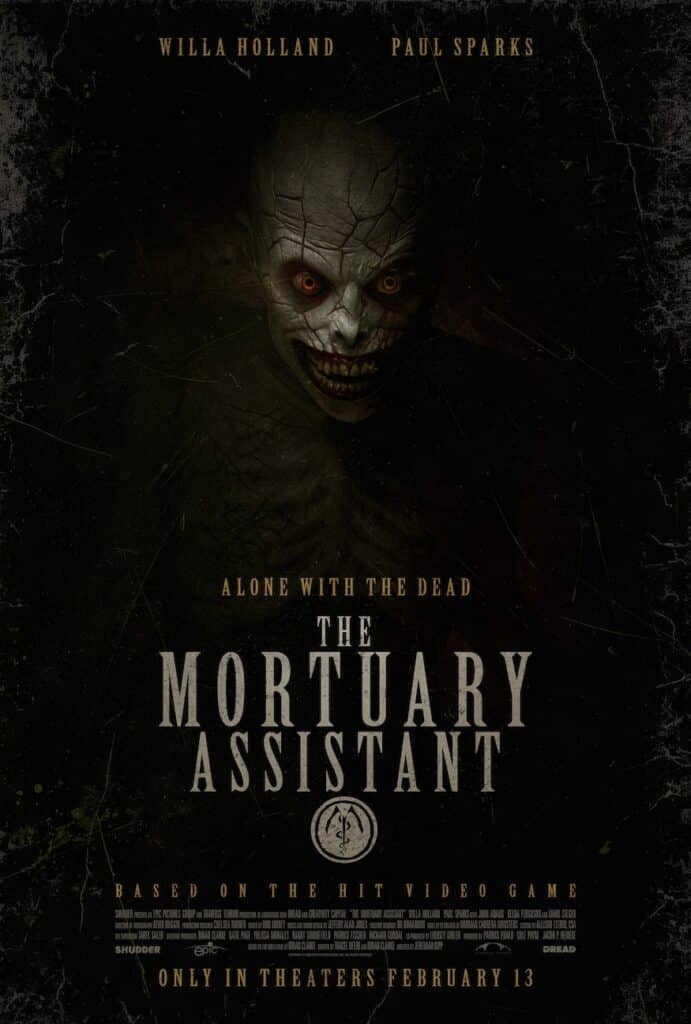
Throughout the 2000s, filmmaker Jeremiah Kipp has explored many facets of the horror genre, in award-winning shorts and features including the much-praised SLAPFACE. Now he has ventured into the realm of video-game adaptation as director of THE MORTUARY ASSISTANT, which opens in theaters today from Epic Pictures/Dread.
Based on the popular game by Brian Clarke, who also scripted the movie with Tracee Beebe, THE MORTUARY ASSISTANT focuses on Rebecca Owens (Willa Holland), who takes the titular job at River Fields Mortuary. After being shown the ropes by her mentor/River Fields owner Raymond Delver (Paul Sparks), Rebecca, a recovering addict with personal demons, begins to encounter the literal kind over the course of a frightening night shift. Following its theatrical play, THE MORTUARY ASSISTANT, which also features genre filmmakers/actors John Adams (HELLBENDER, MOTHER OF FLIES) and Emily Bennett (ALONE WITH YOU, the upcoming BLOOD SHINE) in key supporting roles, will begin streaming on Shudder March 27.
Before you got involved with the movie, were you familiar with the MORTUARY ASSISTANT game?
I hadn’t played the game before Epic Pictures and Patrick Ewald approached me about the movie. They were the sales agent for SLAPFACE and sold it to Shudder, and I’d told Patrick, “I know you guys produce, and if you’re ever looking for a director for something, I’d love to be considered.” So he approached me and said, “Hey, would you be interested in adapting a video game?” And I hadn’t been interested in that; it hadn’t crossed my mind at all. But when he presented me with THE MORTUARY ASSISTANT—he sent me the game and a pitch deck and a bunch of other stuff—I was like, “Oh, I don’t want to adapt a video game, I want to adapt this video game,” because I loved it immediately and saw the possibilities of making it into a film.
What I loved about Rebecca Owens is that she lives so fully in her work and not at all in her life. You know, her apartment is like a hotel room, and she’s more at home in the mortuary. She’s way more comfortable among the dead than she is among the living because the living are complicated creatures. And I sympathize with that enormously. When I was in my mid-20s, I preferred being on film sets; my apartment was bare-bones, and I wasn’t dealing with any of the crap in my life. And the more you push down the crap in your life, the more it blows up in your face like a jack-in-the-box, as it does to Rebecca in the game and the film.
I believe they interviewed many directors, but Brian saw how much I loved the project, that I was passionate about the game and could talk about the characters in a way that felt personal. And I think he saw a kindred spirit in me. We became fast friends, and throughout preproduction, Brian and I were in communication. He was there for the entirety of the shoot; the second dead body you see is actually played by Brian. And then all through post, I kept Brian involved. He saw every iteration of the movie, and when we were talking to sound designers, I said, “Brian, you have to interview these people with me, because sound is such a vital component to this movie.” And he said something beautiful: “This project was mine, it was my personal offering, but in working with you, Jeremiah, it became ours.” I was very moved by that.
Did you find that THE MORTUARY ASSISTANT lent itself more to being translated to film than perhaps other video games have?
I think that video games in general have evolved. The possibilities of adapting them have grown. With THE LAST OF US, when you played the game, you were like, “Wow, this feels like an HBO series,” even before it was one. You can’t say that about, like, SUPER MARIO BROS.; when they did that [first] movie back in the ’90s, there was so little plot and so little characterization, they were just throwing stuff in there saying, “Well, what if we set it in a city like BLADE RUNNER?”, you know? And STREET FIGHTER—they were just making stuff up, trying to craft story elements out of nothing. And the difference between games then and now is that games now are based on narrative and our understanding of progression of character and story.
I really believe THE LAST OF US opened up the doors and showed us the possibilities of what could be done with a video-game adaptation. My favorite recently was Josh Ruben’s WEREWOLVES WITHIN; Josh understood that the movie needed to work in and of itself. It had to have characters you care about in a dramatic situation with story arcs that progress. So he took all the ingredients from the game that people loved and didn’t contradict them, and nested them in a really good story with really good actors.
At the same time, working from a video game was very helpful on MORTUARY ASSISTANT, because everybody was making the same movie: the folks at Epic, the folks at Shudder, the game creator and me. There was none of that nonsense of, like, being in post and people saying, “Well, we thought it was going to be something completely different.” We all understood the movie we were making because we all loved the game so much.
It was strange because while this movie is dark and weird, the set was very warm and welcoming, since we all had true enthusiasm for what we were doing. And that came from the top down. Brian was so excited about the possibilities of this game becoming a movie, and I could vicariously enjoy being in his shoes. Brian arrived, I believe the day before principal photography, and he walked onto the set, and it was really something for him to see that this thing he created in his mind now existed in three-dimensional reality all around him. I think it brought a tear to his eye to feel that River Fields Mortuary, this place he dreamed up, was now something he could walk around inside of and exist in.
How did you and Willa Holland prepare for and approach the portrayal of Rebecca in the film?
I interviewed a lot of young women who had degrees in mortuary science. They were all very shy in talking about their personal lives, very much like Rebecca Owens, but when it came to the process of mortuary science, they were excited to discuss that. But they didn’t talk about it in medical terms; they talked about it in a very compassionate and caring way, like they were caretakers for the dead, and it was their responsibility to be courteous to their guests. They used that kind of language. I was very moved by that, and after talking to them, I was like, no wonder I like Rebecca Owens so much, because she’s kind that way. I thought after talking to people who do this for a living that when I’ve passed away, these are the kind of people I want to be taking care of my body after I’m gone. And the trick with the movie is that once you get used to the mortuary science, then the real horror begins, because it has nothing to do with the dead. It has to do with the entities that exist within River Fields Mortuary that bind themselves to Rebecca.
Where Willa was concerned, I think what she inherently understood about playing Rebecca Owens was, when Willa got into show business, she was 6 years old. She was on movie sets growing up, so her entire childhood and teenagerhood was kind of taken away from her. She didn’t have a normal childhood; she was in Hollywood making things with 300 people around her pointing lenses at her. So I think she feels like she wants in her adult life to get in contact with reality more, and overcome this feeling of detachment. Therefore, when she read the MORTUARY ASSISTANT script, I believe she understood Rebecca’s initial shyness and her desire to try.
And that’s what makes Rebecca a hero: not that she is able to go in immediately and solve all the problems, but because she has to work at it the way that addicts have to work at it every day. I know that the Narcotics Anonymous scene early in the film was very important to Willa, so we worked on that a lot. We both knew that that was the gateway scene into this character because she’s nervous but bravely stands up in front of an audience, which I think many people can relate to. Willa was very nervous before doing that scene; she said, “Jeremiah, I don’t know if I can do this,” and I told her, “Well, that’s exactly how Rebecca would feel.” And she said, “Yeah, that’s right,” and went in and was quite remarkable. That was one of the most extraordinary days of shooting with her. It was very early in the shooting schedule, and it informed all of us about what movie we were making and who this character was.
I really enjoyed seeing John Adams and Emily Bennett in MORTUARY ASSISTANT. Did you cast them as friends, or did they go through the regular casting process?
Well, you know, it was a side benefit that they’re both filmmakers. The joke is, if you want an actor who won’t give you any trouble, hire a director, because they know what you’re up against. But with both of them, they’re also actors I truly admire. I love the Adams Family films, and I’ve always thought John is a remarkable actor. So when we were casting Rebecca’s dad, I immediately thought of John, and I called him up and asked, “Hey, do you want to play this part?” He said, “Well, before I read the script, just tell me about the character. I want to know if it’s in my wheelhouse.” I said, “He’s a loving dad who is doing the best he can for his kid under very difficult circumstances. If you imagine you’re playing those scenes with Zelda or Lulu”—his children who act in their films—“that’s a quality I want.” He was like, “OK, I understand that. I would love to play that.” Then I said, “You also need to be the twisted demonic version of that dad who is saying all these things to hurt his kid, and inflict damage on her.” And I know that John has rock and roll in his heart, so of course, he was like, “Oh, I can play a demon. I can say some shit. I know exactly what to do.” And true to his word, John was terrific, and could be both of those things.
Emily is also a great actor. I first saw her in the films she acted in and directed; BLOOD SHINE was done by the time she played Vallery in our movie. She was trained at RADA, so she has Shakespearean training. And you know, not every actor can plunge into playing a demon, because a lot of them are like, “Well, how can I relate to that? I don’t know what it is to be a demon.” But Emily has done her Shakespeare and knows that those plays are filled with ghosts and witches and creatures like [THE TEMPEST’s] Caliban. So with the flip of a switch, she could transform from the frightened woman in the basement into a demon. That’s a unique quality that Emily brought to it.
How was it working with makeup effects artist Norman Cabrera, and creating the Mimic character?
Norman came on through Epic; he’d done films with them and Mike Mendez. And what a treat to work with somebody who was mentored by Rick Baker. We had a wonderful time. When we cast the actors playing the dead bodies, I didn’t regard them as props, I regarded them as proper characters. And Norman did, too. He told me, “Send me photographs of them, because for these wounds and ligatures, I want to match their skin tones exactly. Especially since you’re going in with a probe lens, so there’s going to be no margin for error. It has to look extremely realistic.” You can tell that he cracked open his medical books and cared very deeply about matching the mortuary science.
The first actor we cast in the movie was Mark Steger as the Mimic, and that was through Norman. He was like, “You know who would be great as the Mimic would be Mark Steger, [the Demogorgon] from STRANGER THINGS.” Because when you’re playing a creature, as brilliant as Norman is, it’s all rubber and paint until you have an actor inhabiting that part. And Mark brought so much character and personality to the Mimic. It’s such an iconic character from the game, we really wanted to do it justice, and Mark understood what to do with his body to convey it. The thing that’s great about the Mimic is that it doesn’t do traditional monster things like run at you and pounce and snarl and scream. It’s watching you, and it’s trembling as if it’s afraid of you. And I’ve always thought that if something is afraid of you, it’s even more dangerous because something that’s terrified is unpredictable. And Mark understood that the fear inside of that creature was the key to it being frightening. So Norman did a beautiful job creating the Mimic, that head-to-toe monster, and Mark did a beautiful job of playing it.