By PAYTON McCARTY-SIMAS
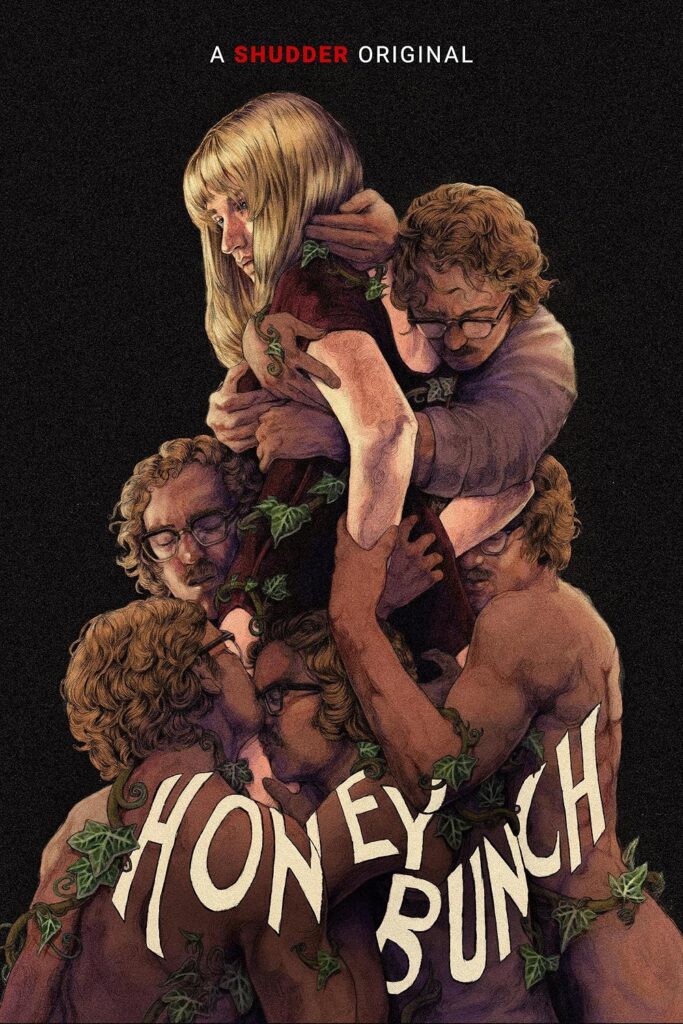
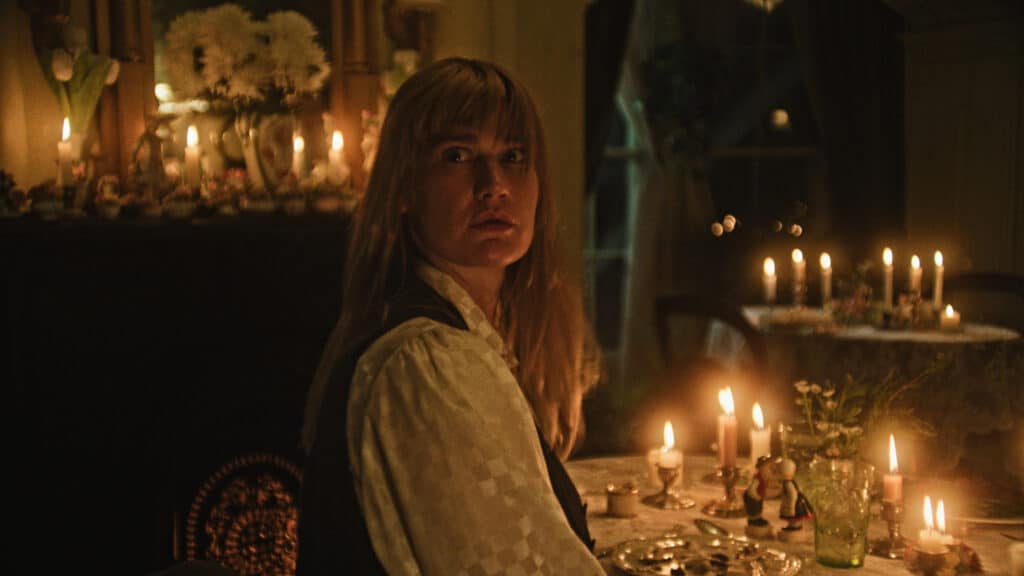
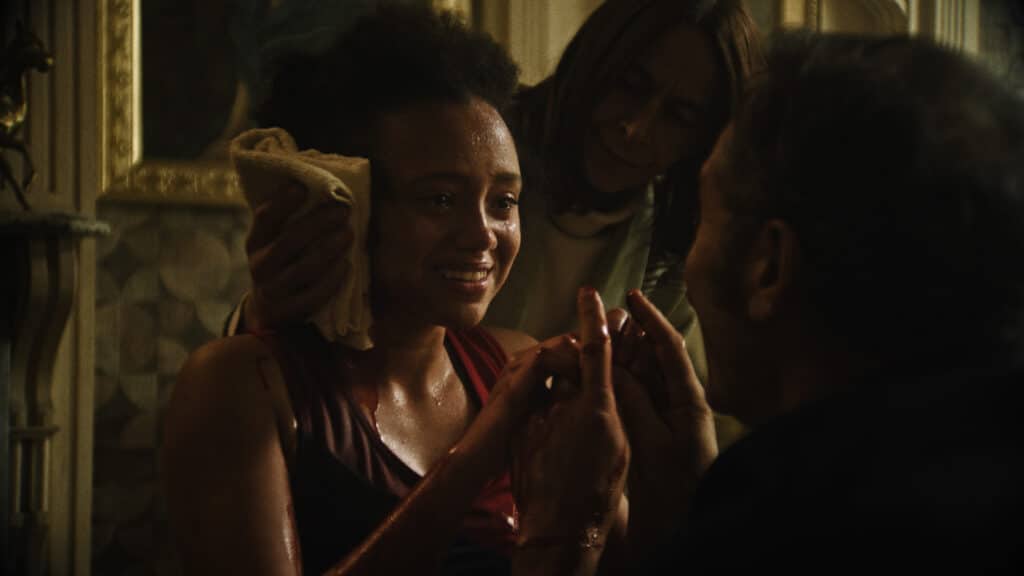
Dusty Mancinelli and Madeleine Sims-Fewer’s HONEY BUNCH is a family affair from start to finish. This surreal and darkly comic, gothic marital mindbender was conceived as an intimate joint effort between two filmmaking couples, Mancinelli and Sims-Fewer, and Grace Glowicki and Ben Petrie, whose latest collaboration, Dead Lover, hits theaters in March. The film, which arrives on horror streamer Shudder the day before Valentine’s Day (this year, a Friday the 13th) follows a husband, Homer (Petrie), and wife, Diana (Glowicki), through their time at an eerie memory rehabilitation center for victims of crippling trauma. Drawing on Kubrickian eroticism, ‘70s science fiction and Glowicki’s unique style of physical comedy in equal measure, HONEY BUNCH is a strange, tart, emotionally complex piece sure to spark many a romantic argument after the credits roll. Over the course of a weekend, RUE MORGUE spoke with both directors and star Glowicki to explore the film’s themes and the nature of their unique creative partnerships.
How did this project get started?
Dusty Mancinelli: I had a health scare a few years ago, right during COVID, I think. I was experiencing heart palpitations. Went to the hospital and luckily, I was okay, but it really had us talking about, you know, what if the worst happened? And then Madeline asked me a really morbid question.
Madeleine Sims-Fewer: At first, I asked if I could taxidermy you! [Laughs].
DM: Right. And I said, “No! That’s disgusting!
MSF: And then I asked if I could make a leather jacket out of his skin, which, for me, was already a massive step down.
DM: Even worse. Even creepier! But through this kind of fun exchange, we were starting to think deeply about what it really means to commit yourself to somebody. And we were really interested in exploring that idea. So that’s where the story emerged.
Nice, very Ed Gein of you! That’s awesome. Okay, so how did Grace get involved?
MSF: We had known Grace for a long time and had admired her and Ben’s work for years. The four of us were friends, and when it was actually very, very early on, when we started writing it, we knew that we wanted to work with actors who were a real couple. That was something that was important to us for this, and they were the first people we thought of, honestly, before we even wrote the first draft of the script. So we had them over for dinner, pitched them the whole idea in kind of a manic way that took about three hours. We just acted out the whole story for them and then said, “Look, we want you to be in it.” And thank God, they immediately said yes.
Grace Glowicki: I can’t remember exactly when they brought it up, but a couple of years before we shot it, [Ben and I] went over to their house, and they pitched it to us over one of their gourmet meals. We would have many dinners with them, where they fed us really, really well. So, it just started in conversation, and Ben and I were super into it.
DM: It was amazing because we had this opportunity to really explore the characters with them as we were writing the script and really try to find their voices with them. That was really a new process for us.
GG: Then, six months to a year before shooting HONEY BUNCH, [Ben and I] shot Dead Lover. We were actually going into post for Dead Lover with our editor, Lev Lewis, when Dusty and Maddie were looking for an editor. And I was like, “Lev’s awesome.” So I kind of lost my editor by my own fault, to Dusty and Maddie, and had to wait for them to be done editing HONEY BUNCH to finish editing Dead Lover. There was a lot of crossover between the projects.
That’s great, sounds like all in the family. Is that fun for you?
GG: It’s very fun. It’s nice to be working with peers in Toronto. The intermingling is great.
And I’d imagine directing your friends takes on a different quality than directing other people. Can you talk to me about working with all of these actors? It’s such a great cast.
DM: I think as directors, we really try to be chameleons and ask lots of questions from our cast to better understand what it is they need from us, what kind of support they need. And every actor works differently, so part of that process during rehearsal is just trying to figure out what language to use and what’s helpful to them to better get into character and better understand the objectives of the scene, to lose themselves in the situation. It’s always uniquely different. The way we directed Ben was different from how we directed Grace.
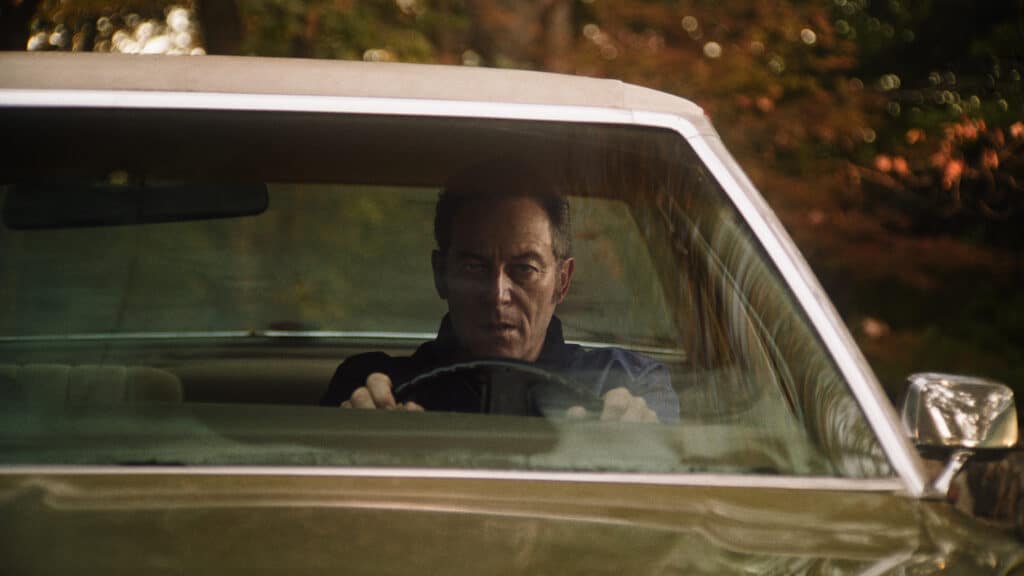
MSF: Their processes were vastly different. It was amazing to see the way that these two, who have almost polar opposite ways of working, could gel together in such a magnificent way. With Kate [Dickie] and Jason [Isaacs] it was interesting, too. We’d been fans of their work for years, so we were a little nervous to work with them – or I was, anyway, I’ll admit. And I think having Grace and Ben there was this extra cushion for us. We knew we were all in it together, and there was a real camaraderie. We’d already been shooting for a week with Ben and Grace when Kate and Jason came.
GG: Ben and I actually had really different processes of how we approached our roles, and we’re used to working together, writing together, being really, really collaborative. But for this, we stayed in our own lanes and prepared in our own ways because it was just such a big task for us to be responsible for characters in someone else’s vision. We had to let go of a lot of control that we normally have when we work together. So instead, we siloed ourselves, and I think it worked really well that way, because the characters are in such different realities in the film. They’re so different that I think, unconsciously, that’s how we attacked being in someone else’s movie.
What first drew you into this story?
GG: I think it was that they were like… Oh! I can’t do spoilers! Well, there are so many parts of Diana, and that was what really drew me in. It was the opportunity to get to play a character that had so many different facets of self, you know?
Without giving anything away, there’s a lot of overlap, I feel, in your work that I’ve seen, around the concept of transformation and rejuvenation, in this film, Dead Lover and Booger, too. How do you pick projects, and what do those kinds of storylines mean to you?
GG: Transformation… When I feel like there’s a challenge in a role, where I get to do something physical, I really struggle when I’m cast, and people are just like, “Be yourself.” I think I’m a really bad actor. [Laughs] When I’m directed by Ben, I can play myself because it feels like performance art, because it’s often so heavily inspired by our life that I can just access it. He really writes me as me. But when it’s a script that’s just a normal person, I just can’t figure out how to do that. I look for roles where I don’t have to do that, because there’s some kind of challenge, whether, as you say, it’s transformational or a bigger character. I like to have something to do, really, as an actor, so that’s what I look for.
I’d love to talk about gender in this movie. I remember when I saw it for the first time, my first thought was, “Are straight people okay?”
MSF: We’re not! We’re not! [Laughs]
But you have so many different kinds of relationships in this movie. Can you talk to me about what you wanted to explore, contrasting a paternal relationship with the paternalism that’s one of the overtones that you’re playing with in the central marital relationship?
MSF: The idea from the very beginning was about male and female relationships. Straight relationships come with a set of dynamics that are kind of precoded into everything around us, and I think both of us had conversations about how those kinds of dynamics can be what erodes the relationship ultimately, because you feel like you have to adhere to whatever that is in a totally subconscious way. Thinking about how if those dynamics are flipped, or challenged, or changed in some way, maybe that could be the key to a lifelong partnership. We wanted to not only explore this one male-female relationship at the center, but we also wanted to explore all the different forms of love, what love means in a variety of different relationships at different stages. So you have the father-daughter relationship, you have Kate and Delwyn’s relationship as well, where they’ve been together for many years. What does that look like? How does that change the way you see each other?
This also feels like a very literary narrative, right? There’s a lot of Shirley Jackson in there, there are the Homeric references. Did any of those references jump out to you? What was your process like there?
GG: I feel like I’m not very good at script analysis. I don’t feel very articulate in that way, and I also feel like I’m a bad actor if I’m too in my head. I really tried to just physicalize to prepare for the role by just stripping away any of the cerebral complexities and just making it as physical as I could. That’s the way I usually make characters, trying to find a couple of physical keys, whether it’s a lip curl, an eyebrow raise or a posture of the back. I use that as a way to anchor the character. So I’m just not thinking about it, especially with this film, because it was so complex, and there were so many parts of her that I was just like, I’m not going to have mental control over this. So I tried to really dumb it down for myself.
MSF: The Odyssey is honestly one of our favorite stories of all time. It can be applied like the bare bones of story structure. I think what was interesting here was that it’s Homer’s Odyssey, obviously, in the book, but it’s Diana’s “Odyssey” in our story, making her the Odysseus character trying to find her way home. When we wrote it originally, I was writing Homer and Dusty was writing Diana, using our own views of relationships and our own fears and worries as those characters. Flipping the gender brought something interesting there, too. We were also really inspired by gothic literature. Jane Eyre was a really big inspiration, Rebecca, and The Turn of the Screw.
This movie is very genre-bending in a lot of ways. How did you come to the decision that you wanted to take this particular kind of intimate relationship drama and bring in a more elevated genre quality to it? There is a twist. We can’t avoid saying that. What inspired that direction?
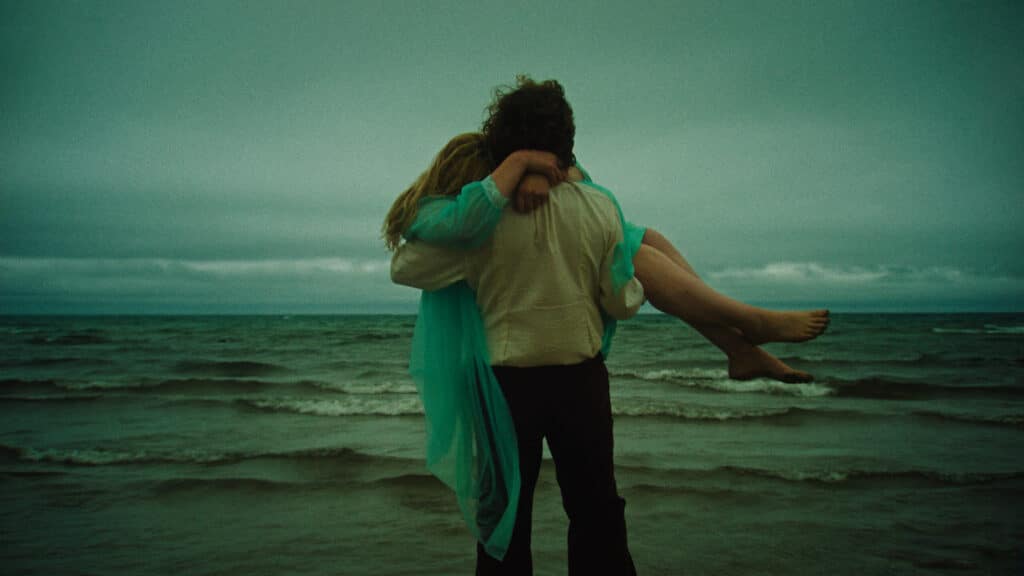
DM: That was born out of the conception of the idea itself. Unlike most films that have a twist at the end of the film, we were very interested in doing something right at the midpoint. Right in the middle of the movie, something happens that dramatically alters your perception of the characters. We’re always very interested in trying to recontextualize a character so that you think you understand who these people are, but throughout the course of the film, we challenge you to think more deeply and give you new information that hopefully makes you think twice. That was pivotal, and ultimately, it is a sort of sleight of hand. We’re asking a lot from the audience, and part of that is, can we get you to emotionally engage with a character that we had you despise in the first half of the film? Can we flip that? And what does it mean to do that to an audience? It works for some people, and others find that quite frustrating, but that’s the challenge of the film.
Because you have the chance to explore so many emotional facets of this character, were there any sides of Diana that you found either most compelling or most challenging to play?
GG: I really liked her anger. Those were some of the most special scenes for me. Dusty and Maddie love to make these films where people walk away debating the morality of each character, and with this one, I’ve been amazed by how some people say, “Oh, I would do this for love,” or “I think this is morally reprehensible.” For me, I have a lot of judgment on how Homer treats Diana. That’s my interpretation of the script, not necessarily Diana’s interpretation of the script, but Grace’s interpretation of the script. So the angry scenes with Diana were fun places for me to release the judgment that I had on his behavior. I felt closest to her in those scenes.
That is a question, though, right? Would you do the kinds of things these characters do for love?
GG: No, I definitely wouldn’t. This was part of Ben’s challenge as an actor, actually, because he had to rationalize taking these steps out of love as his character. But for me, I see how much Diana has unconsensually suffered from his choices, so I can’t personally forgive that. But again, that’s sort of the genius of Dusty and Maddie’s work, is that even when I say that it’s complicated.
What does devotion mean to you?
GG: What does devotion mean to me? What comes to mind is – thinking about parenting – a relentless showing up for someone. That’s how devotion shows itself behaviorally. You just keep tending to somebody’s survival, basically. I think that’s devotion.
MSF: I guess to me, “What is devotion?” comes back to “What is love?” and love is unexplainable. It doesn’t really have boundaries; it doesn’t have an end. That isn’t to say that you accept everything, that you accept abuse, or that you accept horrible things, but horrible things don’t necessarily end love. I guess I would say that I would hope my devotion to a romantic partner would be the same way that I’m always devoted to my family. My family members might do things that I disagree with, or things that I hate, or things that hurt me, and that might mean that our relationship has to change in some way, but it doesn’t stop the love.
DM: For me, devotion is the idea of committing to someone even though they’re going to change in the future. You don’t know how they’re going to change, or who they’re going to become. You’re going to change in that process. That’s pretty terrifying, because it could be for good or for bad. It could be challenging. What we’ve discovered over time is that love ebbs and flows, and what it really means to sustain a relationship is recommitting. Devotion is when you’re in a relationship, and you don’t feel that love. When you’re in that valley, it’s about recommitting yourself and realizing that, yeah, something’s been lost, but something can be found again. For me, that’s what was really exciting about this film. Ultimately, it’s just asking how far would you go for the person that you love. That’s what’s beautiful to me about that idea of devotion.
Having made this film, has your answer changed about the skin leather jacket?
DM: Not for me!
MSF: I don’t want to paint myself with this awful brush, but I still want that leather jacket.
DM: I just don’t get it. [Laughs]
MSF: Maybe it’s just the symbolism of it. You know, actually, I saw 28 Years Later over the weekend for the first time, and I thought, actually, maybe a skull would be good instead.
See HONEY BUNCH, exclusively streaming on Shudder beginning February 13.