By MICHAEL GINGOLD
Having homaged the giallo genre with the much-lauded AMER (2009) and THE STRANGE COLOUR OF YOUR BODY’S TEARS (2013), the French-born, Belgium-based writing/directing duo Hélène Cattet and Bruno Forzani turned to lives of crime with 2017’s LET THE CORPSES TAN and their latest, REFLECTION IN A DEAD DIAMOND. Their abstract, aggressive cinematic approach, shot through with moments of graphic violence, remains the same, and the duo sat down with RUE MORGUE to dissect their latest exercise in bold, eye-grabbing style.
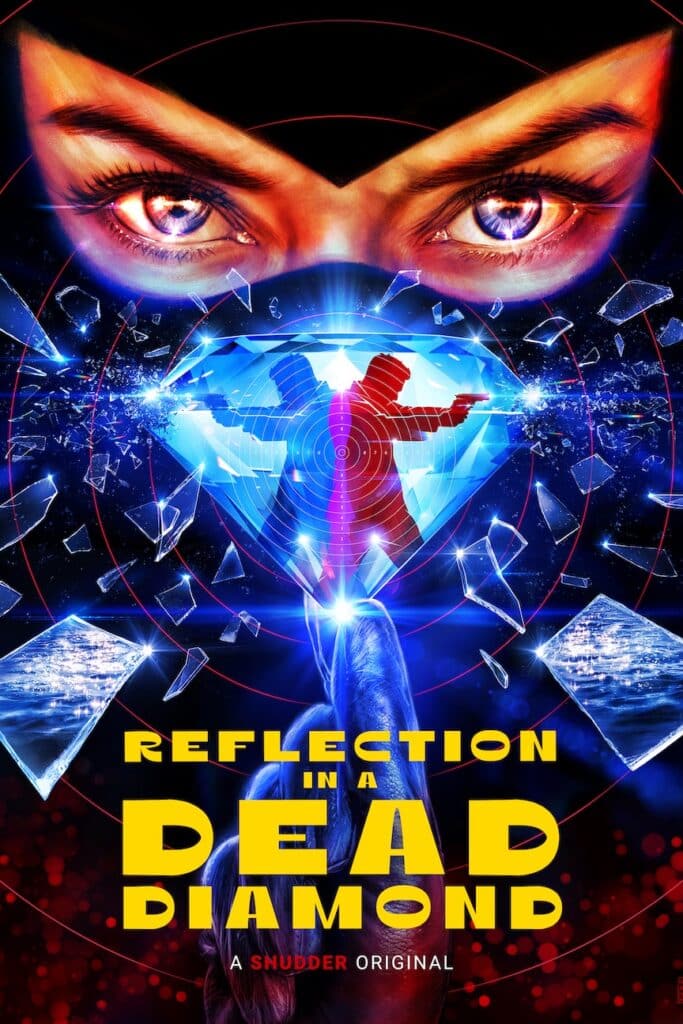
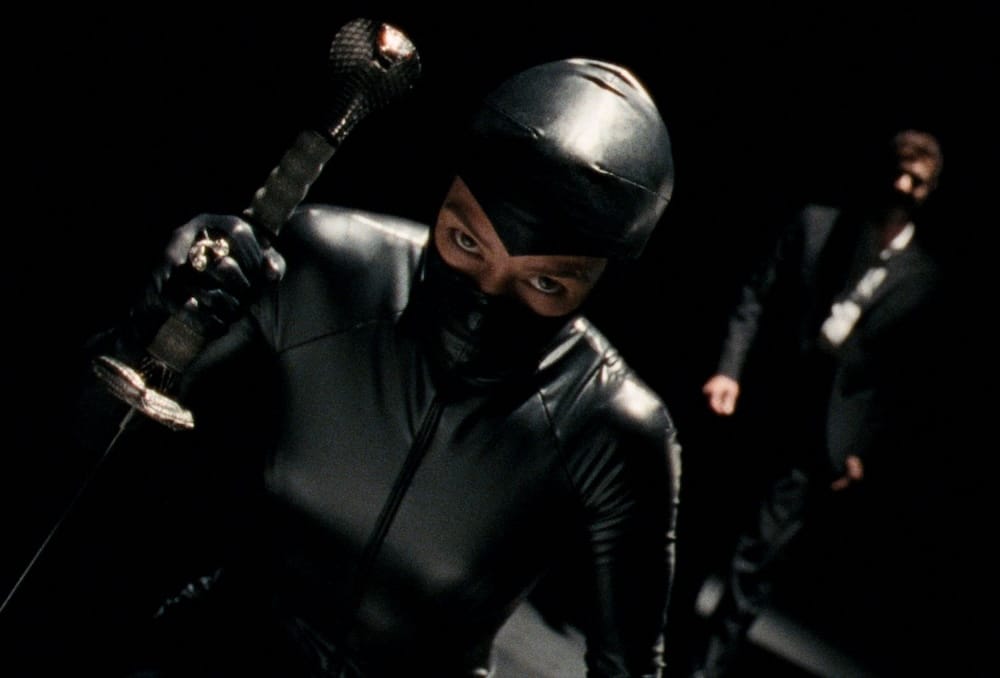
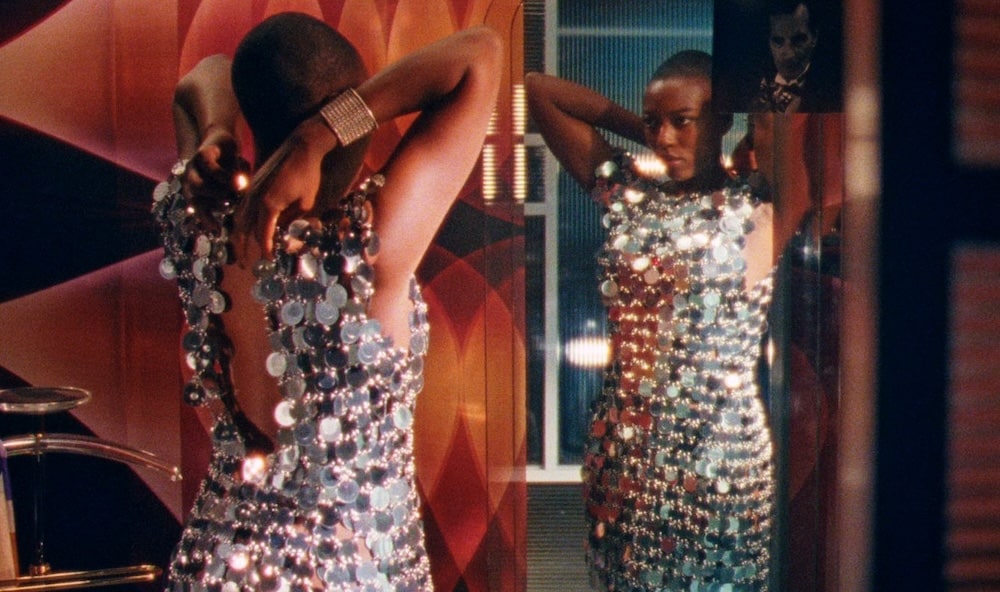
Streaming on Shudder beginning this Friday, December 5 after select theatrical engagements, REFLECTION IN A DEAD DIAMOND uses the Eurospy thrillers that followed the success of the early James Bond films, and Italian comics such as DIABOLIK (which inspired Mario Bava’s cult favorite DANGER: DIABOLIK), as its launching points. It begins on the French Riviera, where a retired spy known as John D. (veteran actor Fabio Testi) spends his time in a luxury hotel and on a nearby beach. The disappearance of a mysterious woman from that hotel triggers memories of his exploits in the ’60s, presented in lengthy, fragmented flashbacks featuring his younger self (played by Yannick Renier). There are also a couple of striking, deadly femmes fatale on hand: the catsuit-clad assassin Serpentik (Thi-Mai Nguyen) and fellow agent Amanda (Céline Camara), whose sequined dress is a lethal weapon. The filmmakers spoke to RUE MORGUE about their typically delirious, sensory-overload exercise following its North American premiere at this year’s Tribeca Film Festival.
What was the first inspiration for REFLECTION IN A DEAD DIAMOND?
HÉLÈNE CATTET: It was Fabio Testi. He was the starting point. We saw him in 2011 in Monte Hellman’s ROAD TO NOWHERE, and he reminded us of Sean Connery. He was in a white suit, so he also reminded us of Dirk Bogarde in DEATH IN VENICE.
BRUNO FORZANI: We said, “Why we don’t try to mix these two universes, which are a little bit different–Visconti and James Bond?” For years it was in a little place in our minds, and after we made LET THE CORPSES TAN, we started work on an animated film called DARLING. It has taken a lot of time and it’s a very dark project, set in the oppressive big city, and we wanted a breath of fresh air. And we had the idea to come back to this universe, mixing those two elements, plus Italian comic books like DIABOLIK. We wanted to go back to something very psychedelic and pop.
The really intriguing question throughout the film is, is John D. remembering his own life, or is he recalling a part that he played?
FORZANI: Yeah–we had this idea, OK, of Eurospy meets DEATH IN VENICE. And we remembered seeing a show inspired by SUNSET BOULEVARD, and so that became the door to enter this universe, and this idea of [remembering] the past.
CATTET: And you can have the two possibilities that you just mentioned.
FORZANI: You can say it’s a film about a spy who is thinking about his past, and there can be another scenario where it’s an actor recalling his past, and getting lost in it. And during the preparation–it’s not an influence, but we saw a movie with Anthony Hopkins called THE FATHER, about an older person who has Alzheimer’s and is totally lost and confused. There’s something a bit like that with our character.
CATTET: Yeah, lost in his memories.
FORZANI: Another of the main inspirations was MILLENNIUM ACTRESS by Satoshi Kon. We had the same approach, because in MILLENNIUM ACTRESS, Kon uses the intimate story of this woman to talk about the history of Japan, the history of Japanese cinema, all of that. We do something similar with the character of Serpentik, who can be several things for John D.
Serpentik is a great character. Can you talk about coming up with her look?
FORZANI: Serpentik was influenced by two things. First was DIABOLIK; we wanted to make a female Diabolik. And there was a photo-comic in Italy called KILLING [a.k.a. SATANIK], where the criminal wore a skeleton costume. And in fact, at the end, nobody knew who was behind the mask. In the last issue, they were supposed to show who that character was, but it was censored and nobody knew!
Was it always a given that Fabio Testi would star in the film? At what point did he get officially involved?
FORZANI: We wrote the script for Fabio Testi, and when we finished it, it was the start of COVID. So a friend gave us his phone number. We asked him, “Don’t you have his e-mail? Because it’s more convenient to contact him first that way.” He said, “No, he’s easy! You’re going to see he’s easy.” So we called him: “Ah, hello, Mr. Testi. We are Hélène Cattet and Bruno Forzani, two directors from Belgium. We have written a script for you.” “Who are you? Who gave you my phone number? It’s my personal number!” “It’s this person,” etc. “Ah, OK.” “So, if you want, we can send you the script.” “No, I want to meet you first. I don’t care about the script.” So we said, “We can come on this day, if you want.” “Yes, please come.”
But one week later, the border was closing because of the pandemic. So the last day before it closed, we took the car and went to Italy. We got to his house and he was a bit surprised; I don’t think he thought this was for real. We gave him the script and talked a lot about Enzo G. Castellari, Sergio Sollima, all the Italian directors. He said, “Ah, you remind me of Monte Hellman or Andrzej Zulawski. They were in their own worlds. They’re very radical.” That was great, because they were the two cinemas we wanted to combine. You know, he was in big auteur films but real exploitation movies too, so he was the perfect mix. And when we told him we were going to shoot on film, he said, “What? That still exists? OK, I’ll do it!”
How did you find the right actor to play his younger self?
CATTET: It was complicated, because it was easier to imagine an American actor or English actor as this kind of character than a French actor or Belgian actor. So it was difficult to find someone. When we met Yannick Renier, we did some readings and he was really good, but he was…
FORZANI: Not like the hero we imagined.
CATTET: Yeah. He didn’t have the physique. He had just finished a movie about someone who was dying, so he was really, really thin.
FORZANI: He was playing someone at the end of life, ill in hospital, so he was very skinny.
CATTET: But he told us, “Don’t worry, I swear I will put on 10 kilos of muscles in four months. I swear to you.”
FORZANI: He worked out a lot, and he changed totally!
Can you talk about the giallo influences in REFLECTION?
FORZANI: There’s not a lot of giallo influence; for us, the main inspirations were, as I said, Eurospies and Diabolik. But there is one character, Kinetik, who was influenced by BLOOD AND BLACK LACE by Mario Bava. If you watch the movie with Kinetik in mind as the main villain, you can see it as a giallo. But if not–maybe we’ve made a sort of Mario Bava movie because there is Diabolik and BLOOD AND BLACK LACE in there, but it’s not so giallo.
How did you come up with Amanda, who wears a dress that’s both a weapon and a communication device?
FORZANI: For this character, we were inspired by Jaws, the bad guy in THE SPY WHO LOVED ME. And one of the key influences on the movie was op art, the art of illusion optics, because it’s a film about illusion. That is a Paco Rabanne dress, which is iconic for this op art movement, and it wasn’t just an in-reference; we wanted each detail to tell our story. So Hélène had the idea to transform this dress into a weapon, and a gadget–not just, you know, “Ah, that’s op art, that’s nice.” We wanted to go further than that.
As you usually do, you use a lot of music from past films on the REFLECTION soundtrack. Can you talk about those choices?
FORZANI: For the end credits, it’s “La Lucertola” by Ennio Morricone, from Lucio Fulci’s LIZARD IN A WOMAN’S SKIN. It’s one of our favorite Morricone tracks. We’ve wanted to use it for a long time; we first tried in STRANGE COLOUR, but we didn’t find the right place for it. It’s a long piece, and we had to have the space for it. There are two from Fernando Di Leo’s MILANO CALIBRO 9 by Luis Enríquez, there is one by Fabio Frizzi from a poliziotteschi, there is one from THE GIRL FROM SALINA by the French musician Christophe. We have some Adriano Celentano for the bar sequence. We used Celentano music from THE GIRL WHO KNEW TOO MUCH in AMER, and the one we used in this movie is a song [“Ventiquattromila Baci”] co-written by Celentano and Lucio Fulci. It’s one of the more well-known Italian love songs.
I never knew Fulci wrote a love song!
FORZANI: Yeah, he used to collaborate with Celentano, and he has worked a lot in musical film. The one we have in AMER was also co-written by Fulci.
Who did your makeup effects? They’re terrific, especially the scene with the hooks in the hair, which is like something out of HELLRAISER.
FORZANI: Yeah, totally. They were created by Oriane De Neve, who did the special effects for MANDY by Panos Cosmatos and THE DEEP HOUSE by Alexandre Bustillo and Julien Maury, and she’s very good at the details in her skin. For that moment you compared to HELLRAISER, we were very impressed, because we go in very close in macro, and all the texture is very precise and realistic.
REFLECTION is devoted to montage, and your distinctive editing style. How much of that was determined on the page, and how much did you discover as you were putting it together?
FORZANI: The montage, the editing, was in the script from the beginning. Each sentence is like a shot, and when we write, we try to find an editing rhythm. We don’t do a lot of shots and then create something special in the editing; each shot is used, so when we arrive at the editing room, we just put them in the right order. Then we work on the rhythm to get the sensation, and after that on the emotions of the characters, because when we shoot, we do several takes with different emotions from the actors, and it’s in the editing that we really create the characters.
There’s a sequence toward the beginning that looks like a James Bond main-title montage, except there are no titles on it. Did you ever consider doing a credits sequence inspired by the Bond films, or some of the Italian spy movies that also have great animated title sequences?
FORZANI: We love those, and in this genre there are several codes, and those credit sequences are among those codes. We wanted to tell John D.’s story, like a sum-up of his missions and what he has done in this world, through this sequence–not putting the names of the crew over these images, but telling the story.
What’s up next for the two of you?
FORZANI: We have two projects. The first is that animated film, DARLING, which we are now starting again. It’s a revenge movie with a kind of PERFECT BLUE side, set in New York in the ’60s, based on a book by a New York writer called Harriet Daimler [a.k.a. Iris Owens]. She was part of the Beat generation in the ’50s and ’60s. And maybe there will be a slasher after that!
Anything else you want to say about REFLECTION?
FORZANI: We love all those James Bond and superhero movies, but the stories are always told the same way–very straightforward, and there’s not a lot to surprise me. When we had the idea to do this movie, we wanted to explore this universe in a different way, more circular than linear. The whole world knows all the tropes of superhero movies and James Bond and things like that, so we wanted to approach it our own way, and to go back to the Italian roots, where in the comics like DIABOLIK, the villain is the hero. And in the Eurospy films, sometimes the hero is very sadistic; in superhero movies, it’s always about good and evil, and in these Italian films it’s more of a grey zone.
One last question: Who’s your favorite James Bond actor?
FORZANI: Sean Connery. When I was little it was Roger Moore, but when I got older, it was Connery.
CATTET: Yeah, me too!